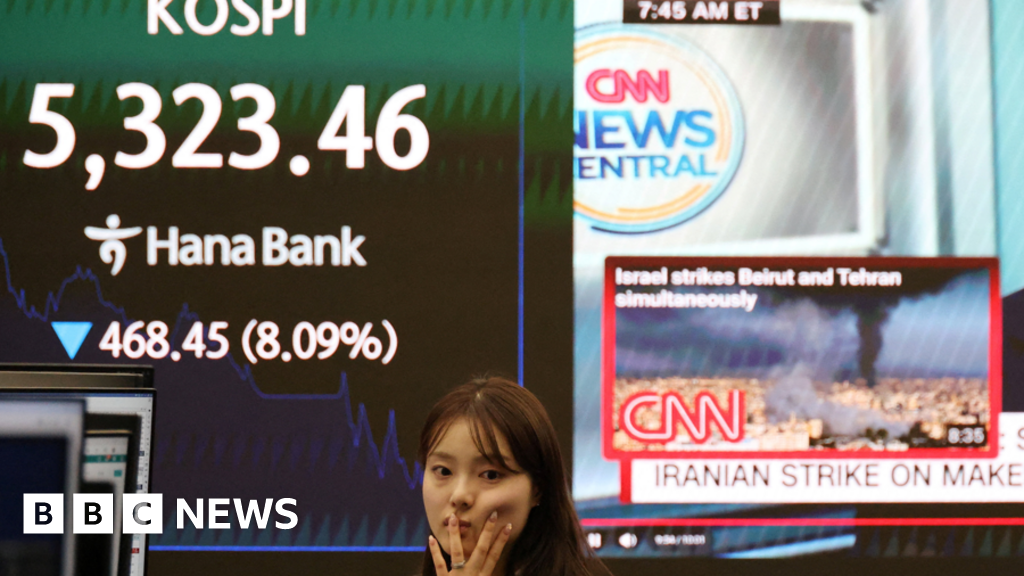
Financial markets across Asia experienced significant downturns for the third consecutive day on Wednesday, with major stock indices registering sharp declines, while global oil prices surged amidst escalating concerns that the ongoing conflict involving the United States, Israel, and Iran could become protracted. This heightened geopolitical tension is fueling anxieties about a potential energy supply shock, which analysts suggest could trigger widespread inflation across economies. The severity of the market reaction was particularly evident in South Korea and Thailand, where trading on key stock indexes was temporarily halted after plunges exceeding 8%, triggering automatic circuit breakers designed to prevent panic selling. Concurrently, Brent crude, a global benchmark for oil, saw its price climb by 2.5% to reach $83.96 per barrel, marking a substantial 15% increase since the initial reports of US and Israeli military actions against Iran commenced over the weekend. The broader market sentiment reflects a deep-seated apprehension regarding the stability of energy supplies and the potential for wider economic disruption stemming from the Middle East.
The current market volatility is directly linked to the recent intensification of hostilities in the Middle East, which began on Saturday with reports of US and Israeli aerial bombardments targeting Iran. Tehran reportedly responded swiftly by launching attacks against neighboring Arab nations, further destabilizing an already volatile region. This rapid escalation has had immediate repercussions on critical global trade routes, most notably the Strait of Hormuz. This narrow waterway, strategically positioned between Iran and the United Arab Emirates, is a vital artery for international energy markets, typically facilitating the passage of approximately one-fifth of the world's total oil and gas supply. However, according to recent reports, maritime traffic through this crucial strait has almost entirely ceased following explicit threats from Iran to 'set fire' to vessels navigating its waters, creating an unprecedented bottleneck for global energy shipments and contributing significantly to the recent surge in both oil and gas prices throughout the week.
Specific market indicators underscore the widespread impact of these geopolitical events. South Korea’s benchmark Kospi index closed the day down a significant 12%, reflecting profound investor unease. Similarly, Japan's Nikkei 225 index recorded a loss of 3.6%, while in afternoon trading, Hong Kong's Hang Seng index was 2.5% lower. Mainland China's Shanghai Composite also experienced a decline, albeit more modest, at 0.8%. In contrast to the Asian downturn, European markets showed a different trend, with the UK's FTSE 100 index opening slightly higher, and both Germany's Dax and France's CAC indices also showing gains. The price of gold, traditionally considered a safe haven asset during periods of economic uncertainty, saw an uptick, reaching $5,169 in early trading. Further exacerbating concerns around maritime security, the UK Maritime Trade Operations Centre reported on Wednesday that a vessel near the UAE had been struck by an 'unknown projectile.' While there were no fires and the crew was reported safe, authorities have launched an investigation into the incident. Meanwhile, officials stated that on Tuesday, President Donald Trump affirmed the US Navy's commitment to protecting maritime interests in the region.
Expert analysis suggests that the primary driver behind the current market jitters is the perceived longevity of the conflict. Lindsay James, an investment strategist at the wealth management firm Quilter, conveyed to the BBC's Today programme that investors are increasingly factoring in 'a growing probability of this conflict just taking longer to resolve.' This perspective highlights a shift from initial reactions to a more sustained concern about the geopolitical landscape. A prolonged conflict in the Middle East, particularly one impacting the Strait of Hormuz, carries significant implications for global energy security and economic stability. An enduring disruption to oil and gas supplies could lead to a sustained energy shock, potentially fueling inflation worldwide as production costs rise and consumer purchasing power diminishes. The divergence in market performance between Asia and Europe could be attributed to varying degrees of exposure to Middle Eastern energy supplies and differing investor risk appetites, with gold's rise serving as a clear indicator of a flight to safety amidst the uncertainty.
In summary, global financial markets are grappling with the profound economic implications of an escalating conflict in the Middle East. The sharp decline in Asian stock markets and the significant rise in oil prices reflect deep-seated fears of a protracted geopolitical struggle, an impending energy crisis, and subsequent inflationary pressures. The critical role of the Strait of Hormuz as a global energy conduit remains a focal point of concern, with recent incidents underscoring the fragility of supply chains. As the situation evolves, investors and policymakers alike will be closely monitoring any further developments in the conflict, particularly regarding maritime security in key shipping lanes and the broader diplomatic efforts to de-escalate tensions. The trajectory of energy prices and the stability of global financial markets will heavily depend on the resolution, or lack thereof, of this escalating regional crisis.