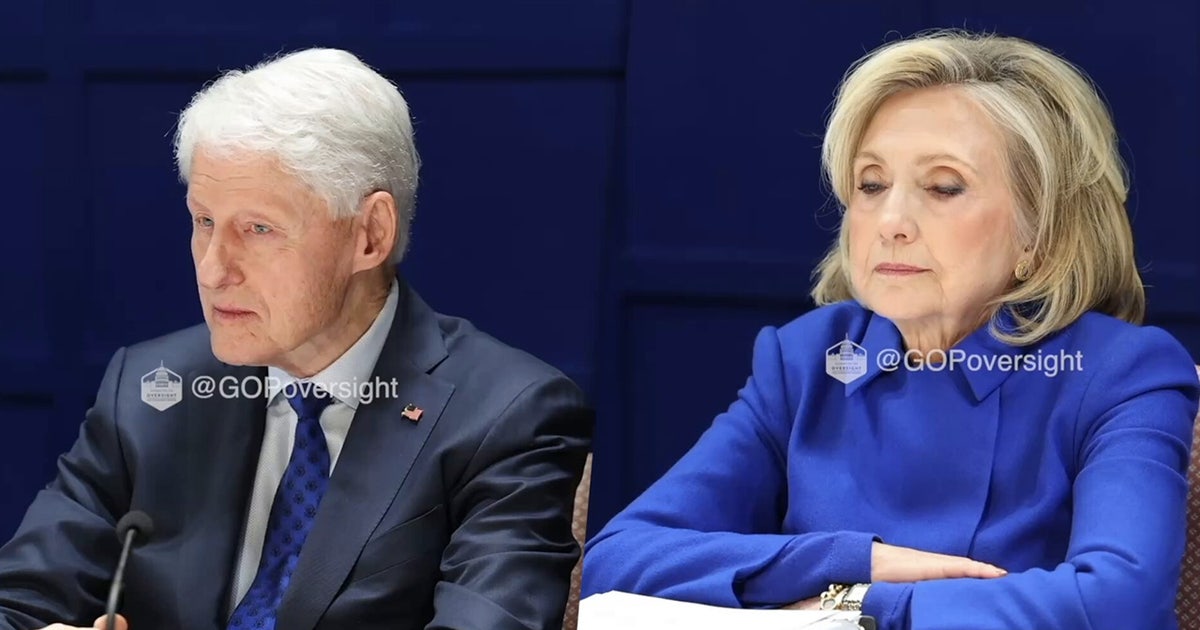
Extensive video recordings of former Secretary of State Hillary Clinton and former President Bill Clinton's testimonies before the House Oversight Committee have recently been made public. These depositions are a crucial component of an ongoing congressional inquiry into the activities of convicted sex offender Jeffrey Epstein. The hours-long sessions, which occurred last week, were conducted behind closed doors at the Chappaqua Performing Arts Center in Chappaqua, New York, a location situated near the Clintons' residence. Hillary Clinton's testimony took place on Thursday, February 26, with Bill Clinton following on Friday, February 27. During her appearance, Hillary Clinton asserted to U.S. House lawmakers that she possessed no knowledge regarding the criminal enterprises of Jeffrey Epstein or Ghislaine Maxwell. She further indicated, according to her opening statement shared on social media, that she did not recall any personal encounters with Mr. Epstein, a claim that forms a central point of her defense in the probe.
The congressional investigation into Jeffrey Epstein's network of illicit activities and his high-profile associates has garnered significant public and political attention, underscoring a broader societal demand for accountability regarding his heinous crimes. Epstein, a financier who was convicted of sex offenses, maintained connections with numerous influential figures across various sectors, leading to widespread speculation and scrutiny over who might have been aware of or facilitated his actions. The House Oversight Committee's decision to depose the Clintons reflects the committee's mandate to thoroughly examine all potential links and information pertaining to Epstein's operations, particularly given the public's intense interest in the extent of his network. These depositions are part of a larger effort to uncover the full scope of Epstein's activities and to ensure that justice is served for his victims, highlighting the persistent questions surrounding the individuals who interacted with him prior to his arrests and convictions.
During Hillary Clinton's deposition, which commenced at approximately 11 a.m. ET, several notable events transpired. Shortly after the proceedings began, at 11:08 a.m. ET, Ms. Clinton released her opening statement on X, a social media platform, outlining her position. By 11:35 a.m. ET, she had explicitly stated to the House lawmakers that she was unaware of any criminal activities perpetrated by Jeffrey Epstein or Ghislaine Maxwell and reiterated her lack of recollection concerning any meetings with Epstein. A significant disruption occurred at 12:43 p.m. ET when the deposition was temporarily halted. This pause was necessitated after Republican Representative Lauren Boebert reportedly transmitted a photograph from the closed-door session to a conservative online personality, Benny Johnson, a right-wing YouTuber. Johnson subsequently posted the image online, attributing its source to Rep. Boebert. Despite the confidential nature of the proceeding, officials confirmed that the entire deposition was being recorded on video, a standard practice for such high-stakes congressional testimonies.
The public release of these high-profile testimonies, particularly in video format, marks a significant moment in the ongoing scrutiny surrounding Jeffrey Epstein's network and its connections to prominent individuals. The transparency offered by the video footage allows for direct public access to the statements made under oath, potentially shaping public perception and political discourse. The incident involving the leaked photograph during Hillary Clinton's testimony also raises critical questions about the integrity and security of closed-door congressional proceedings. It highlights the challenges faced by committees in maintaining confidentiality while conducting sensitive investigations, and the potential for political maneuvering to influence public narrative. Experts suggest that while the depositions provide direct accounts from the Clintons, the broader implications for the Epstein investigation will depend on how these testimonies align with other evidence and whether they prompt further lines of inquiry. The incident also underscores the intense partisan environment in which such investigations often unfold, where even procedural aspects can become points of contention.
In summary, the recent release of video depositions from former President Bill Clinton and former Secretary of State Hillary Clinton to the House Oversight Committee represents a pivotal development in the congressional investigation into Jeffrey Epstein. Hillary Clinton's testimony, where she denied knowledge of Epstein's criminal activities and stated she did not recall encountering him, has been made public, alongside details of a procedural interruption caused by a leaked photo. These testimonies are crucial for public understanding and the ongoing efforts to fully unravel the complexities of Epstein's illicit network. As the investigation continues, observers will be closely watching for how these statements integrate with other findings and what further actions the House Oversight Committee may take. The transparency provided by these video releases is expected to fuel continued public debate and scrutiny regarding the connections of powerful figures to the disgraced financier.