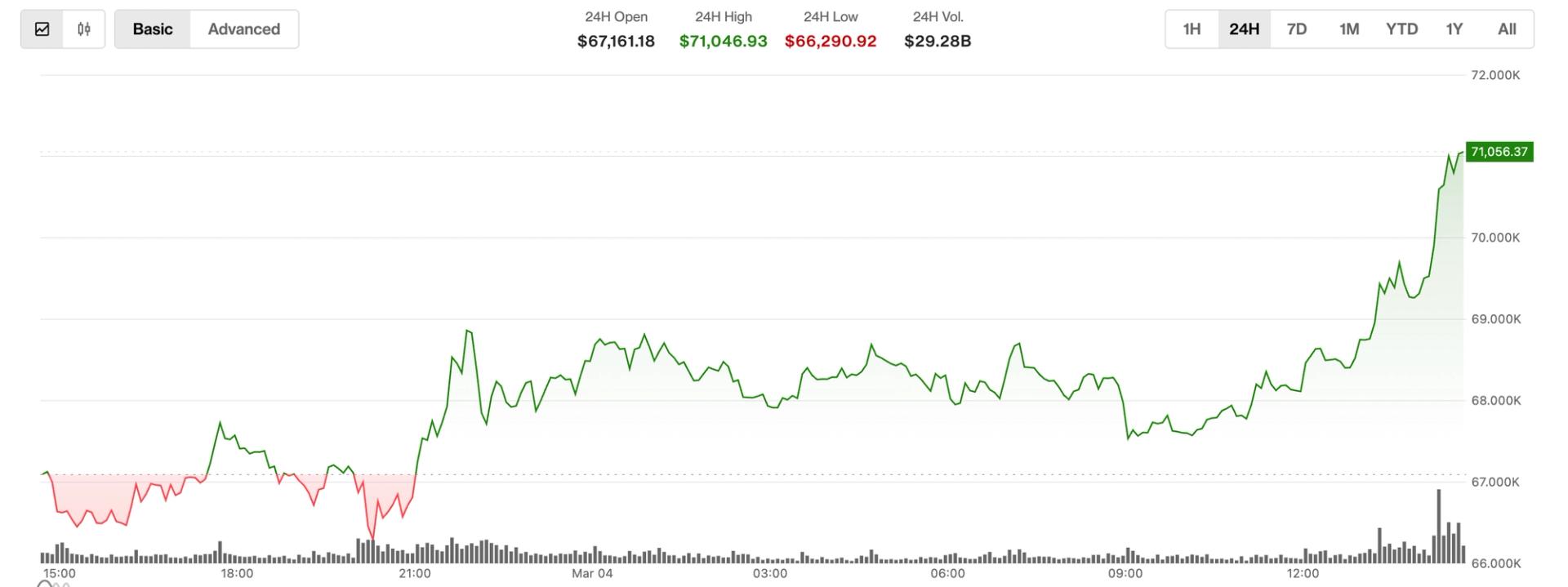
Bitcoin has demonstrated remarkable strength, surging past the $71,000 threshold and registering an impressive gain of over six percent within a 24-hour period. This significant upward movement has spearheaded a broader rally across major cryptocurrencies, signalling a robust performance in the digital asset market. The ascent is particularly noteworthy given the backdrop of escalating geopolitical tensions in the Middle East and concerns over potential disruptions to global oil supplies, specifically through the critical Strait of Hormuz. Despite these significant external pressures, the leading digital currency has managed to maintain a strong support level, reportedly holding firm around $65,000 since the onset of the renewed conflict. This resilience has drawn considerable attention from market observers, who are closely scrutinizing Bitcoin's behaviour in an increasingly volatile global economic landscape, with its capacity to defy traditional market reactions becoming a key talking point.
The current market environment is heavily influenced by an intensifying crisis involving key regional and international players, including Israel, the United States, and Iran, which reportedly escalated over the past weekend. This geopolitical friction has raised serious concerns about global energy security, particularly with reports indicating potential blockages of oil shipments through the Strait of Hormuz. Such disruptions invariably fuel fears of widespread energy-price inflation, impacting economies worldwide. In contrast to Bitcoin's upward trajectory, traditional safe-haven assets have shown varied responses. Gold, historically a go-to asset during times of uncertainty, has reportedly retreated from its recent peak, while Asian equity markets, including South Korea's Kospi index, have experienced significant declines, largely attributed to the rising costs of oil imports. This divergence in performance prompts a re-evaluation of how different asset classes react to global instability.
Specific market data underscores the extent of Bitcoin's recent surge, with the cryptocurrency reaching a high of $71,023 during European trading hours, according to figures compiled by CoinDesk. This impressive climb was not isolated, as other prominent digital assets followed suit; Ether (ETH), XRP (XRP), and Solana (SOL) each recorded gains ranging from four to six percent, further illustrating the broad-based nature of the cryptocurrency rally. The CoinDesk 20 Index, which serves as a comprehensive benchmark for the wider digital asset market, also reflected this positive trend, advancing by over five percent to reach 2,025 points. Meanwhile, the traditional safe haven of gold, which had peaked above $5,400 per ounce earlier in the week, has since seen a decline, settling around $5,160. This contrasting performance highlights a significant shift in how certain assets are perceived and valued during periods of heightened global risk.
Market analysts are increasingly interpreting Bitcoin's performance as indicative of evolving defensive characteristics, particularly during periods of crisis. According to insights from Tagus Capital in their daily newsletter, while Bitcoin may now exhibit some protective qualities, the retreat observed in gold underscores that even long-established safe havens are not immune to broader market dynamics. This perspective positions Bitcoin as a more flexible, albeit still high-risk, alternative to these traditional assets. The implications of this shift are profound, suggesting that investors might be beginning to consider digital currencies as viable hedges against geopolitical and economic instability, moving beyond their previous classification primarily as speculative investments. This re-evaluation could signify a maturation of the cryptocurrency market, even as experts caution about its inherent volatility and higher beta compared to more conventional assets.
In summary, Bitcoin's recent ascent above $71,000, achieved amidst escalating Middle East tensions and concerns over global energy supplies, marks a significant moment for the cryptocurrency market. Its ability to maintain support around $65,000 and lead a broader crypto rally, while traditional safe havens like gold have receded and Asian equities have declined, suggests a potential redefinition of its role in times of global uncertainty. Analysts are beginning to attribute defensive traits to Bitcoin, positioning it as a flexible, though still high-risk, alternative to conventional assets. Moving forward, market watchers will be closely monitoring how Bitcoin continues to respond to geopolitical developments and energy market fluctuations, as its sustained resilience could further solidify its emerging perception as a unique asset class in the global financial landscape.