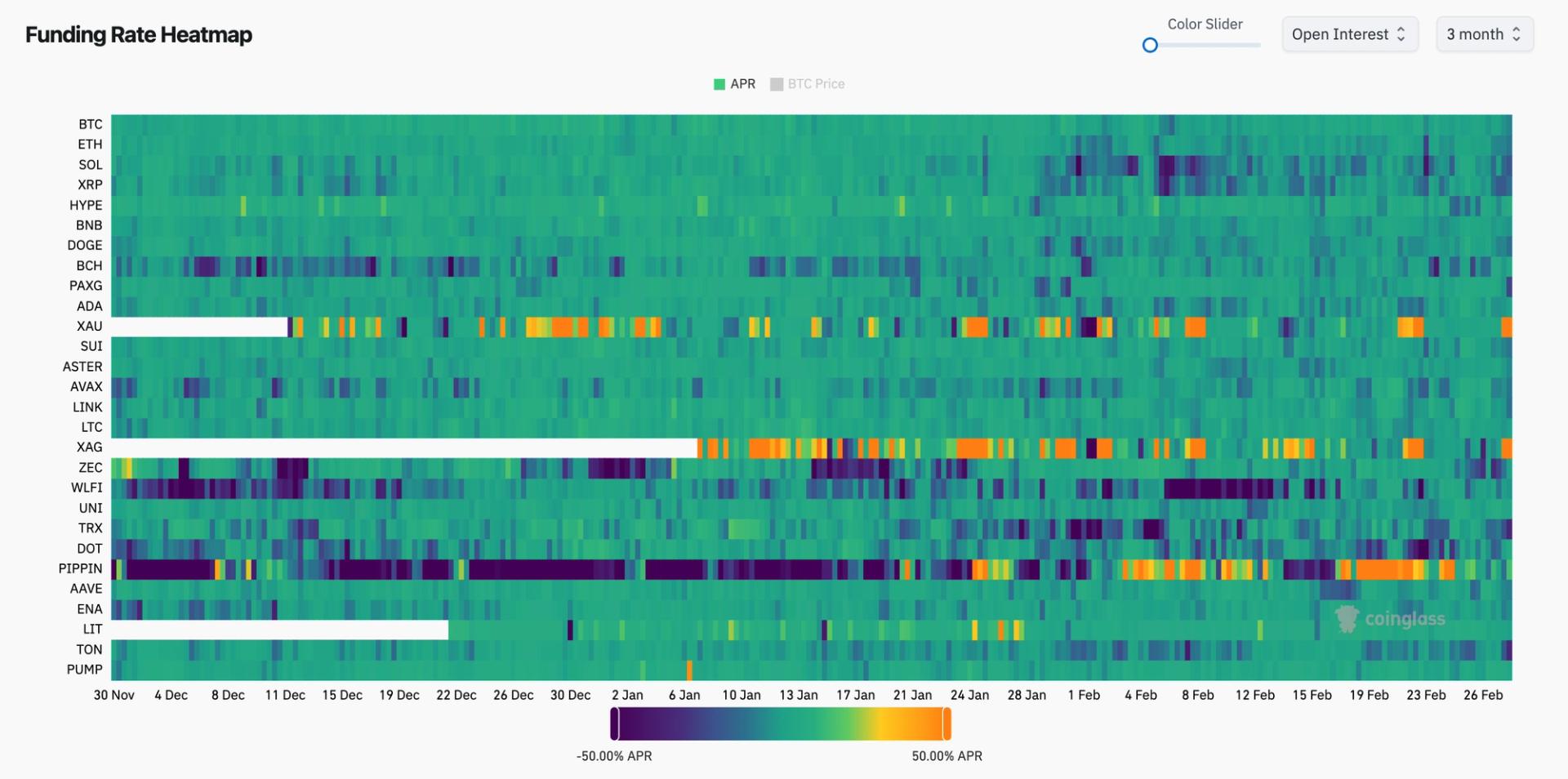
The cryptocurrency market is currently exhibiting conditions that strongly suggest a potential short squeeze for Bitcoin, as key financial indicators have reached critical levels. Recent market data reveals that perpetual funding rates, a crucial metric reflecting trader sentiment in derivatives markets, have plummeted to an unprecedented -6%. This figure, according to reports, represents the lowest point observed in the past three months, signaling a significant build-up of bearish bets against the digital asset. This aggressive accumulation of short positions emerged concurrently with a brief dip in Bitcoin's spot price, which touched approximately $63,000. The downturn in sentiment and price movement coincided with escalating geopolitical tensions, specifically following military actions attributed to the United States and Israel targeting Iran, which reportedly introduced a wave of uncertainty across global financial markets, including the highly volatile cryptocurrency sector. This confluence of extreme negative funding and external geopolitical pressures has created a volatile environment, potentially setting the stage for a sharp price reversal if short sellers are forced to cover their positions.
Understanding the mechanics behind perpetual funding rates is crucial to grasping the current market dynamics. Perpetual futures contracts, unlike traditional futures, do not have an expiry date, requiring a mechanism to tether their price to the underlying spot asset. This is achieved through funding rates, which are periodic payments exchanged between traders holding long and short positions. When funding rates are positive, long position holders pay short position holders, indicating a bullish market sentiment where demand for long positions is higher. Conversely, a negative funding rate, as currently observed at -6%, signifies that short position holders are paying long position holders, reflecting a dominant bearish sentiment and an excess of short interest in the market. This extreme negative rate suggests that a substantial number of traders are betting on further price declines, willing to pay a premium to maintain their short exposure. Historically, such pronounced imbalances in market positioning have often preceded significant price movements, particularly short squeezes, where a rapid upward price movement forces short sellers to buy back assets to limit losses, further fueling the rally. The current scenario, with funding rates at a three-month low, underscores the intensity of this bearish conviction.
The reported -6% perpetual funding rate is not merely a statistical anomaly but a strong indicator of aggressive short selling activity that has not been seen at this intensity for a quarter. Market analysts often view such extreme negative funding as a contrarian signal, suggesting that the market may be "over-shorted." This means that a disproportionately large number of traders have taken short positions, creating a substantial pool of potential buying pressure should the price begin to move upwards. The brief decline of Bitcoin's price to around $63,000 provided the initial impetus for this surge in bearish sentiment and subsequent short accumulation. This price dip was not an isolated event but reportedly occurred amidst a backdrop of heightened global instability. Reports indicated that military actions involving the U.S. and Israel against Iran triggered widespread risk aversion across financial markets. Investors, seeking safer havens or reducing exposure to volatile assets, likely contributed to the selling pressure on Bitcoin, which in turn encouraged derivatives traders to open new short positions, exacerbating the negative funding rates. This interplay between geopolitical events, spot market price action, and derivatives positioning has created a highly leveraged environment ripe for a potential short squeeze.
The current market posture, characterized by deeply negative funding rates and a significant accumulation of short positions, carries substantial implications for Bitcoin's near-term price trajectory. While the immediate trigger for this bearish sentiment appears to be geopolitical instability, the resulting extreme positioning in derivatives markets often sets the stage for sharp reversals. Market observers frequently note that when a consensus forms around a particular direction, especially to such an extreme degree, the market becomes vulnerable to a counter-move. A short squeeze scenario would involve a rapid increase in Bitcoin's price, potentially triggered by positive news, a de-escalation of geopolitical tensions, or simply a lack of further downward momentum. As the price rises, short sellers face increasing losses, compelling them to buy back Bitcoin to close their positions. This forced buying then adds further upward pressure, creating a cascading effect that can lead to a swift and substantial price surge. The current setup suggests that the market is highly susceptible to such an event, with the magnitude of potential price movement amplified by the sheer volume of outstanding short interest. This dynamic highlights the inherent volatility of cryptocurrency markets, where external events can trigger rapid shifts in sentiment and positioning, leading to outsized price reactions.
In summary, the Bitcoin market is currently navigating a period of heightened tension, marked by perpetual funding rates plunging to a three-month low of -6%, signaling an aggressive build-up of short positions. This bearish sentiment was reportedly fueled by a brief price dip to $63,000, coinciding with reports of escalating geopolitical tensions involving the U.S., Israel, and Iran. The confluence of these factors has created a market environment where a significant number of traders are betting against Bitcoin, potentially making the asset highly susceptible to a short squeeze. Should a catalyst emerge, such as a de-escalation of global conflicts or a shift in market sentiment, the forced covering of these extensive short positions could trigger a rapid upward price movement. Investors and traders will be closely monitoring not only geopolitical developments but also the evolution of funding rates and Bitcoin's price action for indications of when this potential squeeze might materialize, underscoring the delicate balance of fear and opportunity in the volatile crypto landscape.