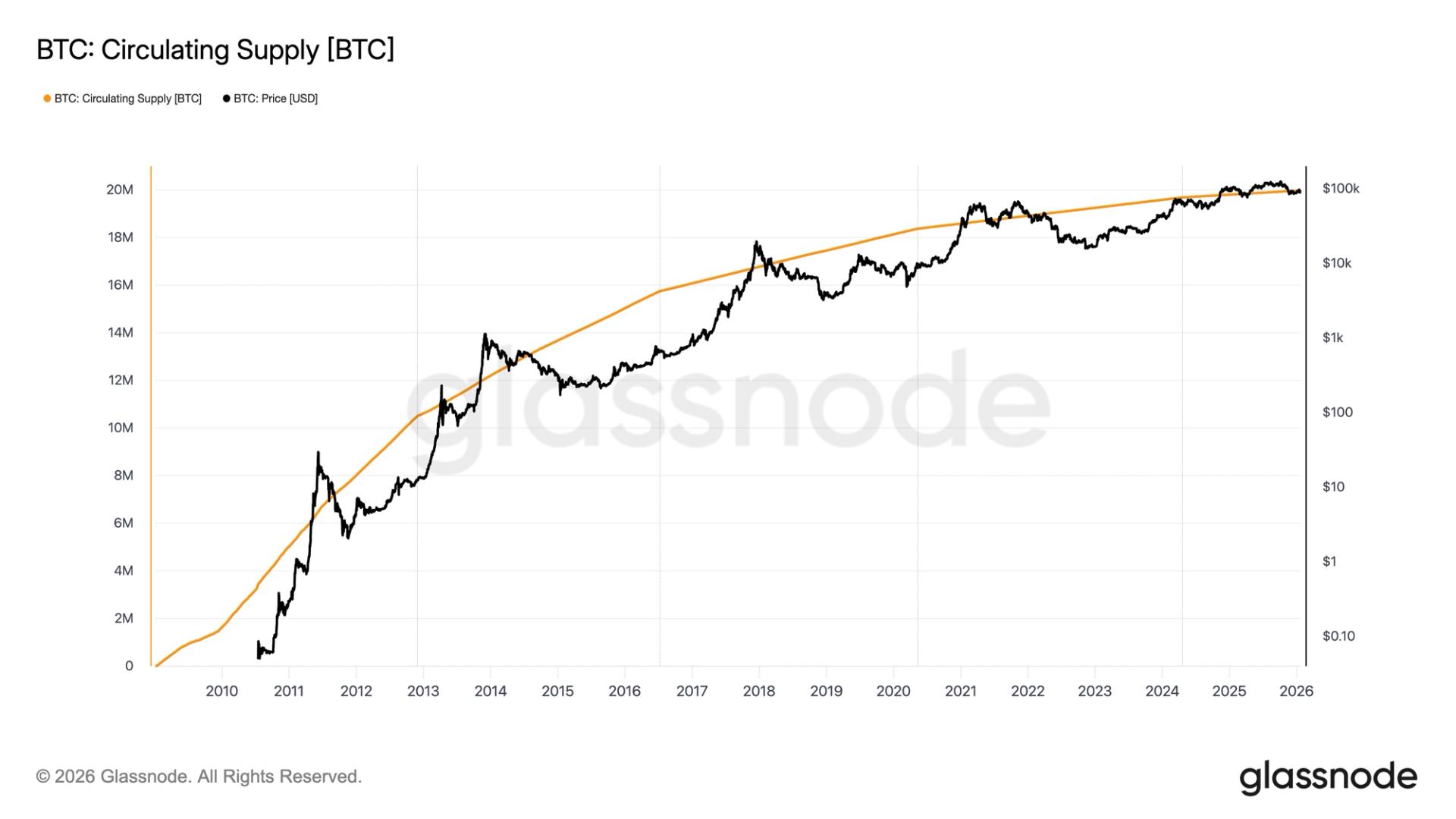
The global cryptocurrency market is witnessing a significant milestone as the circulating supply of Bitcoin (BTC) rapidly approaches 20 million coins. This threshold represents a critical point in the digital asset's predetermined issuance schedule, with over 95% of the total fixed supply now in circulation. According to data from the Clark Moody Dashboard, approximately 19,996,979 BTC have already been mined, leaving a mere 3,000 bitcoins before the 20 million mark is reached. At current issuance rates, this pivotal moment is anticipated within roughly seven days. This development underscores Bitcoin's advanced progression along its unique supply curve, a fundamental aspect of its design that distinguishes it from traditional financial assets and fiat currencies. The impending achievement of 20 million circulating bitcoins highlights the inherent scarcity built into the network's protocol, setting the stage for future dynamics in its valuation and market perception.
The fixed maximum supply of 21 million bitcoins was a foundational principle hard-coded into the cryptocurrency's protocol by its pseudonymous creator, Satoshi Nakamoto. This immutable cap was designed to establish a form of money characterized by absolute scarcity, a stark contrast to fiat currencies, which central banks can expand at will. While the specific rationale behind the 21 million figure was never fully elaborated by Nakamoto, this predetermined limit has been instrumental in building credibility around Bitcoin's predictable supply schedule. For proponents often referred to as 'bitcoin maximalists,' this cap is non-negotiable and central to Bitcoin's core value proposition as 'hard money.' Any suggestion of altering this fundamental aspect is widely viewed as undermining the very essence of Bitcoin's economic model, emphasizing its role as a deflationary asset in a world of potentially inflationary fiat systems.
As the circulating supply edges closer to 20 million, the long-term trajectory for the remaining coins becomes increasingly clear. Following this milestone, only approximately 1 million bitcoins will be left to be mined, a process projected to span more than a century. Reports indicate that at the current pace, 99% of Bitcoin's total supply is expected to be in circulation by January 2035. The final full bitcoin is anticipated to be mined around the year 2105, with fractional issuance continuing until approximately 2140. This extended timeline is primarily due to the network's 'halving' events, which occur roughly every four years, systematically cutting the rewards miners receive for validating transactions. These halvings have progressively slowed the rate of new coin issuance, leading to a current daily mining rate of about 450 BTC and pushing Bitcoin's inflation rate below 1%, further reinforcing its scarcity model.
Bitcoin's unique scarcity model is frequently compared to that of precious metals like gold or commodities such as oil, yet it possesses a crucial distinction. While the supply of traditional commodities can often respond to increased demand or higher prices through accelerated production or new discoveries, Bitcoin's issuance schedule is entirely immutable and transparent. Its supply curve is predetermined and cannot be altered, regardless of market conditions or technological advancements. This fixed and predictable supply mechanism is a cornerstone of its appeal, positioning it as a potentially superior store of value in the long term. Experts suggest that this absolute scarcity, coupled with its decentralized nature, underpins Bitcoin's 'hard money' narrative, offering an alternative to traditional financial instruments susceptible to inflationary pressures and governmental control. The nearing completion of its supply further intensifies discussions around its future value proposition as a truly scarce digital asset.
The impending achievement of 20 million bitcoins in circulation marks a pivotal moment in the cryptocurrency's history, highlighting the advanced stage of its predetermined supply schedule. This milestone not only underscores the inherent scarcity designed into Bitcoin's protocol but also sets the stage for the protracted mining of its final million coins over the next century. The unique combination of a fixed supply cap, predictable halving events, and an immutable issuance curve continues to define Bitcoin's distinct economic model. As the network approaches the completion of its supply, observers will closely watch how this increasing scarcity influences its market dynamics, adoption rates, and its evolving role in the global financial landscape, reinforcing its foundational principles as a 'hard money' alternative.