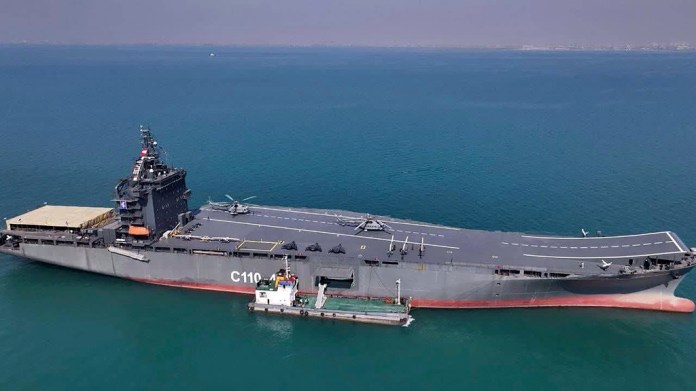
The United States Central Command (CENTCOM) publicly released video footage on Thursday, depicting a successful military strike against a substantial Iranian drone vessel. This unclassified visual evidence emerged on the sixth day of an ongoing military campaign designated 'Operation Epic Fury.' According to statements from Admiral Brad Cooper, the commander of CENTCOM, the targeted drone carrier was of considerable dimensions, reportedly comparable in scale to a World War II-era aircraft carrier. This strike represents a significant development in the current hostilities, with Admiral Cooper further indicating that this particular vessel was one of more than thirty Iranian naval assets that the United States has neutralized since the commencement of the operation. The release of the video underscores the operational transparency and effectiveness claimed by U.S. forces in the region, providing a visual confirmation of their stated actions against Iranian military infrastructure.
The ongoing 'Operation Epic Fury' marks a substantial escalation in military engagements between the United States and Iran, now in its sixth day. This operation follows a period of heightened tensions and represents a concerted effort by the U.S. to degrade Iran's military capabilities. Just hours prior to the video's release, Admiral Cooper held a press conference where he detailed the extent of the damage inflicted upon Iran's naval forces, emphasizing the strategic importance of neutralizing such a large drone platform. The current offensive is not an isolated incident; it builds upon previous actions, including a notable event earlier in the week. On Wednesday, during a separate press briefing, War Secretary Pete Hegseth and General Dan Caine, Chairman of the Joint Chiefs of Staff, disclosed that a U.S. submarine had successfully deployed a torpedo to sink an Iranian warship off the coast of Sri Lanka, marking the first successful torpedo attack by the U.S. in the current conflict. These combined actions signal a robust and expanding U.S. military response aimed at curtailing Iranian influence and capabilities in the region.
The impact of 'Operation Epic Fury' on Iran's military infrastructure has been profound, according to official U.S. assessments. Admiral Brad Cooper highlighted the extensive damage sustained by Iranian forces, stating that their overall military capabilities have been 'significantly destroyed' over the past week. Beyond the substantial naval losses, which include over thirty vessels, Iran's capacity to launch retaliatory airstrikes has reportedly been 'dramatically reduced.' Specific data provided by Admiral Cooper indicated a sharp decline in Iranian offensive actions: ballistic missile attacks have decreased by 90% since the operation's inception, while drone attacks have seen an 83% reduction over the same period. Commenting on the drone carrier strike, Admiral Cooper confirmed during a Thursday afternoon press conference that the vessel was 'on fire' as he spoke, underscoring the immediate and visible consequences of the U.S. military's actions. These figures and observations paint a picture of a highly effective campaign in its initial phase.
The statements from U.S. officials and the visible evidence provided by CENTCOM's video release suggest a clear strategy of overwhelming force aimed at rapidly diminishing Iran's military capacity. War Secretary Pete Hegseth's assertion that 'Operation Epic Fury' has 'only just begun' signals a commitment to a sustained campaign, with initial projections suggesting it could last between four to five weeks, though this timeline remains subject to change based on operational developments. This prolonged engagement indicates a strategic intent to not only counter immediate threats but to fundamentally alter Iran's military posture. The significant reduction in Iranian ballistic missile and drone attacks, as reported by Admiral Cooper, demonstrates the immediate tactical success of the operation in neutralizing offensive capabilities. Analysts suggest that the public release of such footage serves multiple purposes: to reassure allies, deter further Iranian aggression, and demonstrate the advanced capabilities and resolve of the U.S. military. The focus on degrading Iran's ability to launch retaliatory airstrikes also points to a broader objective of establishing air superiority and control over strategic maritime routes, thereby limiting Iran's regional influence.
In summary, the U.S. Central Command's release of video footage confirming a successful strike on a large Iranian drone ship marks a pivotal moment in 'Operation Epic Fury,' an ongoing military campaign that has significantly degraded Iran's naval and aerial offensive capabilities. With over thirty Iranian naval vessels reportedly neutralized and a dramatic reduction in missile and drone attacks, U.S. officials indicate a substantial impact on Iran's military infrastructure. War Secretary Pete Hegseth has signaled that the conflict is in its early stages and is expected to continue for several weeks. Moving forward, observers will be closely watching for further developments in 'Operation Epic Fury,' including any shifts in its projected duration, additional reports on the extent of damage to Iranian forces, and potential responses from Tehran. The sustained nature of this operation and its stated objectives suggest a significant recalibration of regional power dynamics.