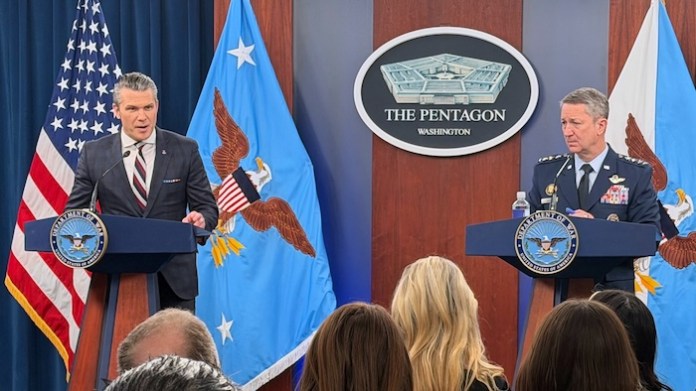
Secretary of War Pete Hegseth and Joint Chiefs Chairman General Dan Caine delivered a crucial operational briefing from the Pentagon on Tuesday morning, detailing the United States' ongoing military actions within Iran. This update comes four days into a significant escalation, during which American and Israeli forces have reportedly executed thousands of strikes. A pivotal development confirmed during the briefing was the elimination of Supreme Leader Ali Khamenei, a claim with immense geopolitical ramifications. In response to these extensive operations, Iranian forces have launched numerous missile and drone attacks targeting both Israel and various U.S. assets situated in several other nations across the broader region. A primary strategic objective outlined by the officials is the swift establishment of uncontested command over Iranian airspace, a goal they anticipate achieving within a matter of days, which would significantly alter the operational landscape and enable further military objectives.
The current military engagement, now in its fourth day, represents a dramatic intensification of long-standing tensions in the Middle East. The initial wave of thousands of coordinated strikes by the United States and Israel marked a decisive shift in regional dynamics, culminating in the reported death of Iran's Supreme Leader, Ali Khamenei. This event, if independently verified, carries immense historical and political weight, potentially destabilizing Iran's leadership structure and prompting profound internal and external repercussions. Historically, the relationship between Iran and the U.S. has been fraught with proxy conflicts and geopolitical rivalries, often involving Israel. The scale and directness of these latest operations, particularly the targeting of Iran's highest religious and political authority, signal a departure from previous strategies. Iran's retaliatory actions, involving a barrage of missiles and drones directed at Israeli territories and American installations in neighboring countries, underscore the immediate and widespread nature of this conflict, raising concerns about broader regional stability and the potential for further escalation.
During the Tuesday briefing, military leaders provided specific insights into the progression of air operations. General Dan Caine, Chairman of the Joint Chiefs, indicated that American forces have presently secured localized air superiority along Iran's southern coastline. This initial achievement is described as a foundational step, enabling greater operational flexibility for U.S. personnel in the immediate vicinity. Caine further elaborated on plans to extend this campaign deeper into Iranian territory, systematically expanding the zones where U.S. forces can operate with increased freedom. Secretary of War Pete Hegseth then projected that within a few days, the combined air forces of the United States and Israel would achieve complete and uncontested command of Iran's entire airspace. Hegseth underscored the strategic advantage this would confer, allowing both American and Israeli pilots to conduct missions safely across the country. This comprehensive air dominance, he explained, would facilitate the precise targeting of Iranian military commanders, destruction of strategic stockpiles, and engagement with any other objectives deemed necessary by the coalition forces, without significant aerial opposition.
The stated objective of achieving "complete control of Iranian skies" within a short timeframe carries profound strategic implications for the ongoing conflict and the future geopolitical landscape of the Middle East. Military analysts suggest that uncontested air superiority is often a prerequisite for large-scale ground operations or sustained precision targeting campaigns, significantly reducing risks to friendly forces while maximizing offensive capabilities. Should the U.S. and Israel successfully establish this dominance, it would severely cripple Iran's ability to project power, defend its assets, or effectively coordinate its military responses. This development could pave the way for more extensive operations, potentially including deeper incursions or prolonged surveillance and strike missions. However, experts also caution that air superiority, while critical, does not guarantee an end to resistance, particularly in a country as vast and populous as Iran. The challenges of managing a potentially fragmented or insurgent response, coupled with the complexities of urban environments, could present a different set of obstacles even with aerial command. The long-term implications for regional power balances and the potential for unintended consequences remain a significant area of concern for international observers.
In summary, the Pentagon briefing highlighted the rapid progression of U.S. and Israeli military operations in Iran, marked by thousands of strikes, the reported death of Supreme Leader Ali Khamenei, and Iran's retaliatory actions across the region. A central takeaway is the coalition's imminent goal of establishing complete air superiority over Iran, a move officials believe will grant unparalleled operational freedom for targeting key military assets and leadership. This strategic objective, if realized, would fundamentally alter the dynamics of the conflict, potentially enabling a new phase of operations. As the situation unfolds, international attention will remain fixed on whether the projected air dominance is achieved, how Iran adapts its response, and the broader ramifications for stability in the Middle East. The coming days are expected to be critical in determining the trajectory of this escalating confrontation.