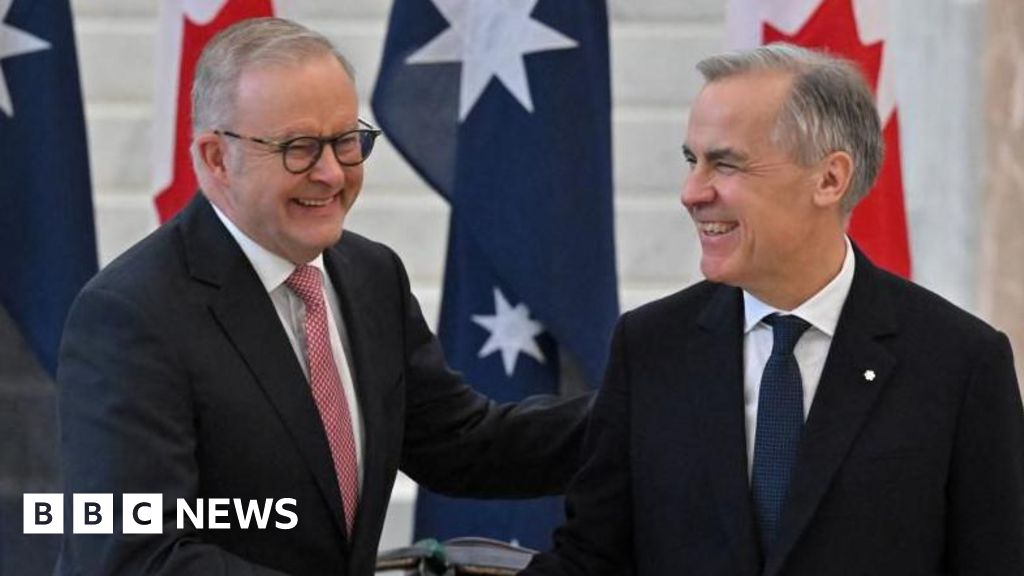
Canadian Prime Minister Mark Carney recently delivered a pivotal address to the Australian parliament, articulating a stark assessment that the prevailing global order is experiencing a profound disintegration. He attributed this breakdown to a succession of crises that have fundamentally eroded the post-World War II international architecture. During his significant remarks in Canberra, Carney underscored the critical imperative for nations like Australia and Canada, which he characterized as "strategic cousins," to proactively collaborate in shaping the forthcoming international norms governing security and prosperity. He posed a fundamental question to these middle powers: whether they would seize the opportunity to author the new rules of engagement or passively permit dominant global actors to unilaterally determine outcomes. This landmark visit, marking the first instance a Canadian head of government has addressed the Australian parliament in nearly two decades, highlighted a shared urgency for these nations to bolster their collective sovereign capabilities, with a particular focus on vital sectors such as critical minerals, defense, and artificial intelligence, according to reports from the parliamentary proceedings. The emphasis on collaborative autonomy signals a strategic realignment in response to perceived vulnerabilities within the existing international system.
Carney's recent pronouncements in Australia are not isolated, but rather echo a consistent theme he has articulated on the international stage, notably during his address at the World Economic Forum in Davos earlier this year. In that January speech, the Canadian leader reportedly conveyed a similar sentiment, asserting that the "old order is not coming back" and urging middle powers to forge stronger alliances to navigate this evolving landscape. He reiterated this perspective on Thursday, explaining that many countries are increasingly opting to enhance their independent autonomy. Carney described this impulse as entirely "understandable when the rules no longer protect you," indicating a growing disillusionment with the efficacy of established international regulations. This shift towards greater national self-reliance, as observed by officials, reflects a broader global trend where nations are re-evaluating their positions and strategies in an environment characterized by heightened geopolitical competition and uncertainty. The historical context of his visit, being the first by a Canadian Prime Minister to the Australian parliament in almost two decades, further amplified the significance of his message, underscoring a renewed commitment to bilateral and multilateral engagement among like-minded democratic states.
Following his impactful parliamentary address, Prime Minister Carney joined his Australian counterpart, Anthony Albanese, for a joint press conference, where both leaders outlined concrete measures aimed at fortifying their bilateral relationship. Officials announced a series of initiatives designed to deepen cooperation across several strategic domains, including enhanced collaboration in defense and security matters, alongside new partnerships between the countries' respective space agencies. A particularly significant development highlighted during the press conference was Australia's formal decision to join the G7 Critical Minerals Alliance. Carney lauded this alliance, describing it as the "largest grouping of trusted democratic mineral reserves in the world," according to statements made at the event. This strategic alignment is expected to bolster the resilience of global supply chains for essential resources, reflecting a concerted effort to secure vital materials within a network of democratic states that share common values and strategic interests. The expansion of cooperation into areas like space and advanced technologies further illustrates a comprehensive approach to partnership, moving beyond traditional diplomatic ties to encompass emerging fields crucial for future prosperity and national security.
Carney's forthright assessment of the "breaking down" global order signals a profound re-evaluation of the post-World War II international system, suggesting that its foundational principles and institutions are increasingly insufficient to address contemporary challenges. His emphasis on "strategic cousins" like Canada and Australia taking a proactive stance underscores a potential paradigm shift, moving away from a sole reliance on traditional hegemonic powers to resolve complex global issues. This perspective implies that middle powers, by pooling their diplomatic influence, economic resources, and technological expertise, can collectively exert greater agency in defining new international standards for security, economic prosperity, and environmental governance. The specific focus on critical minerals, defence, and artificial intelligence cooperation reflects a clear understanding that future global power dynamics will be heavily influenced by technological sovereignty, secure access to essential resources, and robust defense capabilities, as various geopolitical observers have noted. Such alliances could serve as a compelling model for other democratic nations seeking to enhance their resilience and autonomy in an increasingly fragmented and multipolar world, potentially leading to the formation of new regional or thematic blocs that challenge existing power structures and foster a more distributed global leadership.
In essence, Prime Minister Carney's address to the Australian parliament served as a compelling call to action for middle powers to actively shape a new global order, rather than passively adapting to its evolution. His landmark visit and the subsequent agreements forged with Australia underscore a strategic pivot towards strengthening sovereign capabilities and fostering deeper alliances among democratic nations that share a common vision for a rules-based international system. The targeted focus on critical sectors such as minerals, defense, and artificial intelligence highlights the areas deemed most crucial for national security and economic resilience in the coming decades, indicating a forward-looking approach to geopolitical challenges. As the international landscape continues to undergo significant transformations, the collaborative model championed by Canada and Australia could offer a blueprint for how like-minded countries can collectively navigate uncertainty, safeguard their interests, and contribute to a more stable and equitable global future. Future developments in these enhanced partnerships, particularly regarding their tangible outcomes in critical sectors, will undoubtedly warrant close observation from the international community.