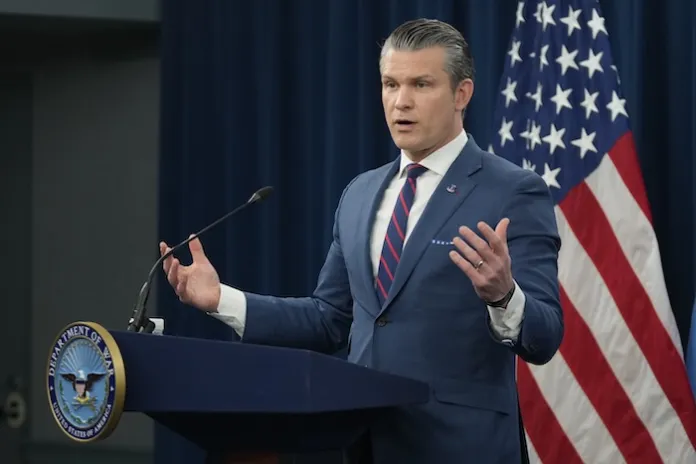
Secretary of War Pete Hegseth publicly addressed the ongoing American military intervention in Iran, dubbed "Operation Epic Fury," on Monday, asserting that despite significant changes in the Iranian leadership, the operation's core objective is not regime change. Speaking for the first time since the United States and Israel initiated widespread, overwhelming strikes on Saturday morning, Hegseth acknowledged the dramatic shift in power, stating, "This is not a so-called regime change war, but the regime sure did change, and the world is better off for it today," according to official reports from his Pentagon press conference. The coordinated assault, which commenced in the early hours of Saturday, targeted critical Iranian infrastructure and high-ranking officials across the nation. These devastating initial strikes notably resulted in the death of Supreme Leader Ayatollah Ali Khamenei and many of his close associates, effectively decapitating a significant portion of the country's top command. This initial phase of the operation focused on dismantling key military capabilities and command structures, setting a decisive and impactful tone for the conflict while simultaneously reshaping Iran's political landscape in an unforeseen and profound manner. The swiftness and scale of the offensive immediately raised questions about its ultimate aims, which Hegseth sought to clarify.
The comprehensive military campaign, launched by a joint U.S. and Israeli force, unleashed an overwhelming series of strikes across Iran early Saturday morning, marking the beginning of what officials have termed "Operation Epic Fury." Reports indicate that the targets were meticulously selected to cripple Iran's military and leadership apparatus, demonstrating a clear intent to severely degrade the nation's capacity for military action. Beyond the elimination of Supreme Leader Ayatollah Ali Khamenei and numerous senior lieutenants, the offensive specifically aimed at critical Iranian command and control centers, integrated air defense systems designed to protect its airspace, various ballistic missile sites, its naval vessels including ships and submarines, and other essential military infrastructure. Secretary Hegseth characterized the objectives as "laser focused," clarifying that the primary goals involve the destruction of Iran's offensive missile capabilities, including production facilities, neutralizing its naval fleet, and incapacitating other vital military installations. This broad-spectrum assault signals a strategic intent to severely degrade Iran's capacity for military action and projection of power in the region, rather than engaging in a prolonged occupation or nation-building endeavor, as Hegseth later elaborated.
During his press conference at the Pentagon, Secretary Hegseth drew a stark contrast between Operation Epic Fury and previous American military engagements, particularly the Iraq War. "This is not Iraq," he emphasized, asserting that the current operation is not intended to be "endless." He highlighted that his generation, having experienced past conflicts, and the current administration, are acutely aware of the pitfalls of prolonged nation-building efforts. Hegseth reiterated the President's assessment that the "last 20 years of nation-building wars" were "dumb," positioning Operation Epic Fury as fundamentally different. He described it as "a clear, devastating, decisive mission" focused on specific military objectives: "Destroy the missile threat, destroy the Navy, no nukes." Furthermore, Hegseth underscored a departure from what he termed "stupid rules of engagement," "nation-building quagmire," "democracy building exercise," or "politically correct wars," asserting a commitment to "fight to win" without "waste[ing] time or lives." The immediate aftermath of the strikes has created a significant power vacuum within Iran, with the elimination of so many senior leaders leaving uncertainty regarding future leadership and potential avenues for negotiating an end to hostilities. While U.S. forces are not currently deployed on the ground in Iran, Hegseth did not explicitly rule out such a possibility, declining to elaborate on future operational decisions.
Secretary Hegseth's forceful articulation of Operation Epic Fury's limited, decisive scope marks a significant rhetorical and potentially strategic departure from the interventionist policies that characterized previous decades of U.S. foreign policy. By explicitly disavowing "regime change" as a primary goal, even while acknowledging its de facto occurrence, the administration appears to be attempting to manage expectations and avoid the perception of an open-ended commitment. The "laser-focused" objectives — dismantling missile capabilities and naval power — suggest a strategy aimed at degrading Iran's capacity to threaten regional stability and project force, rather than a comprehensive societal overhaul. However, the profound disruption caused by the elimination of Ayatollah Ali Khamenei and his inner circle presents an unprecedented challenge for Iran, potentially leading to internal power struggles and an unpredictable political landscape. Experts suggest this leadership vacuum could either pave the way for a more moderate successor or, conversely, lead to increased instability and a more radicalized response. The regional implications are already evident, with reports indicating that Lebanon has moved to ban Hezbollah's military activities following retaliatory strikes launched from Beirut, underscoring the immediate ripple effects of the conflict across the Middle East.
In summary, Operation Epic Fury represents a swift and devastating military action by the United States and Israel, characterized by Secretary of War Pete Hegseth as a targeted effort to neutralize specific Iranian military threats rather than instigate a regime change, despite the profound leadership alterations. The initial strikes effectively decapitated Iran's top leadership and severely damaged critical military infrastructure, aligning with stated objectives to dismantle missile and naval capabilities. Hegseth's insistence on distinguishing this operation from past "nation-building" wars like Iraq signals a strategic shift towards decisive, limited engagements. However, the immediate consequence of this approach is a significant power vacuum within Iran, creating uncertainty about its future leadership and the potential for diplomatic resolution. As the situation evolves, observers will be closely watching for any emergence of new Iranian leadership, the nature of any potential Iranian counter-response, and the broader implications for regional stability, particularly given the ongoing tensions and related developments like those involving Hezbollah in Lebanon.