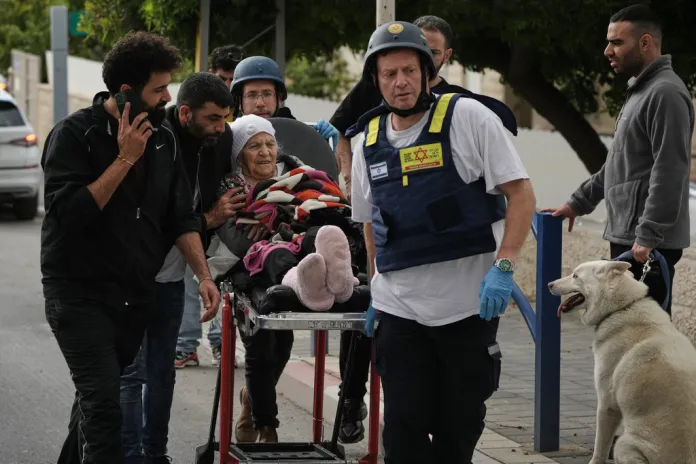
A wave of Iranian missile and drone attacks swept across the Middle East on Sunday, claiming the lives of nearly a dozen individuals and leaving scores injured across Israel, the United Arab Emirates, and Kuwait. Authorities in Israel reported at least eight fatalities and 20 people unaccounted for following a strike on a residential area. Concurrently, officials in the UAE confirmed three deaths and 58 injuries, while Kuwait's Ministry of Health announced one fatality and 20 wounded. These widespread assaults, according to reports, represent Tehran's retaliatory response to earlier surprise operations by the United States and Israel that resulted in the death of Iranian Supreme Leader Ayatollah Ali Khamenei. The coordinated barrage signifies a significant expansion of hostilities, extending the conflict's reach far beyond the immediate Iranian-Israeli dynamic and raising considerable alarm among regional governments, particularly those hosting U.S. military installations.
The immediate catalyst for this dramatic escalation was the reported killing of Iran's Supreme Leader, Ayatollah Ali Khamenei, in what sources described as surprise attacks orchestrated by the United States and Israel. This event, a profound blow to the Iranian leadership, appears to have fundamentally shifted Tehran's strategic calculus, prompting a direct and geographically expansive response. Historically, regional tensions often manifested through proxy conflicts; however, the current series of strikes marks a dangerous departure, with Iran directly targeting sovereign nations. This shift underscores a heightened level of risk in the Middle East, as the death of such a pivotal figure has seemingly removed previous constraints on overt military action, pushing the region closer to a broader confrontation and compelling international observers to reassess the stability of the geopolitical landscape.
In Israel, emergency services were engaged in extensive search and rescue operations for hours after an overnight barrage of missiles and drones struck a residential dwelling. Authorities indicated that multiple individuals were successfully extracted from the debris, though fears persist that the death toll could climb as recovery efforts continue. The United Arab Emirates provided specific details regarding the attacks on its territory, confirming that the three fatalities included citizens from Pakistan, Nepal, and Bangladesh, with 58 others sustaining injuries. Emirati officials stated that Iran launched 165 ballistic missiles targeting the country, of which 152 were successfully intercepted, while 13 impacted the sea. Additionally, 541 bomb-carrying drones were reportedly deployed against the UAE, with 506 neutralized before reaching their targets. Kuwait's Ministry of Health, for its part, reported one death and 20 injuries following a total of 97 projectiles or attacks, emphasizing that none of the casualties were Kuwaiti citizens.
The widespread nature and direct targeting of multiple nations by Iran signal a perilous new phase in Middle Eastern geopolitics. Experts suggest that these retaliatory strikes, extending beyond Israel to include the UAE and Kuwait, demonstrate Tehran's intent to project power and deter future actions against its leadership, even at the cost of broader regional instability. The involvement of non-citizen casualties in the Gulf states highlights the indiscriminate consequences of such military actions and the international human toll of an escalating conflict. This situation places immense pressure on regional governments, many of whom host significant U.S. military assets, to navigate a delicate balance between national security and the imperative to de-escalate. Analysts warn that without swift and concerted diplomatic intervention, the cycle of retaliation could spiral into a full-scale regional war, with profound implications for global energy markets and international security.
The immediate aftermath of these Iranian retaliatory strikes has left a trail of death and destruction across Israel, the UAE, and Kuwait, dramatically intensifying an already volatile regional environment. The direct targeting of multiple sovereign states, following the killing of Iran's Supreme Leader, represents a critical juncture that demands urgent international attention. Moving forward, the world will be closely watching for potential further actions from Tehran, as well as the responses from the United States and Israel. The focus will also be on diplomatic efforts aimed at containing the conflict and preventing a wider conflagration. The safety of both local populations and international citizens residing in the region remains a paramount concern, underscoring the pressing need for de-escalation to avert a catastrophic regional war.