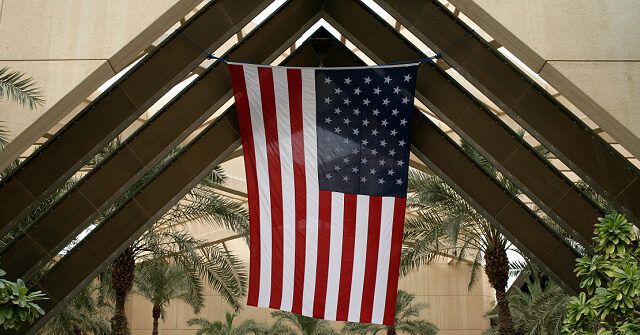
An aerial assault, reportedly carried out by Iranian drones, targeted the United States Embassy complex in Riyadh, Saudi Arabia, on Monday, resulting in a blaze and structural harm to the diplomatic facility. Initial assessments from the Saudi Ministry of Defense indicated that two unmanned aerial vehicles were responsible for the incident, which caused a contained fire and minor material damage to the building. In response to the heightened security situation, the U.S. Embassy in Riyadh issued an urgent directive via its official X account, advising American citizens in Jeddah, Riyadh, and Dhahran to immediately implement a 'shelter in place' protocol. Furthermore, the advisory cautioned against non-essential travel to any military installations across the region, underscoring the gravity of the unfolding events. Reports from a U.S. official to Fox later clarified that no embassy personnel were present at the diplomatic mission when the strike occurred, potentially averting casualties.
This significant incident unfolds against a backdrop of rapidly escalating tensions across the Middle East, marking a critical juncture in the ongoing regional conflict. The drone strike on the U.S. Embassy follows a period of intensified missile attacks attributed to Iran, which reportedly began after a joint operation by the United States and Israel resulted in the death of Iran's Supreme Leader Ayatollah Ali Khamenei over the preceding weekend. This retaliatory cycle has prompted grave concerns for the safety of American nationals abroad. In light of the deteriorating security landscape, Secretary of State Marco Rubio, as reported by Breitbart News, had previously issued a strong recommendation for Americans residing in more than a dozen countries throughout the Middle East to depart the region without delay, citing serious and immediate safety risks. The targeting of a U.S. diplomatic mission in a key regional ally's capital signals a dangerous new phase in the confrontation.
Following the drone attack, the U.S. Mission to Saudi Arabia reiterated its commitment to closely monitoring the evolving regional situation, as conveyed through its public statements. The 'shelter in place' order, specifically directed at American citizens, emphasized the necessity of immediate compliance to ensure personal safety amidst the volatile environment. This directive, encompassing major urban centers like Jeddah, Riyadh, and Dhahran, also included a stringent warning against discretionary travel to military sites, highlighting the potential for broader targeting beyond diplomatic compounds. The confirmation from a U.S. official, as relayed to Fox, that no staff members were on-site at the Riyadh embassy during the time of the strike is a crucial detail, suggesting that while material damage occurred, human casualties were fortunately avoided. This absence of personnel during the attack could significantly influence the nature and scope of any forthcoming U.S. response.
The implications of this attack are profound, signaling a potential for further and more severe escalation in the already fraught relationship between the United States and Iran. President Donald Trump, according to Kellie Meyer of News Nation, issued a stark warning, stating that the nature of retaliation for both the assault on the U.S. embassy in Riyadh and the prior deaths of U.S. service members would soon become apparent. This statement underscores the administration's resolve to respond decisively, elevating the risk of direct military confrontation. An attack on a sovereign diplomatic mission is widely considered an act of aggression against the host nation and the country it represents, potentially triggering international condemnation and robust counter-measures. Analysts suggest that the choice of target—a U.S. embassy in Saudi Arabia—aims to send a clear message of defiance while simultaneously challenging U.S. alliances in the Gulf region, further destabilizing an area already grappling with complex geopolitical rivalries.
In summary, the drone strike on the U.S. Embassy in Riyadh represents a significant and dangerous escalation in the ongoing conflict between the United States and Iran, following the killing of Iran's Supreme Leader. While initial reports indicate limited damage and no casualties, the incident has prompted immediate security advisories for American citizens across Saudi Arabia and has drawn a strong warning of retaliation from President Trump. The coming days are critical, as the international community watches for the U.S. response and any subsequent actions from Iran. The safety of American citizens in the Middle East remains a paramount concern, and the potential for broader regional conflict appears to be at an all-time high, demanding careful diplomatic and strategic navigation.