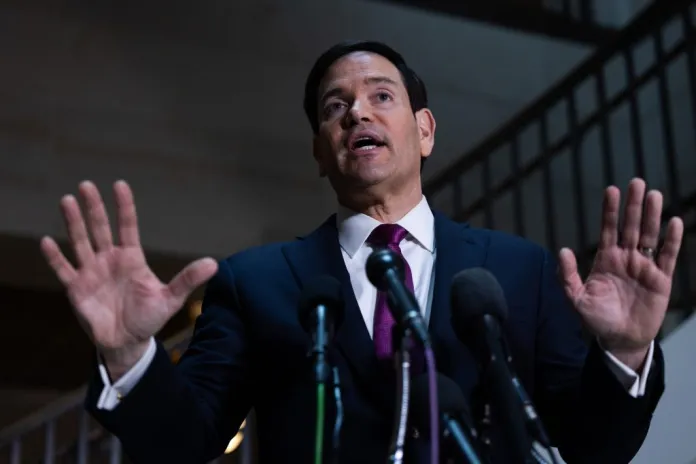
The administration of President Donald Trump is currently navigating a dual challenge, facing not only ongoing military actions from Iran in the Middle East but also significant internal dissent from within its own political base. A recent admission by Secretary of State Marco Rubio, made public on Monday, revealed that the United States initiated preemptive military strikes against Iran in the early hours of Saturday. This action, according to Rubio, stemmed from President Trump's apprehension that Israel was on the verge of provoking retaliatory attacks from Tehran, which could then be directed against American interests. This disclosure has ignited considerable dissatisfaction among some of the president's most ardent supporters, prompting a re-evaluation of the administration's foreign policy direction. The core of this discontent appears to revolve around the perception that U.S. military engagement might be unduly influenced by the security concerns of an allied nation, sparking a contentious debate about the principle of "America First" versus perceived obligations to other states.
The current wave of dissatisfaction among President Trump's supporters appears to be rooted in two primary concerns, reflecting a deeper ideological schism within the conservative movement. Firstly, many of the president's adherents recall his consistent campaign promise to disengage the United States from what he termed "forever wars," advocating for a more isolationist foreign policy. The current military engagement with Iran, initiated under the stated premise of preventing Israeli provocation, is seen by these supporters as a direct contradiction to that pledge, raising fears of a prolonged and costly conflict. Secondly, there is an observable increase in skepticism regarding the U.S. relationship with Israel among certain segments of the base. This skepticism, according to reports, has occasionally veered into instances of antisemitism, highlighting a troubling undercurrent within the broader critique of foreign policy. This evolving dynamic underscores a significant challenge for the administration, as it attempts to balance its strategic alliances with the deeply held convictions of its core electorate, particularly concerning military interventions in the volatile Middle East region.
Prominent conservative voices have amplified the growing unease within the Republican base, articulating strong criticisms of the administration's actions. Former Representative Matt Gaetz, who was once considered for a key role in the Trump administration, publicly questioned the perception of the United States being compelled to act against Iran due to Israel's potential actions. His comments were made on social media in response to a video featuring House Speaker Mike Johnson, who appeared to reiterate Secretary Rubio's explanation for the strikes. Gaetz expressed that, while the statements regarding Israel's role might be factually accurate, they create an image of America as subservient. Similarly, former Representative Marjorie Taylor Greene, a figure who has previously diverged from President Trump on various issues, including government transparency, sharply critiqued the military strikes. Greene asserted that the nation is no longer divided along traditional political lines of left and right, but rather by those who advocate for military interventions on behalf of Israel and those who prioritize domestic peace and economic stability for American citizens, such as affordable healthcare and living expenses. These sentiments have reportedly been echoed and further disseminated by influential conservative figures, including commentator Megyn Kelly and Erik Prince, the founder of Blackwater.
The emergence of such vocal dissent from within President Trump's own political orbit signals a significant internal challenge for the administration and potentially a realignment within the broader conservative movement. The "America First" doctrine, a cornerstone of Trump's political identity, is now being rigorously tested against the backdrop of complex geopolitical realities and long-standing alliances. The criticism from figures like Gaetz and Greene, amplified by other conservative personalities, suggests a growing faction within the right that is increasingly wary of foreign entanglements, particularly those perceived as serving the interests of other nations over direct American priorities. This internal debate highlights the delicate balance the administration must strike between maintaining strategic partnerships, managing regional instability, and adhering to the isolationist or non-interventionist sentiments of a key part of its base. The reported attentiveness of President Trump to the "optics" of the situation, as evidenced by his subsequent press conference, underscores the political sensitivity of these allegations and the potential for this issue to reshape foreign policy discussions moving forward.
In summary, the Trump administration finds itself at a critical juncture, grappling with the immediate repercussions of military strikes against Iran and a burgeoning wave of criticism from its core supporters. The revelation by Secretary of State Rubio, linking the U.S. intervention to concerns over potential Israeli provocations, has ignited a fervent debate within the conservative movement, challenging the very tenets of the "America First" foreign policy. Key figures like Matt Gaetz and Marjorie Taylor Greene have articulated a clear division, questioning the rationale behind engaging in conflicts perceived to be driven by external interests. President Trump, in his initial public comments following the strikes, reportedly sought to reframe the narrative, contending that he had "forced" Israel, though the full context of this statement remains to be elaborated in the provided source material. As this internal ideological struggle unfolds, observers will be closely watching how the administration navigates these competing pressures, and what implications this evolving dynamic will have for U.S. foreign policy in the Middle East and the future cohesion of the conservative political landscape.