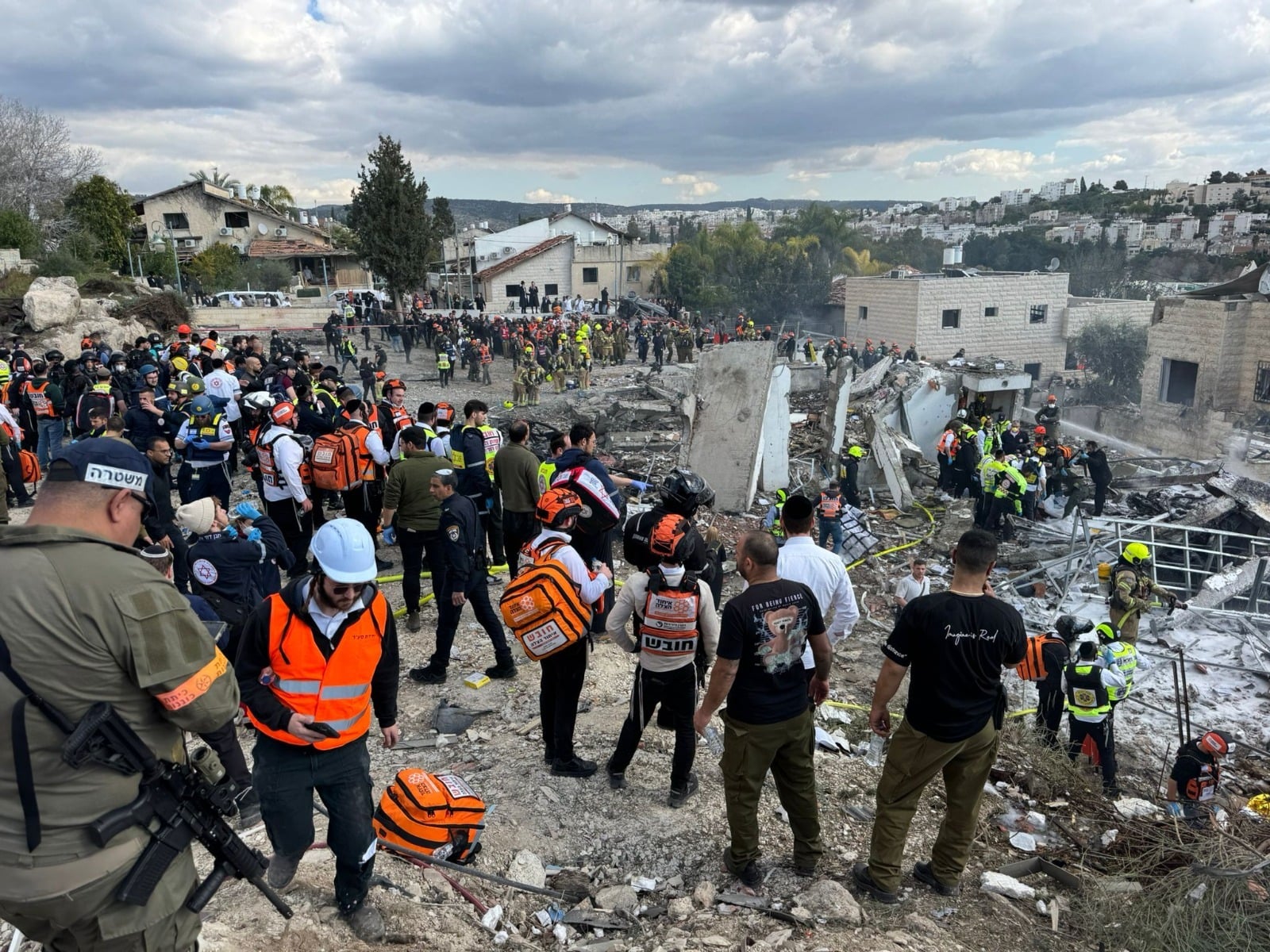
A devastating ballistic missile strike attributed to Iranian forces struck the Israeli city of Beit Shemesh on Sunday, resulting in the deaths of four individuals and injuring approximately twenty others, according to reports from Magen David Adom (MDA) ambulance services. The incident unfolded amid what officials describe as a relentless wave of missile and drone assaults targeting central Israel, marking the second day of intensified hostilities in the region. Among the injured in Beit Shemesh, at least two individuals were reported to be in serious condition, highlighting the severe impact of the attack. Following the strike, the Israeli military promptly deployed search and rescue teams, medical personnel, and a helicopter to the scene to assist with the evacuation and treatment of casualties, underscoring the immediate and coordinated emergency response to the large-scale assault. This particular strike forms part of a broader offensive launched by Iran's Revolutionary Guards, which they have characterized as a significant retaliatory action.
The attack on Beit Shemesh is understood to be a component of a wider, 'large-scale' offensive initiated by Iran's Revolutionary Guards, designated as the 'seventh and eighth waves of Operation Honest Promise 4.' This extensive military action, as stated by the Guards through local media, is presented as a direct response to alleged Israeli and United States strikes that reportedly led to the death of Iran's supreme leader. The ongoing conflict has seen a significant escalation, with Sunday marking the second consecutive day of what has been described as relentless missile and drone attacks across various parts of central Israel. This period of heightened aggression signals a dangerous new phase in regional tensions, with Iran explicitly framing its actions as retribution for a deeply provocative event, thereby raising concerns about the potential for further destabilization and a widening of the conflict beyond its current scope. The specific targeting of an Israeli city like Beit Shemesh underscores the direct and impactful nature of these retaliatory operations.
Further details emerging from the Beit Shemesh incident indicate the profound human cost of the ballistic missile impact. While Magen David Adom initially confirmed four fatalities, medical personnel reported that approximately twenty individuals sustained injuries, with varying accounts indicating between two and four in critical or serious condition. At least seventeen of the injured required immediate hospitalization, while two others received critical care directly at the scene. Visual evidence, including footage circulated online, captured the precise moment of the missile's impact, illustrating the sudden and destructive force unleashed upon the area. In the immediate aftermath, the Israeli military mobilized extensive resources, including specialized search and rescue units, a substantial contingent of medics, and an air ambulance, to ensure the swift and efficient evacuation of the wounded and to manage the emergency response operations on the ground, reflecting the gravity of the situation and the urgent need for assistance.
The launch of 'Operation Honest Promise 4' by Iran's Revolutionary Guards, encompassing multiple waves of attacks, signifies a critical escalation in the ongoing regional conflict, moving beyond proxy engagements to direct, large-scale assaults. This strategic shift, explicitly framed as retaliation for the alleged killing of Iran's supreme leader by Israeli and US forces, carries profound implications for regional stability. The decision to employ ballistic missiles against civilian areas like Beit Shemesh demonstrates a willingness to inflict direct damage and casualties, potentially inviting further counter-retaliation and deepening the cycle of violence. Analysts suggest that Iran's public attribution of the supreme leader's death to its adversaries, coupled with a named military operation, aims to project strength and resolve internally and externally, but simultaneously risks pushing the conflict into an unpredictable and dangerous trajectory where de-escalation becomes increasingly challenging. The involvement of the United States, even if indirectly, further complicates the geopolitical landscape.
The missile strike on Beit Shemesh, resulting in four deaths and numerous injuries, underscores the immediate and tragic consequences of the escalating conflict now in its second day. Iran's 'Operation Honest Promise 4' represents a significant and direct challenge, explicitly linking its large-scale attacks to alleged actions by Israel and the United States. As the region grapples with these intensified hostilities, the international community will be closely monitoring for further developments, particularly concerning the potential for additional retaliatory strikes and the broader implications for regional security. The humanitarian impact of such assaults remains a critical concern, and efforts towards de-escalation are paramount to prevent a wider conflagration in the Middle East.