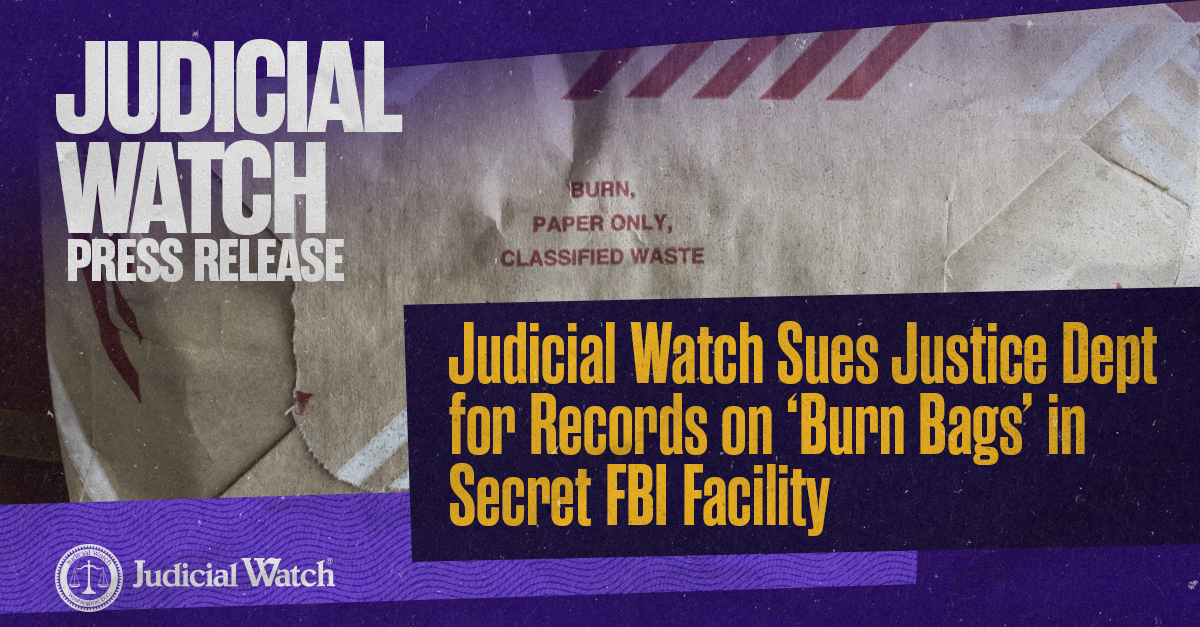
Independent government oversight organization Judicial Watch has initiated legal proceedings against the United States Department of Justice, filing a lawsuit under the Freedom of Information Act (FOIA). The objective of this legal action is to compel the release of official records concerning several "burn bags" reportedly discovered within a highly secure Federal Bureau of Investigation (FBI) facility. This legal challenge, formally docketed as *Judicial Watch Inc. v. U.S. Department of Justice (No. 1:26-cv-00538)*, was submitted to the U.S. District Court for the District of Columbia. The watchdog group’s move follows the Justice Department’s alleged failure to respond to a FOIA request originally submitted by Judicial Watch in November 2025. That initial request specifically sought comprehensive information regarding five distinct burn bags found inside Room 9582, identified as a Sensitive Compartmented Information Facility (SCIF) located at the FBI's main headquarters in Washington, D.C. Judicial Watch is pressing for full disclosure on the contents of these containers, including any materials that might be linked to various significant FBI investigations, highlighting their ongoing advocacy for transparency in governmental operations.
Understanding the broader context surrounding the discovery of these "burn bags" within a Sensitive Compartmented Information Facility (SCIF) at the FBI’s central command is crucial for appreciating the gravity of Judicial Watch's legal pursuit. A SCIF represents a highly controlled and fortified environment, meticulously designed for the handling and storage of classified national security information. Its primary function is to prevent any unauthorized access or disclosure of sensitive data, thereby safeguarding critical intelligence. Conversely, "burn bags" are specialized containers routinely employed for the secure collection and eventual destruction of sensitive or classified documents, ensuring that confidential materials do not fall into the wrong hands. The reported presence of such bags within a SCIF, a location already designated for stringent information security protocols, immediately raises significant questions. These inquiries revolve around the precise nature of the materials these bags contained, the reasons why they were seemingly not processed or destroyed in accordance with established governmental security procedures, and whether proper protocols were adhered to in such a critical environment.
Further details surrounding the discovery of the "burn bags" underscore the specific nature of Judicial Watch's inquiry. According to reports, the presence of these five bags was initially documented in an Opening Electronic Communication dated July 21, 2025. This communication was subsequently filed as Document 138-12 within a separate legal proceeding, Case No. 1:25-cr-00272-MSN-WEF, on November 3, 2025, providing a clear paper trail for their discovery. The bags were reportedly located within Room 9582, a specific SCIF at the FBI's Washington, D.C. headquarters, indicating a precise location within a highly secure zone. Judicial Watch's lawsuit explicitly seeks comprehensive information about what was inside these containers. This includes, but is not limited to, any documents or materials that could pertain to several high-profile FBI investigations, as indicated by the watchdog group. The organization emphasizes its commitment to uncovering details about how sensitive government information is managed and disposed of, particularly when it concerns operations of national significance.
The implications of "burn bags" being found within a Sensitive Compartmented Information Facility (SCIF) extend beyond mere procedural irregularities, touching upon fundamental aspects of national security and governmental accountability. Experts in intelligence and security protocols often highlight that the very purpose of a SCIF is to create an impenetrable barrier against information compromise. The presence of materials designated for destruction, yet seemingly not destroyed, within such a facility could suggest a lapse in the rigorous protocols expected for handling classified data. This scenario raises concerns about the integrity of information management within critical federal agencies. It prompts questions regarding whether sensitive documents were appropriately categorized, stored, or slated for destruction, and if the chain of custody for such materials was maintained. Furthermore, if these bags indeed contain information related to high-profile FBI investigations, as Judicial Watch suggests, the potential for unauthorized access or mishandling could have far-reaching consequences for ongoing cases, national security, and public trust in federal law enforcement operations. This legal action, therefore, serves as a critical test of transparency and adherence to established security standards within the highest echelons of government.
In conclusion, Judicial Watch's Freedom of Information Act lawsuit against the Department of Justice represents a significant effort to enhance transparency regarding the handling of classified materials within federal agencies. The core of the dispute centers on the discovery of "burn bags" inside a highly secure FBI facility, a circumstance that, according to the watchdog group, warrants immediate and thorough public disclosure. The legal challenge underscores persistent concerns about governmental accountability and the meticulous adherence to protocols designed to protect national security information. As the lawsuit progresses through the U.S. District Court, observers will be keenly watching for the Justice Department's response and any subsequent court orders. The outcome could set important precedents for how federal agencies manage and disclose information pertaining to sensitive internal operations, particularly when questions arise about the proper processing of classified documents in secure environments like a SCIF. This case highlights the ongoing tension between government secrecy and the public's right to know, championed by independent oversight groups.