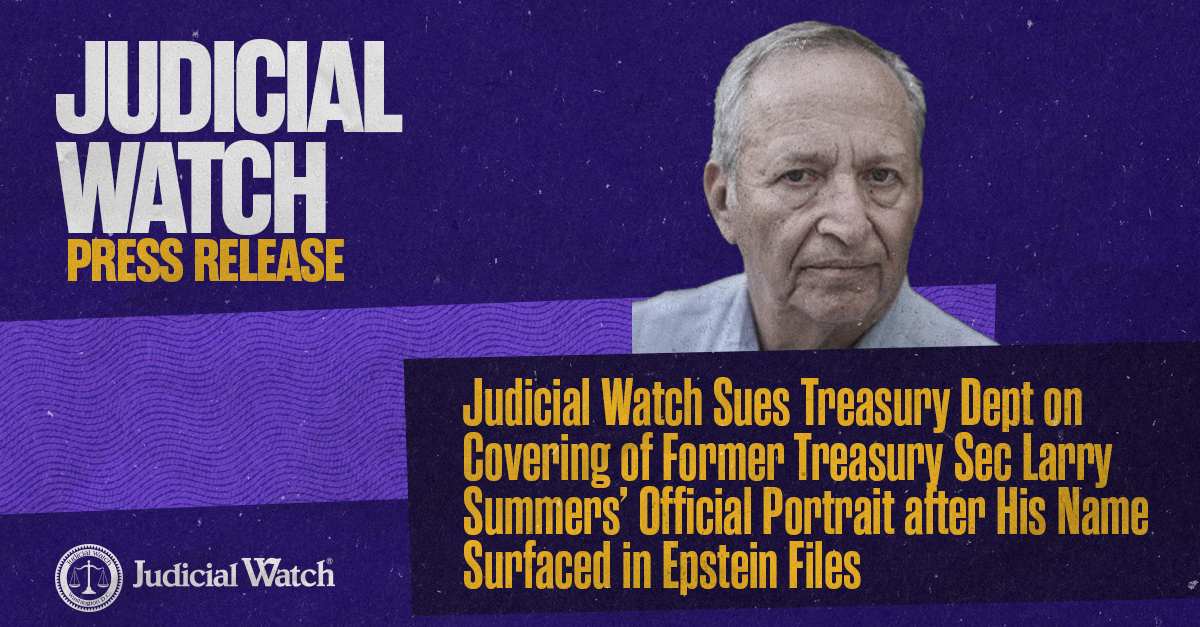
A prominent government watchdog organization, Judicial Watch, has initiated legal action against the U.S. Department of the Treasury, filing a Freedom of Information Act (FOIA) lawsuit to compel the release of documents concerning the alleged covering of former Treasury Secretary Lawrence Summers’ official portrait. This legal challenge, announced recently by Judicial Watch, stems from reports indicating that the portrait, located within the Main Treasury Building in Washington, D.C., was obscured following the emergence of Summers’ name in records associated with convicted sex offender Jeffrey Epstein. The lawsuit was lodged in the U.S. District Court for the District of Columbia after the Treasury Department reportedly failed to respond to a FOIA request submitted by Judicial Watch on January 8, 2026, which sought comprehensive records and communications related to the incident. According to Judicial Watch, the decision to pursue legal recourse was prompted by information received from an internal Treasury source, who apprised a Judicial Watch lawyer about the unusual covering of the portrait, raising questions about transparency and accountability surrounding the matter.
The controversy surrounding Lawrence Summers' portrait is deeply intertwined with the broader and highly sensitive Jeffrey Epstein scandal. Reports indicate that Summers' name surfaced in a trove of Epstein-related documents released in November 2025 by the House Oversight Committee, drawing public scrutiny to his past associations. Among these disclosures were email exchanges between Summers and Epstein, where Epstein notably referred to himself as Summers' 'wing man.' In the wake of these revelations, Summers issued a public statement in November 2025, expressing profound regret. He reportedly stated, "I am deeply ashamed of my actions and recognize the pain they have caused.… I will be stepping back from public commitments as one part of my broader effort to rebuild trust and repair relationships with the people closest to me." Summers, a distinguished economist, served as Treasury Secretary under President Bill Clinton from July 2, 1999, until January 20, 2001, making the alleged covering of his official likeness a significant event given his historical role and the nature of the allegations now connected to him.
The lawsuit, formally titled *Judicial Watch v. U.S. Department of Treasury* (No.1:26-cv-00446), specifically targets "All records, including communications, about the covering up of former Treasury Secretary Lawrence H. Summers’ portrait in the U.S. Treasury Building in Washington, D.C." This broad request aims to uncover the motivations and directives behind the decision to obscure the portrait, which, according to Judicial Watch, occurred soon after Summers' name became publicly linked to the Epstein files. Tom Fitton, the President of Judicial Watch, underscored the organization's stance on the matter, asserting that "Covering Larry Summers’ portrait won’t make the Epstein scandal disappear." He further emphasized the need for openness, stating, "Covering the portrait raises obvious questions. Transparency—not cover-ups—is the proper response." This legal action aligns with Judicial Watch's ongoing efforts to investigate various aspects of the Epstein case, a pursuit they have actively engaged in since November 2025, seeking to bring additional details to light.
This legal challenge by Judicial Watch highlights critical questions regarding government transparency and the handling of sensitive information, particularly when it involves high-ranking former officials. The alleged decision to cover a former Treasury Secretary's portrait, reportedly in response to his connection to a notorious criminal case, raises concerns about accountability and the public's right to access information about governmental actions. Expert observers suggest that such an act, if confirmed, could be perceived as an attempt to distance the institution from a controversial figure rather than addressing the underlying issues through open communication. The lawsuit underscores the vital role of watchdog organizations in holding government agencies accountable, especially when official responses to FOIA requests are deemed inadequate. The ongoing public fascination and demand for clarity surrounding the Epstein scandal mean that any perceived lack of transparency, particularly concerning individuals in positions of power, is likely to draw significant scrutiny and fuel calls for full disclosure.
In summary, Judicial Watch's lawsuit against the Treasury Department represents a concerted effort to shed light on a peculiar incident involving the portrait of former Secretary Lawrence Summers, an event reportedly triggered by his association with the Jeffrey Epstein files. The core of the legal battle revolves around the principle of government transparency, with Judicial Watch seeking to compel the release of records that could explain why the portrait was allegedly covered. As this case proceeds through the U.S. District Court, all eyes will be on the Treasury Department's response and whether it will yield to the demand for greater openness. The outcome could set a precedent for how government institutions manage the public display of figures embroiled in controversy, while also reinforcing the importance of a robust Freedom of Information Act process in ensuring public accountability for actions taken by federal agencies.