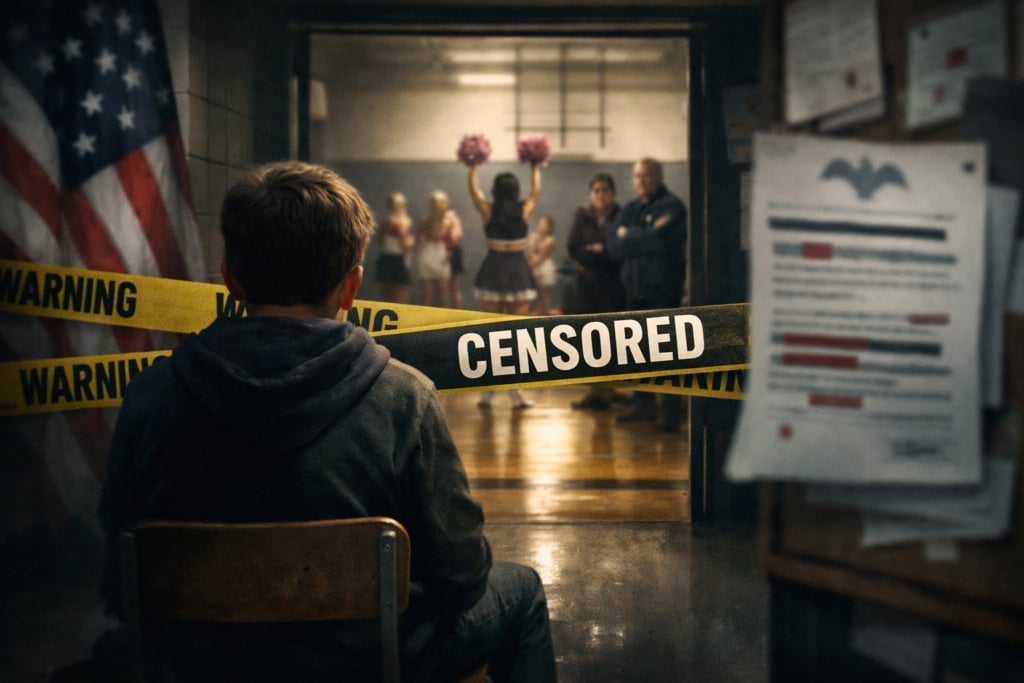
An eighth-grade student attending Nokomis Valley Middle School in Maine has reportedly faced a three-day suspension following a private conversation where he discussed an ongoing federal investigation into his school district. The disciplinary action stems from comments made by the student regarding a federal Title IX inquiry, which focuses on the school's policy allowing a trans-identified boy to participate on the girls' cheerleading team. According to initial reports, the incident, which occurred on February 13, saw the student overheard by another individual while engaging in a discussion with a peer. This situation has brought to light questions surrounding student speech rights within educational environments, particularly when sensitive and politically charged topics are involved. The federal probe itself represents a significant development for the school district, and the subsequent suspension of a student for merely referencing it has drawn considerable attention to the broader implications for free expression among young people in schools.
The federal investigation at the heart of this controversy is a Title IX case, a statute designed to prohibit sex-based discrimination in any education program or activity receiving federal financial assistance. In this specific instance, the inquiry targets the school district's decision to permit a student who identifies as transgender to join the girls' cheerleading squad. Such investigations are initiated when a complaint is filed, prompting federal authorities to examine whether the school's practices align with Title IX regulations concerning equal opportunity and non-discrimination. The issue of transgender athletes participating in sports categories aligning with their gender identity, rather than their sex assigned at birth, has become a contentious national debate, with varying interpretations of Title IX's application. The Maine Wire was the first to bring this particular incident, including both the federal probe and the student's suspension, to public attention, highlighting the local manifestation of this wider societal discussion.
Details surrounding the suspension indicate the incident took place on February 13, as students were gathering near the gymnasium for a 'Rock, Paper, Scissors' competition. During this time, the eighth-grade boy was reportedly engaged in a private dialogue with another student when his comments were overheard. The specific statement, as paraphrased in initial accounts, was along the lines of expressing sadness that the school district was under federal investigation because someone could 'decide their gender.' Crucially, school documentation reviewed by sources confirms that this remark was made during a private exchange between two students, not in a public forum or as a direct address to a wider group. Despite the private nature of the conversation, the school proceeded with a three-day suspension for the student, underscoring the institution's response to discussions around the sensitive topic of gender identity and the ongoing federal inquiry.
This incident at Nokomis Valley Middle School raises important questions regarding the scope of student speech rights within public educational settings, particularly when those discussions touch upon contentious social issues and ongoing administrative matters. While schools maintain a legitimate interest in fostering inclusive environments and preventing harassment, disciplinary actions for private conversations can spark debate about potential chilling effects on open dialogue among students. Legal precedents often balance student expression with the need to maintain order and protect other students, but the context of a private, overheard comment about a factual federal investigation presents a nuanced challenge. Experts suggest that such cases often highlight the tension between a school's desire to manage sensitive topics and students' fundamental rights to express opinions, even if those opinions are perceived as controversial by some. The broader implications extend to how educational institutions navigate the complex landscape of gender identity, federal mandates, and the protection of individual liberties.
The suspension of the eighth-grade student at Nokomis Valley Middle School for discussing a federal Title IX investigation underscores the intricate challenges facing educational institutions today. As the federal probe into the cheerleading team's composition continues, the school district will likely face ongoing scrutiny regarding its policies and their implementation. This incident serves as a poignant reminder of the delicate balance schools must strike between maintaining an inclusive and respectful learning environment and upholding students' rights to engage in private discourse, even on sensitive subjects. Moving forward, observers will be watching for any further developments in the Title IX investigation, potential appeals of the student's suspension, and how this situation might influence future school policies concerning student speech and gender identity issues. The case highlights the need for clear guidelines that protect both student expression and the well-being of all members of the school community.