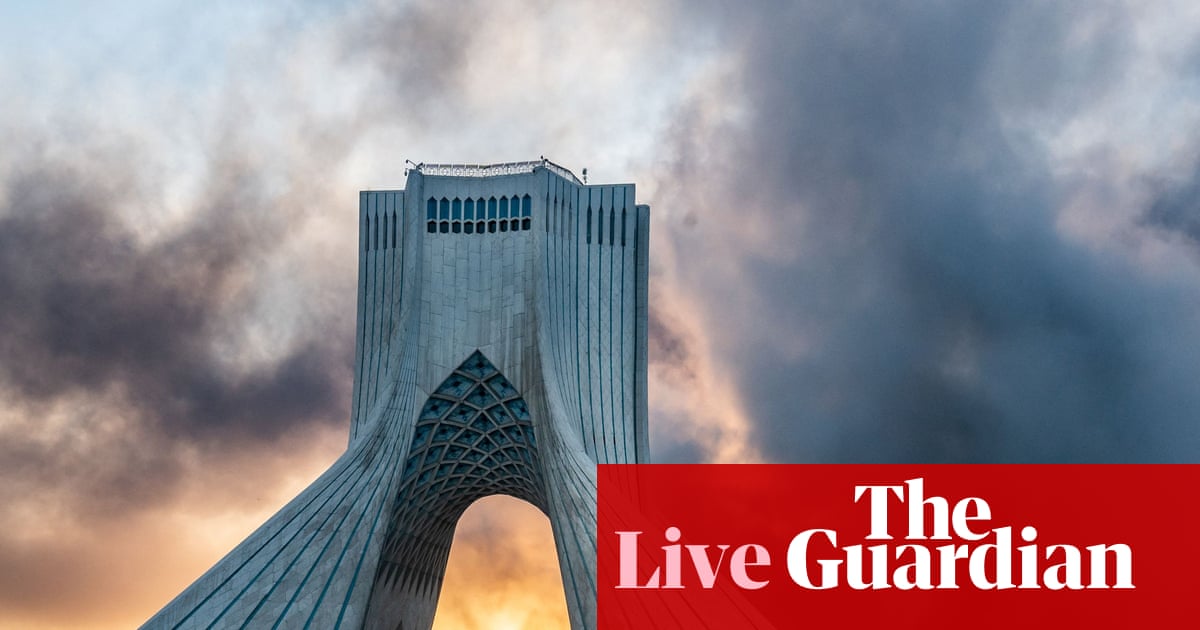
A significant escalation in Middle East tensions unfolded this morning as Israeli forces reportedly initiated a "broad wave of strikes" targeting governmental installations across Tehran, including the presidential office. This intense bombardment marks the fourth consecutive night of explosions rocking Iranian cities, with a substantial blast specifically noted in the northeastern sector of the capital. Simultaneously, the conflict's reach extended to Lebanon, where Israeli strikes continued in Dahiyeh, a southern Beirut suburb recognized as a stronghold for the militant group Hezbollah. In a swift response, Iran’s Islamic Revolutionary Guard Corps (IRGC) asserted that it had launched approximately 40 missiles aimed at both American and Israeli positions, underscoring the reciprocal nature of the current hostilities. These developments occur as Iran prepares for the funeral ceremonies of its recently deceased Supreme Leader, Ayatollah Ali Khamenei, whose passing on Saturday, reportedly due to US-Israeli strikes, has plunged the nation into a critical period of leadership transition.
The current wave of aggression follows the death of Supreme Leader Ayatollah Ali Khamenei, who, according to state media, was killed in US-Israeli strikes on Saturday, an event that has profoundly reshaped the geopolitical landscape of the region. His demise has triggered an urgent succession process within Iran, with reports from the New York Times, citing Iranian officials, indicating that Mojtaba Khamenei, 56, the late leader's son, has emerged as the principal candidate to assume the powerful role of Iran's supreme leader. This potential leadership change is unfolding under immense pressure, exacerbated by a stark warning from Israeli Defense Minister Israel Katz, who publicly stated that his military forces would target any Iranian leader designated as Khamenei's successor. This declaration highlights the extreme volatility of the situation and suggests a potential for even greater direct confrontation, as both nations navigate a period of heightened military action and political uncertainty following the significant loss of Iran's long-standing spiritual and political head.
Specific details of the ongoing conflict paint a grim picture of widespread disruption and escalating military engagement. This morning, residents in northeastern Tehran reported hearing a loud explosion, adding to the series of blasts that have reverberated across Iranian urban centers for four consecutive nights. The Iranian Islamic Revolutionary Guard Corps (IRGC) confirmed its direct involvement in retaliatory actions, claiming responsibility for firing approximately 40 missiles towards what it identified as American and Israeli targets, a clear indication of Iran's resolve to respond to perceived aggressions. Concurrently, Israeli military operations extended beyond Iranian borders, with continued bombardment reported in Lebanon, specifically targeting the southern Beirut suburb of Dahiyeh, an area widely regarded as a key support base for Hezbollah. Amidst these hostilities, Iran is preparing for a three-day commemoration ceremony for Ayatollah Ali Khamenei, scheduled to commence tonight at 10 pm local time (6:30 pm GMT) at the prayer hall of the Grand Mosalla of Tehran, where supporters are expected to gather to mourn their late leader.
The escalating conflict has sent immediate and severe repercussions across global financial markets and energy sectors, signaling broader implications for international stability. Global oil and gas prices have experienced a significant spike, directly attributable to the war's impact on energy exports from the Middle East. Iran's actions, including attacks on shipping vessels and critical energy infrastructure, have led to the closure of navigation routes in the Gulf and forced production stoppages from major energy producers like Qatar and Iraq. This disruption has created considerable turbulence on global markets; in Tokyo, the Nikkei 225 index continued its downward trend on Wednesday, recording a decline of approximately 3.9% during early trading. Similarly, in Seoul, the Kospi index, which had already fallen by 7.2% on Tuesday, saw a further sharp drop of 8.1% before trading was suspended on Wednesday. While Wall Street appeared poised for only a marginal decline in New York, according to pre-market trading data, the overall sentiment remains one of deep concern. In response to the threats to maritime trade, President Donald Trump indicated on Tuesday that the US Navy might begin escorting oil tankers through the strategically vital Strait of Hormuz if deemed necessary, marking one of the administration's more assertive stances in the crisis.
In summary, the Middle East is currently gripped by an intense and rapidly escalating conflict, marked by Israel's extensive strikes on Iranian government targets and Iran's swift retaliatory missile launches. The death of Supreme Leader Ayatollah Ali Khamenei has introduced a critical leadership vacuum in Iran, with his son Mojtaba emerging as a frontrunner, a transition complicated by explicit threats from Israeli defense officials. Beyond the immediate military confrontations in Iran and Lebanon, the conflict's economic fallout is already reverberating globally, causing significant volatility in energy markets and stock exchanges worldwide. As Iran proceeds with Khamenei's funeral and the succession process unfolds, international observers will be closely monitoring further military actions, the stability of global energy supplies, and any potential direct intervention by the United States in the Strait of Hormuz, all of which could dramatically reshape the regional and global geopolitical landscape in the coming days.