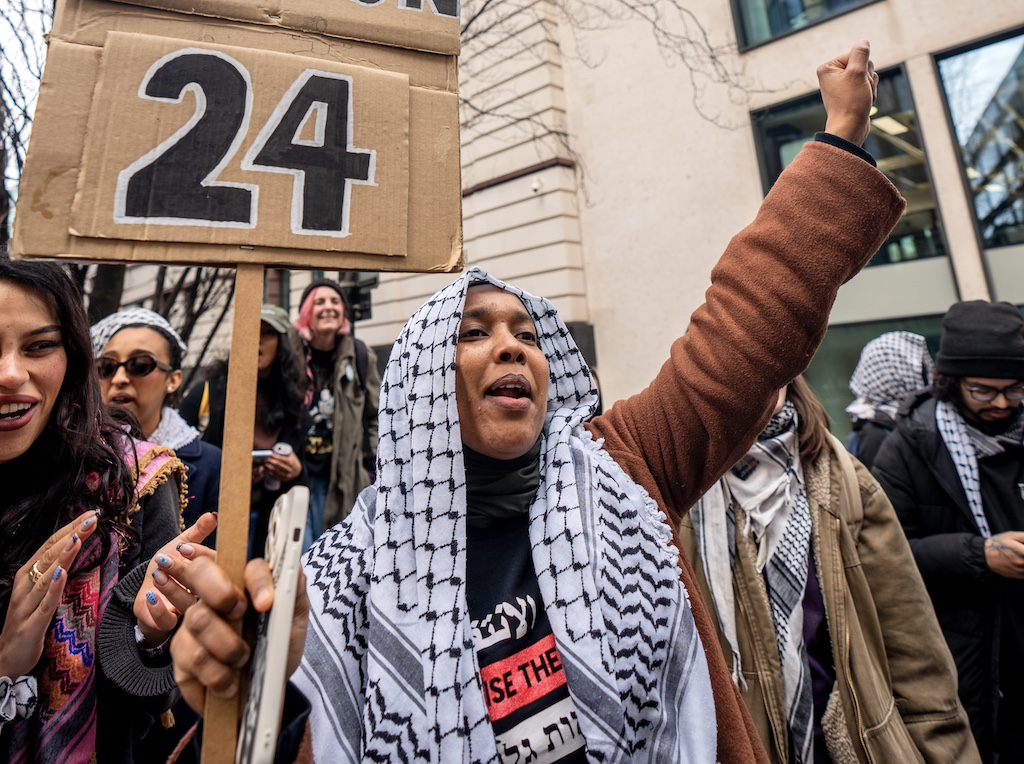
A series of significant legal developments in Britain during February led to the exoneration of numerous activists associated with the direct-action group Palestine Action. These judicial decisions resulted in the release of most individuals who had been incarcerated following their involvement in protests against an Israeli arms manufacturer. Despite these court outcomes, official government statements, according to reports, continue to characterize Palestine Action as a "terrorist operation," a stance critics interpret as an effort to suppress political dissent. A notable instance occurred on February 4 at London’s Woolwich Crown Court, where Lottie Head was declared not guilty of aggravated burglary, prompting an emotional reaction. Head was among an initial group of six defendants, part of a larger cohort of twenty-four activists, collectively known as the "Filton 24," who faced charges stemming from their activities at an Elbit Systems facility near Bristol, which led to their arrests and subsequent detention for eighteen months.
The legal proceedings centered on actions undertaken by Palestine Action at a factory operated by Elbit Systems in Filton, situated near Bristol. Elbit Systems, an Israeli defense electronics company, has frequently been the target of Palestine Action's direct-action campaigns, which aim to disrupt its operations in the UK. The specific incident leading to these charges involved a group of activists, later identified as the "Filton 24," who were indicted on serious charges including aggravated burglary and violent disorder. These individuals had been held in various prisons across the country for approximately eighteen months prior to their trials. The extensive period of pre-trial detention underscores the gravity with which authorities initially viewed these alleged offenses. The activists' actions are part of a broader strategy by Palestine Action to protest the arms trade and its perceived role in international conflicts. The significance of this particular trial lies in its potential to set precedents for how protest and direct action are legally handled in Britain, especially when targeting companies involved in defense manufacturing.
The comprehensive ten-week trial, which concluded in late February, saw significant legal victories for the defendants. All individuals facing charges of aggravated burglary were acquitted by the jury. Furthermore, three of the defendants were found not guilty of violent disorder, indicating a clear rejection of some of the more serious accusations leveled against them. For the remaining charges, the juries either reported being hung, unable to reach a unanimous verdict, or, according to reports, outright refused to convict. This outcome effectively cleared the activists of many of the initial allegations. Following these rulings, twenty-three of the "Filton 24" were granted bail and subsequently released from detention, ending their eighteen-month incarceration. However, the legal challenges may not be entirely over, as sources indicate there remains a possibility of retrials for some of the unresolved charges, suggesting continued legal scrutiny from the authorities.
The stark contrast between the judicial exonerations and the government's persistent classification of Palestine Action as a "terrorist operation" raises critical questions about state power and the right to protest in Britain. Analysts suggest that the government's continued use of such severe terminology, despite court findings, could be interpreted as an attempt to delegitimize the group's activities and deter future acts of direct action. This approach, according to some observers, risks undermining public trust in the justice system by appearing to disregard its independent rulings. The legal outcomes for the "Filton 24" could embolden other activist groups, demonstrating that direct action, while carrying risks, can sometimes withstand stringent legal challenges. Conversely, the threat of retrials indicates that authorities may not be abandoning their efforts to prosecute activists, signaling an ongoing struggle between civil liberties and state security narratives. This situation highlights a broader societal debate regarding the boundaries of legitimate protest, particularly when it targets industries linked to controversial international conflicts.
In summary, the recent series of court decisions in Britain represents a significant moment for Palestine Action, resulting in the acquittal and release of most of its activists who faced serious charges related to protests at an Elbit Systems facility. These judicial outcomes directly challenge the narrative put forth by the government, which continues to label the group as a "terrorist operation." The divergence between the courts' findings and the executive's rhetoric sets a complex precedent for the future of direct action and the state's response to dissent. Moving forward, observers will be closely watching for any developments regarding potential retrials for the remaining charges. The ongoing dynamic between activist groups, the judiciary, and government policy will undoubtedly continue to shape the landscape of protest and civil liberties in the United Kingdom.