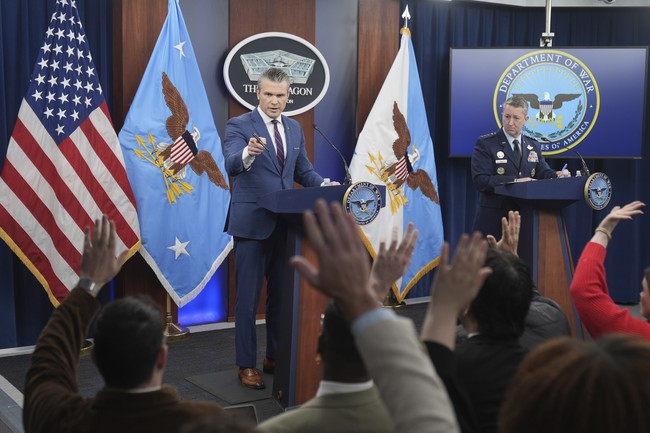
Secretary of War Pete Hegseth, alongside Chairman of the Joint Chiefs of Staff Dan Caine, recently delivered a comprehensive update on Operation Epic Fury, a significant joint military endeavor undertaken by the United States and Israel against Iran. During his address, Secretary Hegseth conveyed a dual message, emphasizing both the early, yet purportedly decisive, successes of the campaign while simultaneously tempering expectations. He explicitly stated, "This is not a 'Mission Accomplished' situation. This is simply a reality check," a direct caution against premature declarations of total victory. Despite this caveat, officials presented a narrative of overwhelming progress, asserting that America is achieving victory "decisively, devastatingly, and without mercy" in the ongoing conflict. The operation, which commenced just four days prior on a Saturday morning, is still in its nascent stages, with metrics continually evolving and additional forces being deployed, according to the War Department's briefing. This initial assessment underscores the Trump administration's strategic focus and the underlying rationale guiding this concerted effort to neutralize Iranian capabilities.
Operation Epic Fury represents a critical escalation in the Trump administration's foreign policy stance towards Iran, framed as a direct campaign to dismantle and defeat the nation's military infrastructure and leadership. According to official statements, the operation was unleashed under the direct command of President Trump, highlighting a top-down strategic imperative. The collaboration with the Israeli Defense Forces is presented as a cornerstone of the campaign's effectiveness, with officials describing the combined might of the two nations' militaries as generating "sheer destruction" for what they termed "radical Islamist Iranian adversaries." This joint approach is portrayed as unique and indispensable, with the United States leading the charge, buttressed by Israel's formidable military capabilities. The swift initiation of the operation, just four days prior to the update, suggests a rapid response strategy aimed at achieving immediate and impactful results, setting the stage for what the administration describes as a historic undertaking.
A central claim emerging from the recent briefing is the assertion of impending and complete airspace dominance over Iran by the combined US and Israeli air forces. Officials indicated that this critical objective, which began the previous night, is expected to be fully realized within a few days, certainly "in under a week." This achievement of "uncontested airspace" is described as a pivotal development, granting the coalition the ability to operate continuously, day and night, across Iranian skies. The strategic implications of such control are profound, enabling forces to relentlessly "find, fix, and finish" Iranian missile systems, defense industrial bases, and, crucially, their military and political leaders. Reports indicate that this operational freedom will extend to flying over key strategic locations, including Tehran, allowing for comprehensive surveillance and targeting capabilities. Despite these significant claims of progress, Secretary Hegseth reiterated the early phase of the operation, emphasizing that forces have "only just begun" the process of hunting, dismantling, demoralizing, and ultimately defeating Iran's military capabilities.
The administration's messaging surrounding Operation Epic Fury presents a complex strategic narrative, balancing triumphalist claims of decisive victory with a pragmatic call for patience. While officials assert that America is winning "decisively, devastatingly, and without mercy," the simultaneous caution from Secretary Hegseth that this is "not a 'Mission Accomplished' situation" suggests a deliberate attempt to manage public expectations and underscore the long-term commitment required. This approach implies that while initial military objectives, such as achieving air superiority, may be rapidly met, the broader goal of defeating Iran's capabilities and leadership is a more protracted endeavor. The emphasis on the combined strength of the US and Israeli forces highlights a strategic alliance designed to project overwhelming power, signaling a robust and unified front against perceived threats. The administration's confidence in achieving "uncontested airspace" within days suggests a belief in the rapid degradation of Iran's air defense systems, which, if true, would significantly alter the operational landscape and provide a substantial advantage for future military actions.
In summary, the update on Operation Epic Fury paints a picture of a rapidly unfolding military campaign characterized by strong claims of early success and strategic dominance. While Secretary Hegseth tempered expectations with a "reality check," the overarching message from the War Department is one of decisive progress, particularly concerning the imminent establishment of complete airspace control over Iran. The joint US-Israeli effort is portrayed as a formidable force, poised to systematically dismantle Iranian military assets and leadership. As the operation progresses beyond its initial four days, the world will be watching for further developments regarding the full establishment of air superiority and the subsequent impact on Iran's defense capabilities and command structure. The administration's commitment to taking "all the time we need to make sure that we succeed" indicates a sustained, long-term approach to achieving its stated objectives in the region.