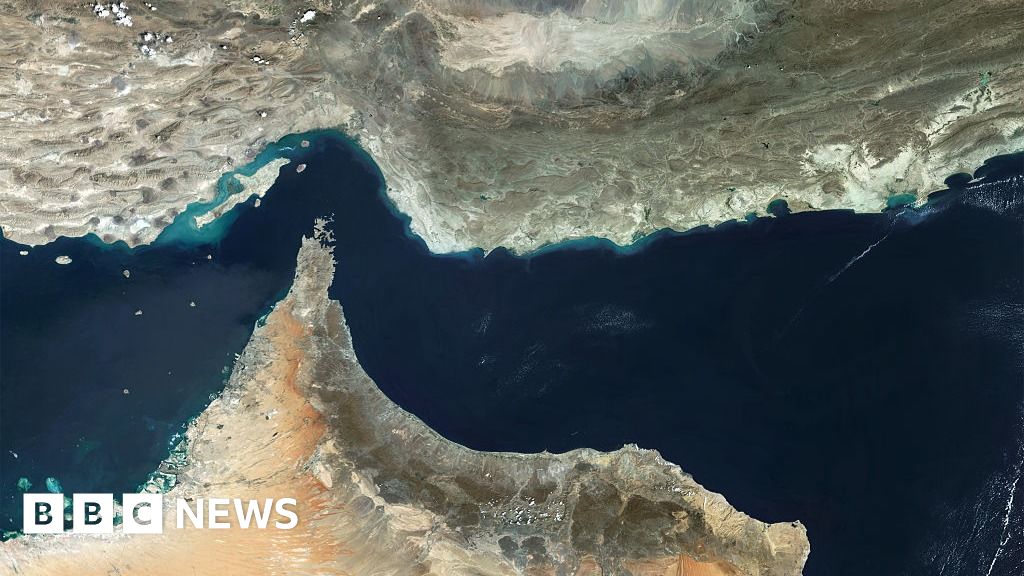
Recent escalations have seen Iran issue stark warnings regarding the Strait of Hormuz, a pivotal global waterway for energy transit. Tehran has reportedly threatened to impede all maritime traffic through the narrow channel, with a senior military official, General Sardar Jabbari, stating that Iran would "not let a single drop of oil leave the region" and would "set fire" to any vessels attempting passage. These pronouncements come amidst heightened regional tensions, reportedly in response to recent strikes attributed to the United States and Israel. The Strait of Hormuz is an indispensable artery for international trade, typically facilitating the movement of approximately 20% of the world's total oil and gas supply. The mere uncertainty stemming from these threats has already contributed to an uptick in global oil prices, signaling the potential for widespread economic disruption should Iran act on its warnings.
The Strait of Hormuz holds unparalleled strategic importance as the world's most vital oil transit choke point. Geographically, it forms a crucial link between the Persian Gulf and the Arabian Sea, bordered by Iran to the north and Oman and the United Arab Emirates (UAE) to the south. Its physical dimensions underscore its vulnerability: at its entrance and exit, the corridor measures about 50 kilometers (31 miles) wide, narrowing to approximately 33 kilometers (20.5 miles) at its most constricted point. Despite its narrowness, the strait is sufficiently deep to accommodate the largest crude oil tankers, making it indispensable for major oil and gas producers across the Middle East, including Iraq, Kuwait, Qatar, Saudi Arabia, the UAE, and Iran itself, to reach their international customers. According to estimates from the US Energy Information Administration (EIA), in 2025, an estimated 20 million barrels of oil traversed the Strait of Hormuz daily, representing an annual energy trade value approaching $600 billion.
The potential closure of this critical maritime passage carries profound implications for the global economy. Analysts have consistently warned that any prolonged disruption or threat to shipping in the Strait of Hormuz would inevitably lead to a substantial increase in crude oil prices, alongside a significant rise in the cost of maritime shipping itself. Such an escalation would translate into higher prices for goods and services across the globe, fueling inflationary pressures worldwide. Major economies heavily reliant on crude oil imports passing through this waterway, most notably China, India, and Japan, would face particularly severe economic repercussions. Reports indicate that around 3,000 ships navigate the strait each month, underscoring the sheer volume of trade at risk. The existing uncertainty, driven by Iran's recent rhetoric and regional instability, has already contributed to market volatility, with a full closure threatening to trigger an unprecedented energy crisis.
Expert perspectives suggest that the ramifications of a full or even partial closure of the Strait of Hormuz would extend far beyond immediate energy price hikes. Such an event would fundamentally disrupt global supply chains, impacting industries reliant on oil-derived products and transportation. The economic shockwaves could precipitate a global recession, as major importing nations struggle to secure alternative energy sources or absorb the dramatically increased costs. Analysts have also posited that even persistent threats, without an actual physical closure, can create a 'de facto' closure by making the route prohibitively risky and expensive for insurers and shipping companies, effectively deterring traffic and driving up costs. This scenario highlights the delicate balance of geopolitical stability and its direct correlation with global economic health, emphasizing the strategic vulnerability inherent in relying on such a narrow and contested waterway for a significant portion of the world's energy needs.
In summary, Iran's recent threats to close the Strait of Hormuz represent a critical flashpoint with potentially catastrophic global economic consequences. The waterway's irreplaceable role in facilitating approximately 20% of the world's oil and gas trade means that any disruption, whether physical or perceived, could trigger unprecedented energy price surges, widespread inflation, and severe economic strain on major importing nations. The situation underscores the urgent need for de-escalation in regional tensions and robust international diplomatic efforts. As the world watches for further developments, the stability of this vital maritime corridor remains a paramount concern for global energy security and economic prosperity.