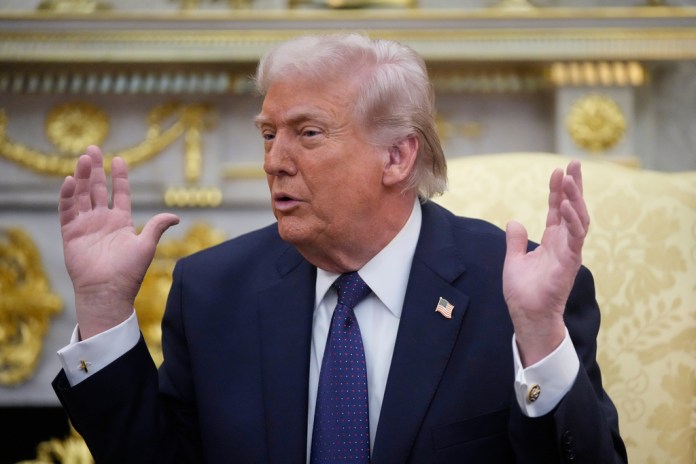
Former President Donald Trump has significantly expanded his legislative agenda, publicly outlining new demands for the proposed SAVE America Act, a piece of legislation primarily designed to enhance election integrity across the nation. In a statement disseminated via his Truth Social platform on Thursday, Mr. Trump articulated two distinct and previously unmentioned provisions he wishes to see incorporated into the act. These include a nationwide prohibition on individuals identified as male participating in women's sports and a comprehensive ban on gender-affirming surgical procedures for minors, according to his post. These newly introduced social policy elements represent a notable expansion from his earlier public pronouncements concerning the bill's scope. The SAVE America Act itself, spearheaded by prominent Republican lawmakers such as Representative Chip Roy of Texas and Senator Mike Lee of Utah, is fundamentally structured to fortify electoral processes, primarily through measures aimed at voter identification and citizenship verification. This recent development underscores a strategic move by the former president to weave broader cultural issues into his established platform of electoral reform.
The SAVE America Act, in its current form and as advocated by its congressional sponsors, already encompasses a series of stringent measures designed to fortify national voting standards. According to legislative outlines, the proposed bill would necessitate proof of citizenship and the presentation of voter identification for all individuals seeking to register to vote. Former President Trump's recent Truth Social communication explicitly reaffirmed his endorsement of these foundational electoral integrity points. Furthermore, his post introduced an additional voting-related requirement: a broad prohibition on mail-in ballots, allowing exceptions only for specific circumstances such as documented illness or disability, active military service, or travel during the election period. However, it is noteworthy that the existing draft of the SAVE America Act does not presently incorporate a ban on mail-in voting, a strategic omission reportedly made to avoid potentially alienating segments of the Republican voter base, as legislative observers suggest. This legislation represents an updated iteration of the earlier SAVE Act, which, despite twice passing the House of Representatives, has consistently encountered legislative roadblocks in the Senate.
A significant divergence can be observed between the comprehensive list of demands articulated by the former president and the precise provisions contained within the current draft of the SAVE America Act. Notably, while Mr. Trump's recent social media communication did not explicitly reference it, the existing legislative text also mandates that states actively engage in processes to purge non-citizens from their current voter registration databases, a key element consistent with the bill's overarching objective of safeguarding election integrity. The legislative path for such extensive electoral reform, particularly when coupled with new social policy demands, has historically been fraught with difficulty. The prior version, the SAVE Act, encountered substantial impediments in the Senate, primarily due to the chamber's procedural requirement of a 60-vote supermajority to overcome a filibuster before a final vote can occur. Given the present Senate composition of 53 Republicans, securing passage for this measure would necessitate garnering support from a minimum of seven Democratic senators, a formidable challenge for legislation perceived as highly partisan, as political observers frequently point out. This inherent need for bipartisan cooperation underscores the considerable political obstacles confronting the SAVE America Act, especially as its scope broadens to encompass increasingly divisive social issues.
The strategic decision to integrate highly contentious social issues, specifically the prohibition of male participation in women's sports and a ban on gender-affirming surgical procedures for minors, into a bill primarily focused on election integrity signifies a notable political maneuver. Political analysts suggest that this expansion of the SAVE America Act's scope could serve several objectives for the former president. Primarily, it allows him to galvanize his core conservative base by championing causes that resonate deeply with their values, potentially solidifying support in anticipation of future political campaigns. Conversely, this broadening of the bill's focus also introduces substantial new complexities to its legislative journey. The inclusion of these polarizing provisions is likely to render the already arduous task of securing bipartisan support in the Senate even more challenging, particularly given the existing struggle to overcome the filibuster threshold. Detractors of the move might contend that these additions dilute the original, stated purpose of election integrity, effectively transforming the legislation into a broader cultural battleground rather than a focused reform initiative. This expansion of demands clearly indicates an intention to utilize legislative frameworks as conduits for a wider spectrum of policy objectives, potentially reshaping the public understanding of what "election integrity" truly encompasses.
In conclusion, former President Trump's recent public statements concerning the SAVE America Act signal a substantial broadening of its intended legislative scope, extending beyond its initial focus on election integrity to incorporate deeply divisive social policy issues. The integration of proposed prohibitions on male participation in women's sports and gender-affirming surgical procedures for minors, alongside established demands for stringent voter identification and citizenship verification, charts a new course for the legislation. While these newly added provisions may serve to invigorate a specific segment of his political base, they concurrently introduce heightened political complexities, rendering the bill's successful navigation through a politically divided Congress, especially the Senate, an even more formidable challenge. Political observers will undoubtedly be watching closely to discern how these expanded demands influence the bill's reception among lawmakers and whether they prompt any strategic adjustments from its congressional sponsors. The ultimate fate of the SAVE America Act, now a complex amalgamation of electoral reform and cultural policy, remains highly ambiguous.