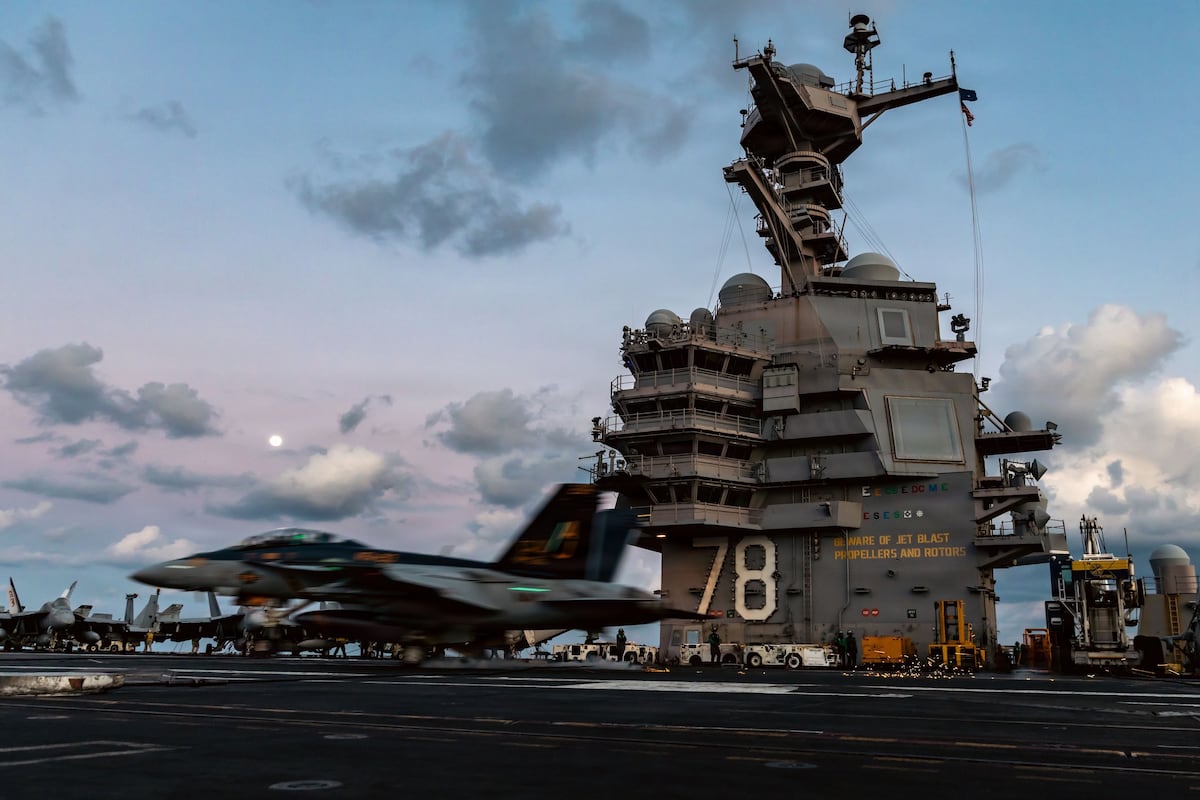
The United States has inflicted substantial damage on Iran's naval fleet and its drone operational capacity, including the recent destruction of an Iranian drone carrier, according to a high-ranking U.S. military official. Admiral Brad Cooper, who commands U.S. Central Command (CENTCOM), stated on Thursday that Iran's maritime forces have been significantly diminished and its unmanned aerial vehicle capabilities severely impacted as joint military actions by the United States and Israel against Iran persist. Speaking from CENTCOM headquarters at MacDill Air Force Base in Tampa, Florida, alongside Defense Secretary Pete Hegseth, Admiral Cooper provided updates on 'Operation Epic Fury,' an offensive campaign that commenced early Saturday morning. He specifically noted that American forces had targeted and destroyed an Iranian drone carrier ship, which he described as comparable in size to a World War II-era aircraft carrier, confirming it was actively ablaze at the time of his remarks. This incident marks a significant escalation in the ongoing regional conflict, highlighting the intensity of the military engagement.
The recent strikes are part of a broader, sustained military campaign aimed at degrading Iran's offensive capabilities. Operation Epic Fury, initiated just days prior, underscores a concerted effort by the United States and Israel to counter Iranian military influence and infrastructure. Admiral Cooper's update elaborated on the extensive damage inflicted, indicating that the U.S. has either sunk or rendered inoperable more than 30 Iranian naval vessels since the operation began. This systematic targeting of Iran's maritime assets, coupled with strikes against its drone infrastructure, suggests a strategic objective to cripple key components of Iran's military projection. The context for these actions stems from long-standing tensions and recent escalations in the region, with the U.S. and its allies asserting a need to respond to perceived threats from Tehran. The ongoing military engagement reflects a determined posture to diminish Iran's capacity to conduct offensive operations and project power across the Middle East, signaling a critical phase in regional security dynamics.
Further details provided by Admiral Cooper revealed the extensive scope and intensity of the American military's recent actions. Over the preceding 72 hours, U.S. bomber aircraft executed nearly 200 strikes deep within Iranian territory, with targets identified even in the vicinity of the capital, Tehran. In a particularly impactful sequence of events, U.S. B-2 stealth bombers reportedly deployed dozens of 2,000-pound penetrative bombs against subterranean ballistic missile launch sites within the last hour of Cooper's briefing. Additionally, American forces targeted what officials described as Iran's 'equivalent of Space Command,' suggesting an effort to disrupt critical command, control, and intelligence infrastructure. Defense Secretary Pete Hegseth emphasized the escalating nature of the U.S. response, stating that the volume of firepower directed over Iran, particularly over Tehran, was poised for a dramatic increase. Hegseth further indicated that future deployments would include additional fighter squadrons, enhanced capabilities, improved defensive measures, and more frequent bomber sorties, underscoring a sustained and intensifying military commitment.
The reported decimation of Iran's navy and the significant damage to its drone capabilities carry profound implications for regional power dynamics and Iran's strategic posture. Experts suggest that the targeting of a drone carrier, described as a substantial vessel, represents a direct blow to Iran's asymmetric warfare capabilities, which heavily rely on unmanned systems for surveillance and attack. The strikes against buried ballistic missile launchers and Iran's 'Space Command' equivalent indicate a concerted effort to neutralize both its conventional long-range strike options and its advanced technological infrastructure, potentially hindering its ability to monitor and project influence. According to Admiral Cooper, these aggressive actions have already led to a considerable slowdown in Iran's military offensive campaign, suggesting an immediate impact on its operational tempo. This strategic degradation could force a re-evaluation of Iran's regional ambitions and its approach to proxy conflicts, while simultaneously signaling a robust commitment from the U.S. and Israel to maintain military superiority and deter further aggression. The long-term effects on regional stability and the potential for a broader conflict remain a critical concern.
In summary, recent statements from U.S. Central Command indicate a significant escalation in military operations against Iran, resulting in substantial damage to its naval forces and drone capabilities. The destruction of a large Iranian drone carrier, along with the reported sinking or disabling of over 30 other vessels, marks a critical blow to Iran's maritime power. Furthermore, extensive aerial bombardments targeting nearly 200 sites, including buried missile launchers and key command centers, underscore the breadth of the ongoing 'Operation Epic Fury.' As U.S. officials signal an impending surge in military firepower, the immediate future will likely see continued vigilance and potential further engagements. Observers will be closely watching for any official response from Tehran and how these developments might reshape the geopolitical landscape of the Middle East.