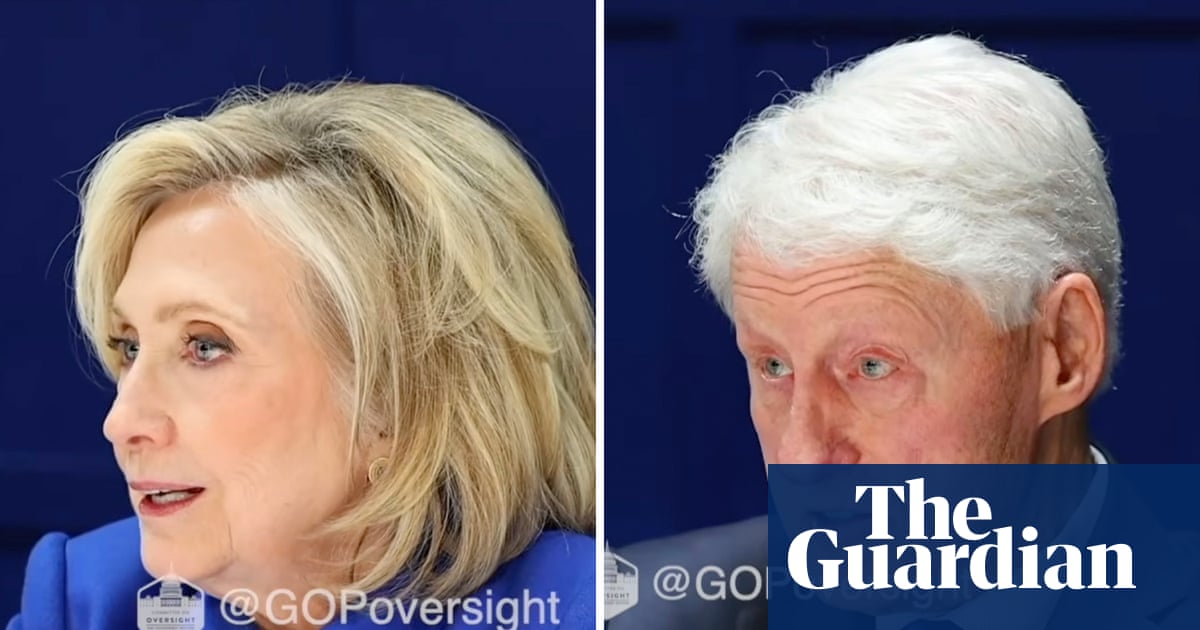
A congressional committee tasked with investigating the late financier and convicted sex offender Jeffrey Epstein publicly released video recordings on Monday featuring testimonies from former U.S. President Bill Clinton and former Secretary of State Hillary Clinton. These depositions, which reportedly spanned several hours over two days last week, capture the Clintons addressing their past connections to Epstein and largely seeking to distance themselves from his illicit activities. According to the released footage, former President Bill Clinton told the committee that his association with Epstein had concluded years before the financier's 2008 guilty plea for soliciting prostitution from an underage girl. Meanwhile, former Secretary of State Hillary Clinton asserted that she had no recollection of ever meeting Epstein. The release of these videos marks a significant development in the ongoing scrutiny of Epstein's extensive network and the high-profile individuals linked to him, offering new insights into how the prominent political figures responded to questioning under oath.
The context surrounding these testimonies is rooted in the long-standing public and congressional interest in Jeffrey Epstein's network of powerful associates, particularly in the wake of his 2008 conviction and subsequent arrest in 2019, which ultimately led to his death while awaiting trial on new sex trafficking charges. Reports indicate that Bill Clinton recounted first encountering Epstein in 2002, when he utilized Epstein's private jet for humanitarian endeavors, and stated that their interactions ceased the following year, in 2003. During his testimony, the former Democratic president maintained that he observed nothing during his time around Epstein that would have led him to suspect the financier was involved in human trafficking. Despite numerous documented visits by Epstein to the White House during Clinton's presidency, including photographs showing them together, Bill Clinton reportedly stated he did not recall these specific interactions. The committee's persistent inquiry into Epstein's connections underscores the enduring public demand for transparency regarding the full scope of his criminal enterprise and the roles, if any, played by his influential acquaintances.
Hillary Clinton's deposition, also among the released videos, presented a different dynamic, as she firmly stated her lack of any memory of meeting Jeffrey Epstein. Furthermore, the former first lady reportedly used her time before the House oversight committee to deliver a sharp rebuke of the Republican members' handling of the investigation. She criticized the committee for holding no public hearings and for denying media access to the proceedings, including her own testimony, despite frequently advocating for transparency. The former Secretary of State also highlighted what she perceived as a lack of effort to summon individuals prominently featured in Epstein's files, noting specifically that not a single Republican member attended the deposition of Les Wexner, a key figure in Epstein's orbit. According to reports, Hillary Clinton characterized these actions as an "institutional failure" designed to shield a particular political party and a specific public official, rather than genuinely pursuing truth and justice for Epstein's victims and survivors. Footage from her testimony also captured a moment where she was informed that Representative Lauren Boebert had shared an unauthorized photograph with a conservative YouTuber named Ben, adding an unexpected turn to the proceedings.
The release of these video testimonies carries significant implications for both the ongoing Epstein investigation and the broader political landscape. The committee's decision to make these recordings public could be seen as an effort to demonstrate progress in their inquiry, while simultaneously fueling partisan debates about the investigation's true motives and effectiveness. Hillary Clinton's pointed criticisms suggest a deep-seated distrust in the committee's impartiality, raising questions about whether the inquiry is genuinely focused on accountability or is being leveraged for political advantage. Experts suggest that such high-profile releases, while providing some level of transparency, often become entangled in political narratives, potentially overshadowing the core objective of seeking justice for victims. The differing accounts and recollections from the Clintons, coupled with the former Secretary of State's direct challenge to the committee's methods, underscore the complex and often contentious nature of investigations involving powerful figures and sensitive allegations, making it difficult for the public to discern a clear, unbiased narrative.
In summary, the public release of Bill and Hillary Clinton's video depositions concerning Jeffrey Epstein marks a pivotal moment in the ongoing investigation into the late financier's network. The testimonies reveal Bill Clinton's assertion that his limited association with Epstein ended years before the latter's criminal conviction, and his denial of any awareness of Epstein's illicit activities. Hillary Clinton, conversely, maintained she never met Epstein and used her deposition to strongly criticize the House committee's investigative practices, accusing them of partisan bias and a lack of transparency. These videos provide a rare glimpse into the sworn statements of prominent political figures grappling with their connections to a notorious criminal. Moving forward, observers will be watching for further actions from the House committee, the potential for additional revelations regarding Epstein's associates, and how these testimonies might influence public perception and the broader political discourse surrounding accountability for those connected to his crimes.