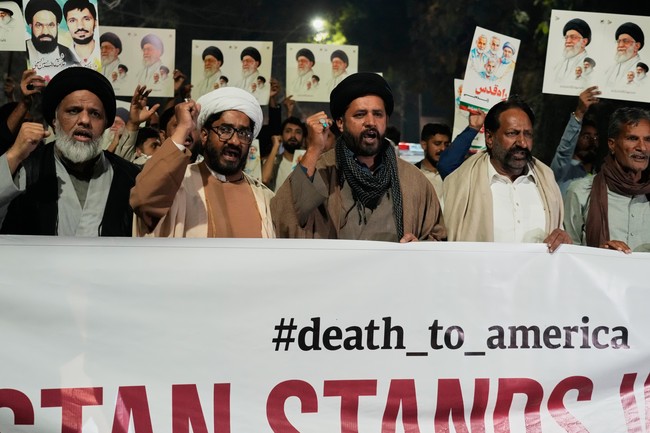
A significant escalation of regional tensions unfolded on March 1, 2026, when hundreds of demonstrators converged upon the American diplomatic mission in Karachi, Pakistan. The protest, reportedly sparked by unconfirmed reports of Iranian leader Ayatollah Ali Khamenei's demise in a joint U.S.-Israeli military action, quickly devolved into violent confrontation. Eyewitness accounts and video footage circulating online depicted the crowd breaching initial security barriers before attempting to penetrate deeper into the consulate compound using improvised tools. The situation escalated dramatically when defensive gunfire erupted from within the perimeter, resulting in a tragic loss of life and numerous injuries. Initial reports from various sources indicated a death toll ranging from at least nine to over a dozen individuals, with scores more sustaining wounds in the chaotic scenes outside the heavily fortified facility. This incident marks a critical flashpoint in the ongoing geopolitical landscape, underscoring the volatile reactions to perceived Western aggression in the Middle East.
The violent demonstration in Karachi did not occur in isolation but against a backdrop of heightened geopolitical friction. Reports indicate that U.S. and Israeli forces have been conducting sustained military operations against targets in Iran, creating an environment ripe for retaliatory actions and widespread public unrest among pro-Iranian factions globally. The alleged killing of Ayatollah Ali Khamenei, Iran's supreme leader, served as a potent catalyst, particularly for Shiite Muslim communities in countries like Pakistan, where he commands significant spiritual and political reverence. His reported death, if confirmed, would represent a monumental shift in regional power dynamics and a severe blow to the Iranian regime, inevitably provoking strong reactions from its allies and sympathizers. This incident echoes historical patterns of anti-American sentiment in the region, often fueled by U.S. foreign policy decisions and military engagements, making diplomatic facilities frequent targets during periods of intense public anger and perceived injustice.
The sequence of events at the U.S. Consulate in Karachi unfolded with alarming speed and intensity. According to various reports and visual evidence, the large crowd, identified by witnesses as predominantly Shiite Muslims, initially gathered to express outrage, chanting slogans critical of both the United States and Israel. Their protest quickly turned aggressive as they successfully breached the consulate's main gate. Demonstrators were then observed utilizing pieces of wood and other implements in an attempt to force their way into the inner sections of the diplomatic compound. As the mob pressed further into the restricted perimeter, security forces stationed at the consulate responded with defensive fire. While it remained unclear whether both Pakistani security personnel and U.S. Marines on site engaged the crowd, or if the response came from a single entity, the outcome was devastating. Casualty figures varied slightly across different accounts, with some reports citing ten fatalities and dozens injured, while others indicated at least nine dead and more than twenty-four wounded. A specific, unverified claim circulating on social media, attributed to a user named '@treeni', alleged that U.S. Marines at the consulate made 'direct head-shots' at the Pakistani protesters, a detail that, if substantiated, could further inflame tensions.
The storming of the U.S. Consulate in Karachi carries profound implications for regional stability and international relations. Such an aggressive act against a diplomatic mission is universally condemned as a severe breach of international law and diplomatic protocols, regardless of the underlying grievances. For Pakistan, the incident raises critical questions about its capacity to protect foreign diplomatic assets and manage internal dissent, potentially straining its complex relationship with the United States. The involvement of both Pakistani security forces and U.S. Marines in the defensive response highlights the immediate threat faced by diplomatic staff and the necessity of robust security measures. Furthermore, this event serves as a stark reminder of the volatile consequences of escalating conflicts in the Middle East, particularly when they involve high-profile figures like Ayatollah Khamenei. Experts suggest that such violent demonstrations could embolden extremist elements, complicate diplomatic efforts to de-escalate tensions with Iran, and potentially lead to further instability across the broader region, impacting trade, security, and humanitarian efforts.
In summary, the violent assault on the U.S. Consulate in Karachi on March 1, 2026, represents a grave incident stemming from deep-seated regional animosities and the immediate trigger of Ayatollah Khamenei's reported death. The tragic loss of life and numerous injuries underscore the perilous environment for diplomatic missions amid ongoing U.S.-Israeli military actions against Iran. As investigations into the precise sequence of events and the identity of those responsible for the defensive fire continue, the international community will be closely watching for responses from both the Pakistani and U.S. governments. The incident is likely to intensify calls for de-escalation in the wider conflict, while simultaneously posing significant challenges to diplomatic relations and regional security. The coming days will reveal the full extent of the fallout and the potential for further unrest in a region already grappling with profound instability.