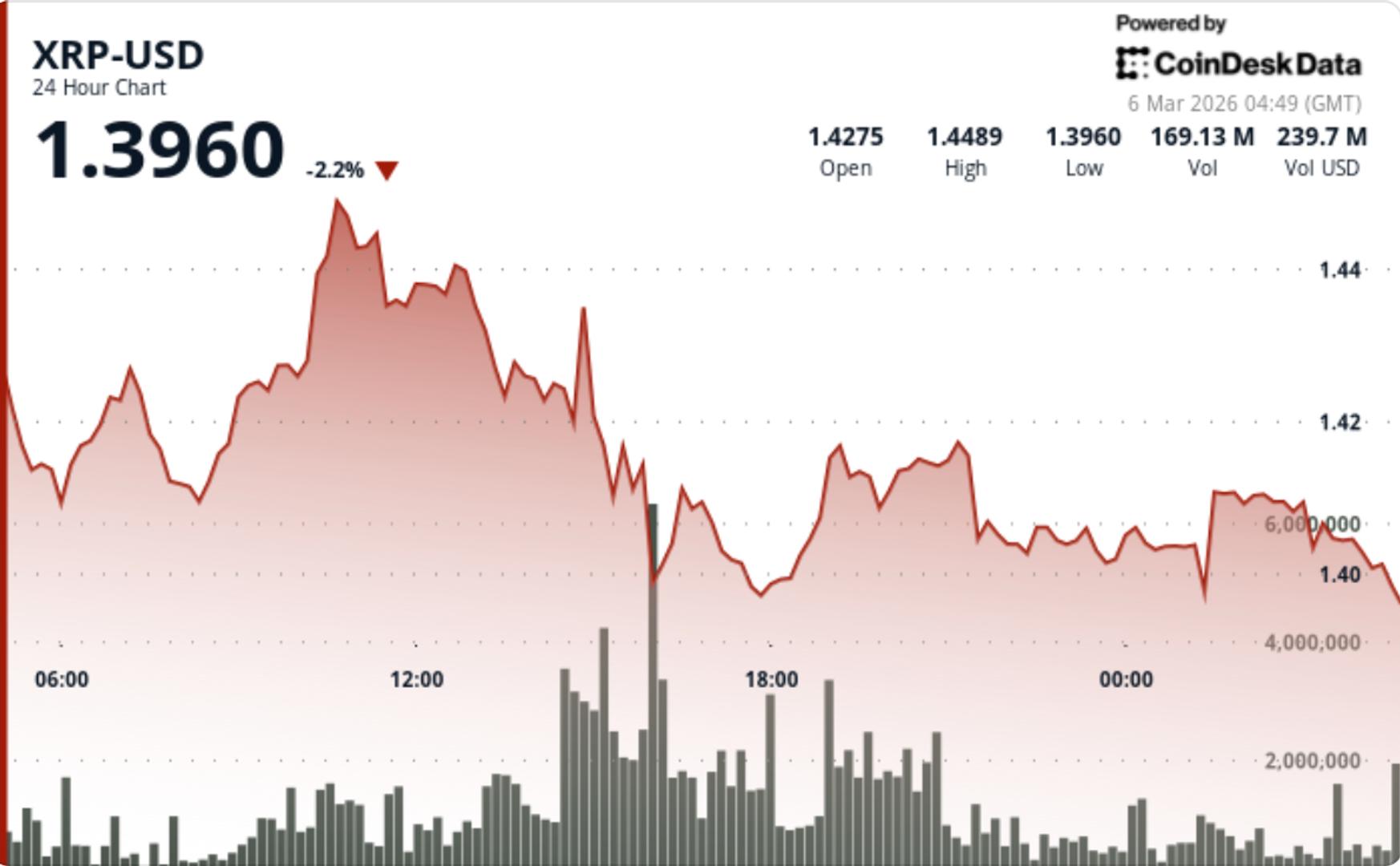
XRP, a prominent digital asset, experienced a notable downturn on March 6, 2026, with its value falling by 3.3 percent to $1.4108. This decline followed yet another unsuccessful attempt to surpass the crucial resistance zone situated between $1.43 and $1.45, according to recent market reports. The late-session dip below the $1.411 mark has further solidified a short-term bearish momentum for the cryptocurrency. During this significant sell-off, trading activity surged dramatically, with volume spiking 74 percent above its average levels. This substantial increase in trading volume during the price drop is a key indicator, underscoring that sellers currently maintain a dominant position in the market, even as certain institutional entities and large-scale investors continue to accumulate XRP positions. Market participants are now closely monitoring the $1.40 support level, which analysts describe as a pivotal point for XRP's immediate future trajectory.
The recent price action for XRP is set against a backdrop of prolonged struggle to regain upward momentum, a trend that has persisted since its peak in July 2025. The digital asset currently trades approximately 60 percent below that previous high, indicating a sustained period within a broader corrective market structure. This extended consolidation phase has sparked considerable debate among market participants regarding its true nature: whether it represents a period of accumulation by long-term holders in anticipation of future gains, or if it signifies a continuation of the prevailing downtrend. Adding to the complexity, institutional positioning has presented a mixed bag of signals. On one hand, dedicated Spot XRP Exchange Traded Funds (ETFs) have reportedly attracted substantial inflows, accumulating roughly $1.24 billion over the past four months. Concurrently, on-chain data indicates that large individual wallets have been actively adding to their XRP holdings during recent price dips, suggesting a bullish sentiment among these significant players. Conversely, activity within the derivatives market has shown a marked cooling, with open interest experiencing a sharp decline since late 2025, reflecting a broader unwinding of leveraged positions across the cryptocurrency landscape. Amidst these fluctuating market dynamics, Ripple, the company associated with XRP, has maintained a consistent approach to its supply management. As part of its routine cycle, the company re-locked 700 million XRP into escrow on March 1, demonstrating a steady and predictable supply dynamic.
Delving deeper into the specific price movements, XRP's value receded from an intraday high of $1.4588 to its current level of $1.4108. This movement was characterized by repeated failures to establish and hold above the critical $1.43 to $1.45 resistance zone, a pattern that technical analysts often interpret as a strong indication of selling pressure. The subsequent late-session drop below the $1.411 threshold served to confirm the short-term downside momentum, suggesting that immediate price action is likely to remain subdued. The surge in trading volume, which was 74 percent higher than average during the primary sell-off period, is particularly significant. This high-volume selling activity provides strong evidence that sellers are firmly in control of the short-term trend, overpowering any buying interest that might emerge. Looking ahead, market analysts are emphasizing the critical importance of the $1.40 support level. Should XRP manage to hold above this pivotal point, it could potentially pave the way for a recovery, with targets set at $1.45 and possibly extending to $1.55. However, a decisive breakdown below the $1.40 support could trigger a more significant correction, opening the path to deeper support levels near $1.33 and, in a more severe scenario, potentially revisiting the $1.00 mark, according to various technical forecasts.
The current market behavior for XRP presents a complex picture, with conflicting signals requiring careful analysis. The robust selling pressure, evidenced by the 74 percent surge in trading volume during the price decline, strongly indicates that short-term bearish sentiment is dominant. This occurs despite reports of sustained accumulation from significant institutional players, such as Spot XRP ETFs, which have seen substantial inflows, and large on-chain wallets actively purchasing during dips. Market strategists suggest that the unwinding of leverage in the derivatives market, characterized by a sharp decline in open interest since late 2025, might be contributing to the broader market weakness, potentially overriding the positive signals from spot market accumulation. The ongoing debate among observers about whether XRP's current consolidation represents a healthy accumulation phase or a continuation of its downtrend since the July 2025 peak remains central to its future outlook. Expert analysis points to the $1.40 support level as a crucial psychological and technical barrier. A failure to defend this level could signal a deeper corrective phase, potentially eroding investor confidence built on the back of institutional interest. Conversely, a successful defense could re-energize bullish sentiment, allowing the asset to retest higher resistance levels and potentially break free from its prolonged corrective structure.
In summary, XRP's recent 3.3 percent price drop to $1.4108, following its inability to overcome the $1.43-$1.45 resistance zone, highlights the prevailing bearish sentiment in the short term. The significant increase in trading volume during the sell-off confirms that sellers currently dictate the market's direction. While institutional inflows into Spot XRP ETFs and accumulation by large wallets offer a glimmer of long-term optimism, the cooling derivatives market and persistent struggle since the July 2025 peak present a more cautious immediate outlook. Investors and traders will now be closely monitoring the pivotal $1.40 support level. Its ability to hold or break will be instrumental in determining XRP's next significant price movement, potentially dictating whether the asset attempts a recovery towards $1.45 and $1.55, or faces a deeper correction towards $1.33 or even $1.00. The coming days will be crucial in discerning whether the current consolidation is indeed a foundation for future growth or merely a pause in a continued downtrend.