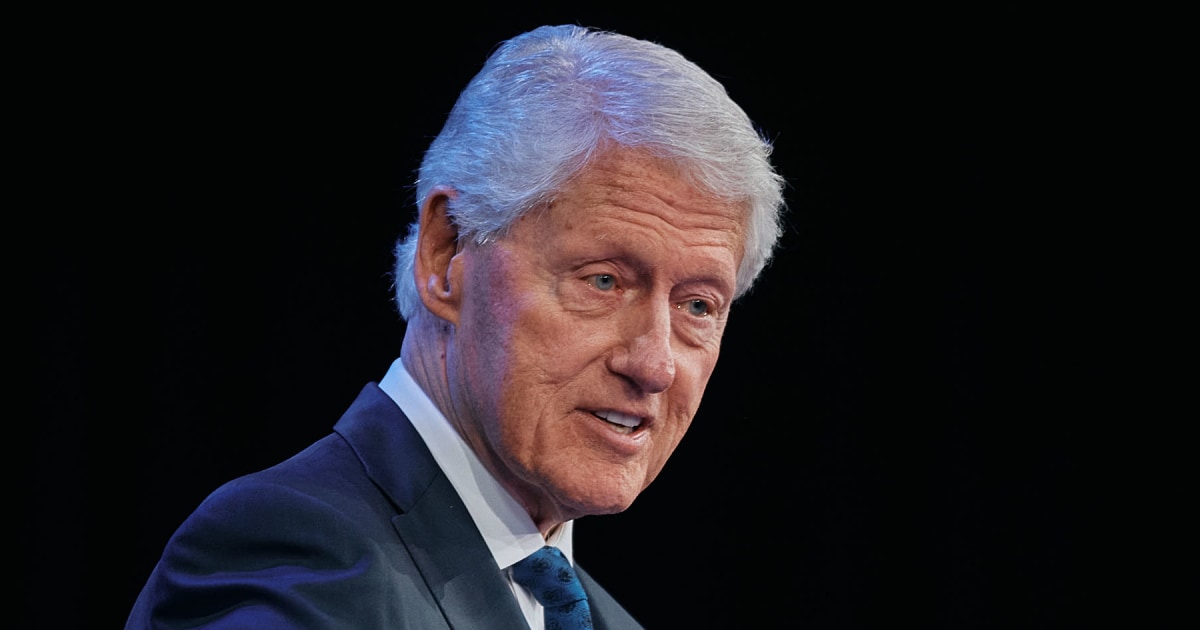
Former President Bill Clinton recently underwent a six-hour closed-door deposition before the Republican-led House Oversight Committee, asserting unequivocally that he 'saw nothing' untoward and 'did nothing wrong' concerning his association with convicted sex offender Jeffrey Epstein. The former commander-in-chief, who also expressed strong disapproval of the committee's decision to compel his wife, former Secretary of State Hillary Clinton, to testify, provided his statements on a Friday, just one day after Mrs. Clinton faced similar questioning for approximately six hours. According to reports, the extensive inquiry aimed to scrutinize the depth and nature of his connections to Epstein and his co-conspirator, Ghislaine Maxwell, as part of a broader congressional investigation into the disgraced financier's network. Mr. Clinton's appearance marked a significant moment in the ongoing efforts by the House panel to uncover information related to Epstein's activities and the individuals who associated with him.
The House Oversight Committee's investigation into Jeffrey Epstein's vast network and the individuals connected to him has been a persistent focus, particularly for the Republican majority. This latest round of depositions, held in Chappaqua, New York, underscores the committee's commitment to exploring all avenues related to the convicted sex offender, who died in federal custody in 2019. The context of these inquiries stems from Epstein's high-profile conviction for sex trafficking and the subsequent public demand for accountability from those who enabled or were aware of his illicit activities. The committee's decision to question both Bill and Hillary Clinton highlights the enduring public and political interest in understanding the full scope of Epstein's associations, especially given the former president's acknowledged past travel and interactions with Epstein. The closed-door nature of the proceedings, while standard for such depositions, has also fueled speculation regarding the specific lines of questioning and the information sought by the congressional panel.
During his testimony, former President Clinton made several pointed remarks, including an opening statement, which he subsequently shared on X, where he vehemently condemned Epstein's actions. He stated that, as someone who grew up in a household affected by domestic abuse, he would have never traveled on Epstein's plane had he possessed 'any inkling' of the financier's criminal behavior, adding that he would have personally ensured Epstein faced justice. While acknowledging his past acquaintance and travel with Epstein, Mr. Clinton firmly maintained that his wife, Hillary Clinton, had 'nothing to do with Jeffrey Epstein' and possessed 'no memory of even meeting him,' criticizing the committee for including her in their subpoenas. Following the deposition, Oversight Committee Chair James Comer, a Republican from Kentucky, informed reporters that Mr. Clinton 'answered every question' or 'attempted to answer every question,' describing the session as 'very productive.' Comer noted that the committee 'learned some things' but had 'hoped to get more,' characterizing Clinton as 'charming' and possessing 'Southern people skills.' Representative Nancy Mace, a Republican from South Carolina, also commented, indicating that Clinton continued to answer questions 'even when his attorneys told him to shut up.' Unlike his wife the previous day, Mr. Clinton did not address reporters after his testimony.
The depositions of former President Bill Clinton and former Secretary of State Hillary Clinton by a Republican-led House committee carry significant political implications, extending beyond the immediate scope of the Epstein investigation. Such inquiries often serve a dual purpose: genuine oversight and potential political leverage, especially in a highly polarized environment. Chairman Comer's remarks — that the committee 'learned some things' but 'hoped to get more' — suggest that while some information was gleaned, the session may not have yielded the definitive breakthroughs or admissions the committee might have sought. The public's enduring fascination with Epstein's network, coupled with the high-profile nature of the Clintons, ensures continued scrutiny of any revelations. Experts suggest that the committee's persistence in pursuing these connections reflects a broader public desire for transparency and accountability regarding individuals associated with Epstein, regardless of their political standing. The challenge for investigators often lies in substantiating claims or denials made years after the fact, particularly when dealing with interactions that occurred in private settings, making the task of uncovering new, verifiable information particularly complex.
In conclusion, former President Bill Clinton's testimony before the House Oversight Committee reiterated his strong denials of any knowledge regarding Jeffrey Epstein's criminal activities, while also criticizing the committee's decision to involve his wife. Despite the committee chair's assessment of the deposition as 'productive' and yielding 'some things,' there was an expressed desire for 'more' information, indicating that definitive new revelations might have been limited. The ongoing investigation into Epstein's associates continues to be a point of focus for the Republican-led panel, with the public keenly watching for any further developments. The political implications of these high-profile depositions are likely to persist, influencing public discourse and potentially shaping future oversight efforts. Moving forward, observers will be watching to see if the committee pursues additional avenues of inquiry or if these latest testimonies mark a concluding phase in their investigation into the Clintons' connections to the disgraced financier.