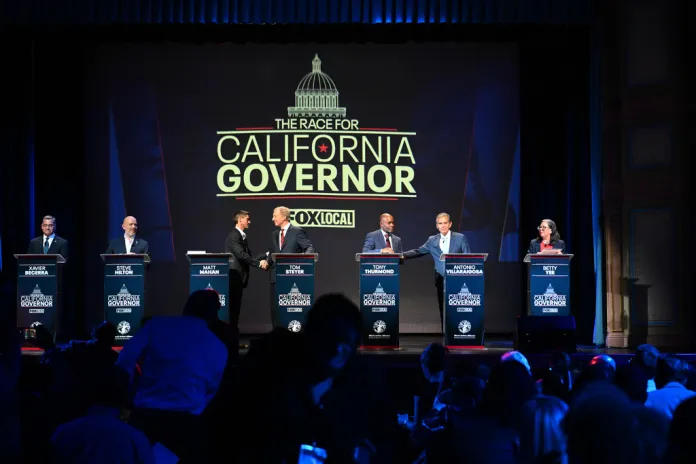
California's Democratic Party chairman, Rusty Hicks, has reportedly issued a strong appeal to several candidates vying for the state's top executive office, urging those with limited prospects of success to withdraw from the crowded primary field. This unprecedented intervention, conveyed through an open letter to the numerous hopefuls seeking to succeed term-limited Governor Gavin Newsom, stems from growing anxieties within the party. According to reports, Hicks articulated concerns that a fragmented Democratic vote, combined with campaigns driven by individual ambition rather than collective strategy, could inadvertently create an opening for Republican contenders. The core apprehension revolves around the state's unique "jungle primary" system, which party strategists fear could lead to a scenario where no Democratic candidate advances to the general election, despite the party's significant numerical advantage in the Golden State. This urgent plea underscores a strategic gamble by the party leadership to consolidate support and avert a potentially disastrous outcome in the upcoming election cycle.
The strategic concerns voiced by Chairman Hicks are deeply rooted in California's distinctive electoral framework, known as the "jungle primary" or "top-two primary" system. Under this mechanism, all candidates, regardless of their party affiliation, compete on a single primary ballot. The two individuals who garner the highest number of votes then proceed to the general election in November, irrespective of their political party. This system, while designed to foster broader appeal, presents a unique challenge for dominant parties when multiple strong candidates emerge from their ranks. Historically, California has been a stronghold for Democrats, demonstrating an overwhelming voter registration advantage and nearly two decades of continuous Democratic leadership in the governor's mansion. However, party officials and political analysts are now expressing significant worry that a large number of Democratic candidates could dilute the vote, inadvertently allowing a smaller, more consolidated Republican field to secure both coveted spots in the general election, thereby locking out any Democratic representation entirely.
In his direct communication to the gubernatorial aspirants, Chairman Hicks emphasized the critical need for each candidate to conduct an honest and thorough evaluation of their campaign's viability and potential for success. He acknowledged that such a request would likely be met with resistance and could prove unpopular among certain factions within his own party. Nevertheless, Hicks underscored the potential perils of continued infighting and campaigns primarily driven by personal ambition, warning that these factors collectively risk paving a viable path for Republicans to reclaim the governorship. The gravity of the situation was further highlighted by Jeff Le, a managing principal at 100 Mile Strategies, who, according to the Washington Examiner, stated that Hicks' message to the Democratic candidates clearly "illustrates the growing party concern that Democrats may inflict their doomsday scenario: a November general election without a Democrat on the ballot." This sentiment reflects a palpable anxiety among party strategists regarding the potential for self-inflicted electoral damage.
The intervention by the state's Democratic Party chair signals a critical juncture in California's political landscape, prompting widespread analysis of its implications. Despite the state's deep-blue leanings and a substantial Democratic voter base, the unique mechanics of the jungle primary system introduce a significant element of unpredictability. Experts suggest that while Democrats enjoy a considerable numerical advantage, the sheer volume of candidates could paradoxically undermine their strength. This situation forces a re-evaluation of traditional campaign strategies, where candidates often focus on differentiating themselves within their own party. The current scenario demands a more unified approach, or at least a strategic thinning of the field, to prevent vote-splitting from becoming a fatal flaw. The broader implications extend beyond this specific election, potentially setting a precedent for how dominant parties manage crowded primaries in states with similar electoral systems, highlighting the tension between individual political aspirations and collective party objectives.
Chairman Hicks' urgent appeal serves as a stark reminder of the strategic complexities inherent in California's gubernatorial race, particularly under its top-two primary system. The central takeaway is the Democratic Party's profound concern that internal divisions and a fragmented vote could lead to an unprecedented general election without a single Democratic candidate on the ballot, despite the party's overwhelming statewide dominance. As the primary season progresses, all eyes will be on how the numerous Democratic candidates respond to this call for self-assessment and potential withdrawal. The success or failure of Hicks' intervention will not only shape the immediate future of California's governorship but could also offer valuable lessons on party management and electoral strategy in diverse political environments. The coming weeks will reveal whether unity can prevail over individual ambition in the face of a perceived electoral threat.