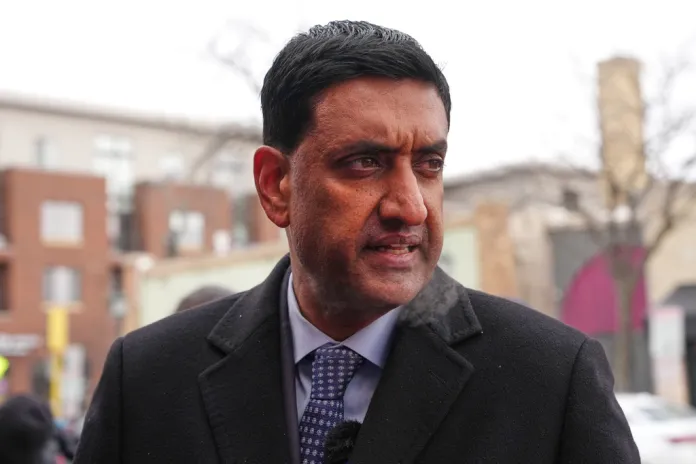
Following coordinated military operations conducted by the United States and Israel against targets within Iran early Saturday morning, Democratic legislators have significantly intensified their demands for an immediate vote on proposed legislation aimed at restricting President Donald Trump's authority to unilaterally deploy military force. Representative Ro Khanna, a Democrat from California, who co-sponsored the War Powers Resolution last year alongside Republican Representative Thomas Massie of Kentucky, publicly pressed for Congress to reconvene on Monday. This appeal challenges the current congressional schedule, which allocates a district work period extending until Wednesday. Through a social media statement issued on Saturday, Representative Khanna characterized the recent military actions as an unauthorized pursuit of regime change in Iran, highlighting the potential hazards this poses to American service members. He urged every member of Congress to publicly declare their position on the resolution, underscoring the perceived constitutional necessity for legislative oversight in matters of war and the critical urgency of the situation.
This renewed legislative push for a vote on the War Powers Resolution emerges amidst enduring apprehensions among Democratic lawmakers concerning the executive branch's capacity to initiate military engagements without explicit approval from Congress. The resolution, initially put forth by Representatives Khanna and Massie, seeks to reassert Congress's constitutionally mandated power to declare war and to require the withdrawal of U.S. forces from hostilities in Iran unless specifically authorized by the legislative body. This particular legislative endeavor forms a component of a broader Democratic strategy advocating for de-escalation within the volatile Middle East region. The consistent demand for a reassertion of Congressional authority over military actions has been a hallmark of Democratic policy, reflecting a deep-seated belief in the checks and balances designed to prevent unilateral executive action in matters of war and peace.
House Democratic leadership had previously indicated their firm intention to compel a vote on this resolution in the upcoming week, a commitment that was promptly reiterated by House Minority Leader Hakeem Jeffries, a Democrat from New York, immediately following the weekend strikes. This consistent messaging from prominent Democratic figures underscores a unified front within the party regarding the imperative to curb presidential war powers. Reports indicate that the timing of these renewed calls is directly linked to the recent military actions, which have reignited concerns about the scope of executive authority in foreign policy and national security. The legislative effort aims to establish a clear legal framework that would mandate congressional consent for any sustained military engagement in Iran, thereby preventing future administrations from engaging in prolonged conflicts without explicit legislative backing. This move is seen by its proponents as a critical step toward restoring the constitutional balance of power.
The intensified push for a War Powers Resolution vote represents a significant moment in the ongoing constitutional debate surrounding the division of war-making powers between the executive and legislative branches. Experts suggest that the outcome of this legislative challenge could redefine the parameters of presidential authority in initiating military action, particularly in regions as volatile as the Middle East. Should the resolution pass, it would send a powerful message about Congress's determination to reclaim its constitutional prerogatives, potentially influencing future foreign policy decisions and military deployments. Conversely, a failure to pass the resolution might be interpreted as a tacit endorsement of broader executive discretion in military matters. This legislative battle is not merely about a single military action but about the fundamental architecture of American governance concerning war and peace, with profound implications for international relations and the safety of U.S. personnel abroad.
In summary, the recent joint military actions in Iran have catalyzed a robust legislative response from Democratic lawmakers, who are urgently advocating for a vote on the War Powers Resolution. This initiative, spearheaded by figures like Representative Ro Khanna, aims to reinforce Congress's constitutional role in authorizing military force and to prevent unilateral executive action. The coming days will reveal whether Congress will reconvene as urged and proceed with this critical vote, which could significantly impact the balance of power between the executive and legislative branches regarding military engagements. Observers will be closely watching the legislative proceedings and the broader political discourse surrounding presidential war powers and U.S. foreign policy in the Middle East.