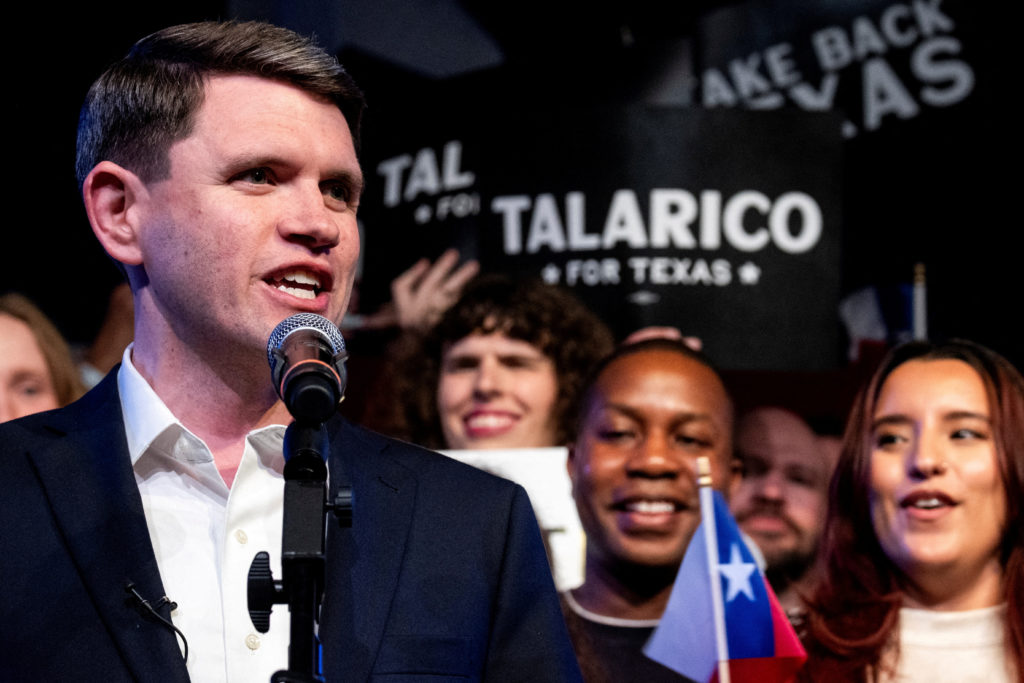
Democrat James Talarico has successfully secured his party's nomination for the U.S. Senate in Texas, marking a significant development in the state's political landscape and setting the stage for a closely watched general election. Following a competitive primary contest, Talarico's emergence as the official candidate positions him not merely as a challenger within Texas, but as a prominent figure in the broader national opposition to the incumbent Republican president, according to recent assessments. This development elevates the Texas Senate race beyond state lines, transforming it into a significant battleground with implications for the national political narrative and the balance of power in Washington. His nomination signals a renewed Democratic effort to gain traction in a traditionally conservative state, drawing national attention and resources to a contest that could redefine the political discourse surrounding the upcoming presidential election. The focus now shifts to how Talarico will leverage this newfound national spotlight to galvanize support both within Texas and across the country, as he prepares to face his Republican opponent in what is anticipated to be one of the most closely watched races of the cycle.
The political environment in Texas, a state long considered a Republican stronghold, provides a complex backdrop for Talarico's nomination. While Democrats have made inroads in some urban and suburban areas in recent election cycles, statewide victories have remained elusive. The U.S. Senate seat in Texas holds immense strategic value for both major parties, representing a potential shift in the national balance of power if Democrats could secure it. Historically, Democratic challengers in Texas have faced an uphill battle against well-funded Republican incumbents and the state's conservative voting trends. However, demographic shifts and evolving voter sentiments have fueled optimism among Democrats that Texas could eventually become a swing state. This particular Senate race is thus seen by many as a litmus test for the Democratic Party's long-term strategy in the Sun Belt and its ability to mobilize diverse coalitions. The national implications are magnified by the current political climate, where every Senate seat is critical for legislative control and the ability to advance or obstruct a presidential agenda.
In his newly defined role as a 'front man' for the political opposition, Talarico is expected to play a crucial part in shaping the national discourse against the Republican president. This designation, as indicated by reports, suggests that his campaign will transcend local issues, becoming a platform for broader critiques of the current administration's policies and direction. Such a position often entails increased media scrutiny, heightened fundraising expectations from national donors, and a greater responsibility to articulate the Democratic Party's vision on a national stage. Political strategists suggest that this role could involve frequent appearances on national news programs, participation in high-profile events, and a concerted effort to connect with voters beyond Texas through digital campaigns and national outreach initiatives. The challenge for Talarico will be to balance the demands of a statewide campaign, which requires addressing local concerns, with the expectations of his national 'front man' status, which necessitates a broader focus on federal policy and presidential politics. His ability to effectively navigate this dual mandate will be critical to his campaign's success and his impact on the national political conversation.
The broader implications of Talarico's emergence as a national opposition figure extend to the Democratic Party's strategy for the upcoming presidential election and beyond. Analysts suggest that a strong showing in Texas, even if it doesn't result in a victory, could energize the party's base nationwide, inspire increased voter turnout, and attract significant financial investment in future Texas races. This could also serve as a blueprint for other Democratic candidates in traditionally red states, demonstrating how to effectively link local campaigns to national political narratives. Conversely, a less impactful performance could temper expectations for Democratic gains in conservative territories. Furthermore, Talarico's platform and messaging, particularly as they relate to challenging the Republican president, will be closely scrutinized by both allies and adversaries. His campaign's ability to articulate a compelling alternative vision could influence the national Democratic Party's messaging, potentially shaping debates on key issues such as economic policy, healthcare, and social justice. The race will be a significant indicator of the national mood and the potential for shifts in political allegiances.
As James Talarico transitions from primary victor to the Democratic U.S. Senate nominee in Texas, his new designation as a 'front man' for the national opposition marks a pivotal moment in American politics. This role elevates his campaign to a national stage, making the Texas Senate race a key battleground for the broader political struggle against the Republican president. Observers will be closely watching how Talarico manages the dual pressures of a demanding statewide campaign and his newfound national prominence. His performance will not only determine the fate of a crucial Senate seat but could also significantly influence the national political narrative, fundraising efforts for the Democratic Party, and the strategic outlook for future elections. The coming months will reveal whether this Texas nominee can effectively harness national attention to drive both local support and broader political change, making this race an essential barometer for the nation's political trajectory.