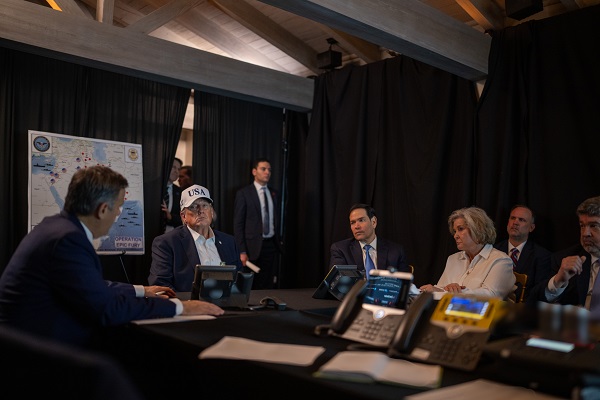
American and Israeli military forces initiated a major coordinated offensive, dubbed Operation Epic Fury, targeting Iranian military and regime infrastructure in the early hours of February 28, 2026. U.S. Central Command (CENTCOM) confirmed the operation via a statement on social media platform X, indicating that the extensive strike campaign was conducted under the direct orders of the President of the United States. According to CENTCOM, American and allied forces commenced offensive actions at approximately 1:15 am Eastern Time, with the stated objective of dismantling the Iranian regime's security infrastructure. Officials indicated a particular focus on sites identified as posing an immediate danger. Initial targets reportedly included command and control facilities belonging to the Islamic Revolutionary Guard Corps (IRGC), Iranian air defense capabilities, various missile and drone launch sites, and key military airfields across Iran. This marks a significant escalation in regional tensions, with the joint operation underscoring a unified front against perceived threats from Tehran.
The launch of Operation Epic Fury represents a culmination of several months of intricate joint planning between American and Israeli military strategists, signaling a highly calculated and deliberate response. Reports indicate this is not a singular event but is designed as a multi-day operation, emphasizing the comprehensive nature of the campaign. The scale of the coordinated strikes, involving both U.S. and Israeli assets, highlights the strategic depth of the alliance and the perceived gravity of the threats being addressed. Historically, both the United States and Israel have expressed concerns regarding Iran's regional influence, its nuclear program, and its support for various proxy groups. This operation, as described by CENTCOM, appears to be a direct and forceful effort to degrade Tehran's capacity to project power and destabilize the region, moving beyond previous limited engagements to a broad, systemic targeting of the regime's foundational security elements.
The initial phase of Operation Epic Fury involved the deployment of precision munitions from a diverse array of platforms, including air, land, and sea assets. Among the first wave of attacks, a barrage of Tomahawk cruise missiles was launched, alongside air-launched missiles fired from U.S. Navy vessels and U.S. Air Force jets. Within the first twelve hours of the operation, American forces alone reportedly executed hundreds of individual strikes. Initial targets extended beyond military installations to include critical regime infrastructure, with reports indicating strikes against the office compound of Supreme Leader Ayatollah Ali Khamenei, the Ministry of Intelligence, the Ministry of Defense, facilities linked to Iran's nuclear program, and various military research centers. Furthermore, according to a social media account (@LeventkemaI), which cited the Israeli Defense Force (IDF), a preliminary list of senior Iranian officials reportedly killed in the initial day of attacks has emerged. This list includes Supreme Leader Ayatollah Ali Khamenei, Mohammad Pakpour (Commander of the IRGC Ground Forces), Ali Shamkhani (Senior Security Advisor to the Supreme Leader), Mohammad Shirazi (Head of Military Office of Ali Khamenei), Aziz Nasirzadeh (Minister of Defense), Salah Esadi (Intelligence Chief of “Khatam al-Anbiya”), Reza Mozaffari-Nia (Former Deputy Defense Minister), and Hossein Jabal Ameli (Deputy Defense Minister). Many of these individuals were reportedly present at a meeting within a targeted compound.
The reported targeting of such high-level Iranian regime figures and critical infrastructure, if confirmed, signifies an unprecedented escalation in the long-standing tensions between Iran and its adversaries. Analysts suggest that an operation of this magnitude, meticulously planned over months, indicates a strategic decision to fundamentally alter the regional power dynamic rather than merely respond to specific provocations. The justification of 'imminent threat' by CENTCOM underscores the perceived urgency and severity of the intelligence that prompted this coordinated action. Observers note that striking the Supreme Leader's office and other key ministries represents a direct challenge to the very core of Iran's political and military leadership, potentially leading to profound internal instability and an unpredictable response from Tehran. The broader implications could ripple across global energy markets, international diplomacy, and the security landscape of the Middle East, demanding careful monitoring from international bodies and world powers.
As Operation Epic Fury unfolds, the international community is closely watching for further developments and official confirmations of the reported casualties and the full extent of the damage. The stated goal of dismantling Iran's security apparatus suggests a sustained campaign rather than a swift, decisive blow, indicating that the region may be entering a prolonged period of heightened conflict. Key factors to monitor in the coming days include any official statements or retaliatory actions from the Iranian regime, the reactions of regional and global powers, and the verification of the reported deaths of senior Iranian officials. The success or failure of this operation, and its ultimate impact on Iran's capabilities and the stability of the Middle East, will depend heavily on its execution and the subsequent geopolitical fallout, making the coming days critical for understanding the future trajectory of this volatile region.