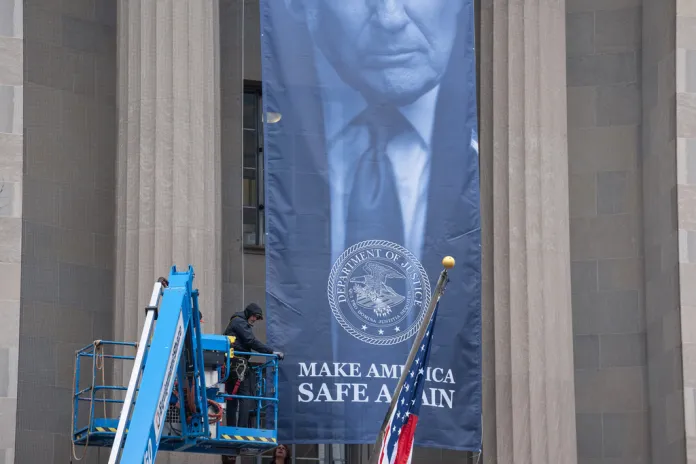
The U.S. Department of Justice (DOJ) made an unexpected move on Tuesday, informing a federal appeals court of its intention to continue defending executive orders issued by former President Donald Trump that targeted several prominent law firms. This decision came less than a full day after the department had initially sought to withdraw from the legal challenge. In a concise filing submitted to the U.S. Court of Appeals for the District of Columbia Circuit, legal representatives for the DOJ formally requested to retract their earlier petition to voluntarily dismiss the consolidated appeals related to these orders. Reports indicate that the department provided no public rationale for this sudden shift in its legal strategy. The executive orders in question have been a point of contention, with critics asserting they were designed to penalize firms perceived as being aligned with the former president's political adversaries. This abrupt reversal sets the stage for a continued legal battle over the scope of presidential authority and the government's role in defending past administrations' directives.
The executive orders at the heart of this legal dispute were initially issued by former President Trump and became the subject of intense scrutiny and legal challenges shortly after their promulgation. According to various reports and analyses, these directives were widely interpreted by critics as an attempt to exert pressure on law firms that had represented clients or causes opposed to the Trump administration's agenda. The specific provisions within these orders were far-reaching, reportedly aiming to suspend the security clearances of attorneys, impose restrictions on their access to federal government buildings, and instruct federal agencies to terminate existing government contracts involving the targeted firms and their clients. Last year, judges presiding over four distinct cases independently invalidated these executive orders, finding them to be unconstitutional or otherwise unlawful. These rulings set the stage for the appeals process that the DOJ initially sought to abandon, highlighting the significant legal challenges the orders faced from their inception.
The procedural maneuver by the Justice Department involved a formal submission to the appellate court, specifically requesting the withdrawal of its prior motion to dismiss the consolidated appeals. This action effectively signals the department's intent to actively pursue the defense of the executive orders in the ongoing legal proceedings. The lack of an accompanying explanation for this dramatic change in stance has drawn particular attention. When inquiries were directed to the White House regarding the matter, officials reportedly referred questions to the Justice Department. A spokeswoman for the DOJ, when contacted for comment, declined to provide any further details or clarification on the department's decision. A spokesperson for Perkins Coie, one of the law firms potentially affected by the executive orders, issued a statement expressing strong criticism of the reversal. The spokesperson highlighted that the Justice Department had offered no justification for its change of heart, either to the involved parties or to the court itself, underscoring the perceived opacity of the department's actions.
The Justice Department's unexpected decision to resume its defense of former President Trump's executive orders could be interpreted in several ways by legal observers and political analysts. One perspective suggests that the move might reflect a broader commitment within the current administration's legal apparatus to maintain continuity in defending the legal positions of the United States government, regardless of the change in presidential administrations. Alternatively, some might speculate about potential internal deliberations or external pressures that could have influenced such a swift and unexplained reversal. The decision ensures that the legal battle over the constitutionality and scope of these executive orders will continue to unfold in the appellate courts, potentially setting precedents regarding presidential power and the government's ability to target private entities. This development also raises questions about the consistency of legal strategy within the DOJ, particularly when transitioning between administrations, and how such shifts might impact public perception of the department's independence and impartiality. The ongoing litigation will likely scrutinize the original intent and legal basis of the orders, as well as the implications of their potential enforcement.
In summary, the U.S. Justice Department has made an abrupt and unexplained reversal, opting to continue its defense of former President Trump's executive orders targeting specific law firms in federal appeals court. This decision, coming less than 24 hours after an attempt to abandon the legal fight, has been met with criticism, particularly from affected parties like Perkins Coie, who noted the absence of any official explanation. The executive orders, previously struck down by lower courts, sought to impose significant restrictions on the targeted firms and their personnel. As the legal proceedings move forward in the U.S. Court of Appeals for the District of Columbia Circuit, all eyes will be on the arguments presented by the DOJ and the court's eventual ruling. This case will continue to be a significant test of executive authority, the independence of the legal system, and the government's approach to defending past presidential directives, especially those perceived as politically motivated. The lack of transparency surrounding the DOJ's reversal remains a key point of interest.