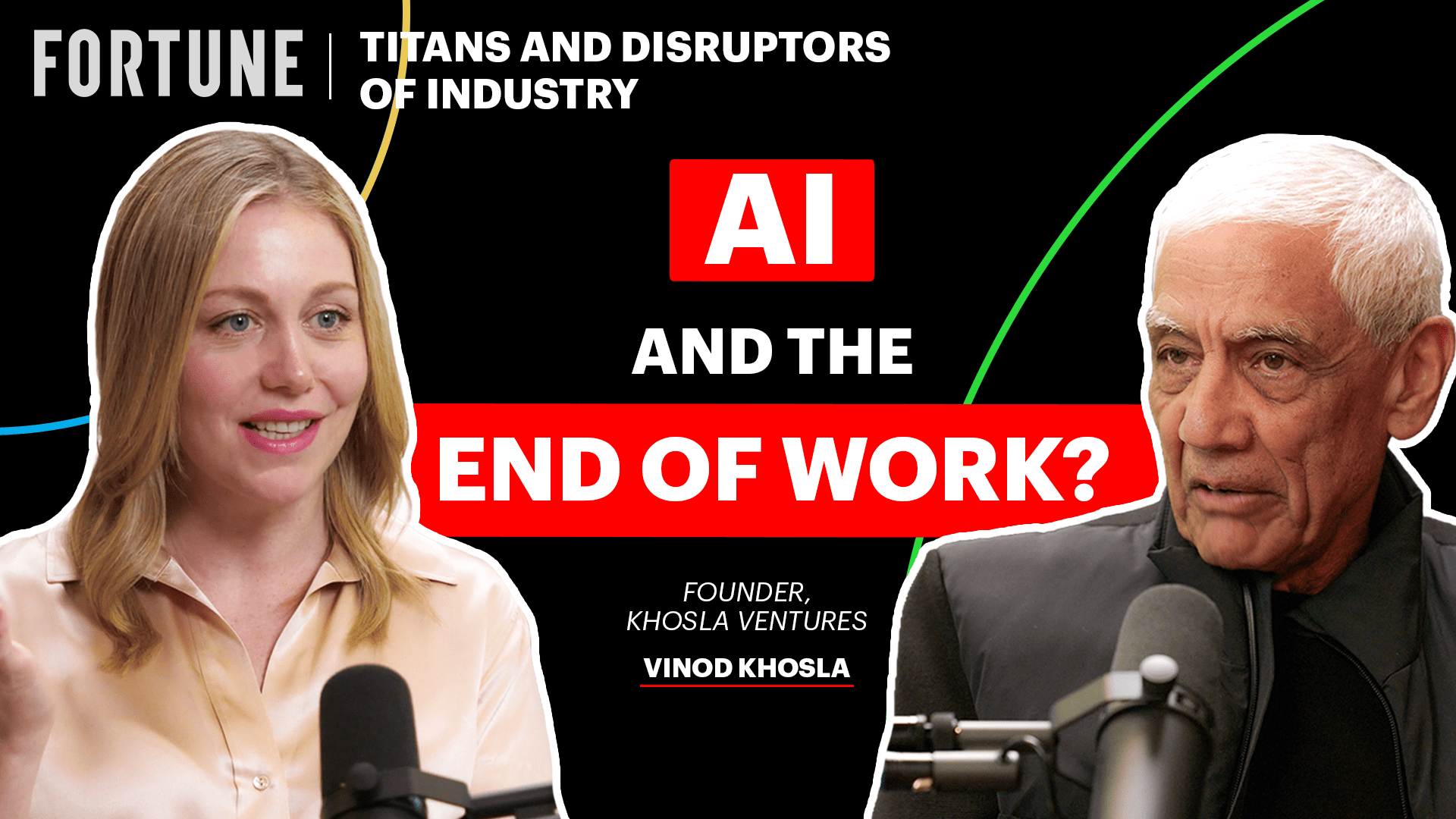
Silicon Valley luminary Vinod Khosla, a venture capitalist renowned for his prescient investments, has articulated a profoundly transformative vision for the future, suggesting that artificial intelligence will render the majority of human jobs obsolete within the next decade. In a recent interview with Fortune’s Editor-in-Chief Alyson Shontell for her podcast, Khosla projected that by 2030, approximately 80% of all current employment roles could be competently performed by AI systems. This dramatic shift, he contends, will not lead to widespread hardship but rather usher in an era of unprecedented abundance and affordability across critical sectors such as education, healthcare, and housing, fundamentally altering the societal structure by 2040. Khosla’s optimistic outlook posits a future where labor effectively becomes free, raising profound questions about human purpose and economic models in a world largely unburdened by the necessity of traditional work. He envisions a society so advanced by AI that a child born today, currently five years old, might never need to seek traditional employment, marking a radical departure from historical economic paradigms. This perspective, coming from an investor with a notable track record in forecasting technological shifts, underscores the escalating debate around AI's societal impact.
Khosla's predictions carry considerable weight given his extensive and successful history within the technology sector. As a co-founder of Sun Microsystems and Daisy Systems, he played a pivotal role in shaping early computing landscapes. His venture capital firm, Khosla Ventures, has been an early backer of numerous disruptive companies, including Square and DoorDash, demonstrating a consistent ability to identify future market leaders. Crucially, Khosla was also an early institutional investor in OpenAI, the company at the forefront of the current AI revolution. Reports indicate that Khosla Ventures provided the initial institutional funding to OpenAI in 2019, contributing $50 million when the company was valued at $1 billion. This early bet has seen an astronomical return, with OpenAI recently securing $110 million in new funding at a staggering $780 billion valuation. This deep involvement and early foresight into the potential of AI lend significant credibility to his current forecasts regarding its future impact on labor and society. His track record, as acknowledged by Fortune's editor, positions him as a key voice in discussions about technological evolution.
Delving deeper into his techno-optimistic forecast, Khosla firmly believes that the pervasive integration of AI will fundamentally redefine the concept of work. He explicitly stated that "starting in about 2030—four years away—80% of all jobs will be capable of being done by an AI," a timeline that suggests a rapid and profound transformation of the global workforce. This imminent capability, according to Khosla, will lead to a scenario where "all labor is free," implying a dramatic reduction in the cost of goods and services that currently rely heavily on human effort. He envisions a future where the current need for higher education institutions, such as colleges, could diminish significantly, as AI-driven systems might provide equivalent or superior learning and skill development opportunities. Furthermore, his vision extends to tangible improvements in daily life, predicting that essential services like healthcare, housing, and education will become vastly more affordable and accessible. The investor's perspective suggests a paradigm shift where the traditional pursuit of a career, as understood today, may become an outdated concept for future generations, exemplified by his belief that a five-year-old alive today might never need to seek employment. The interviewer, Alyson Shontell, acknowledged the utopian nature of this vision, raising pertinent questions about how individuals would sustain themselves without traditional income and find purpose in a work-free society, as well as the governmental policies required to navigate such a transition successfully and avoid potential dystopian outcomes.
Khosla's bold predictions, while optimistic, naturally prompt critical examination regarding the practicalities and potential pitfalls of such a radical societal restructuring. The interviewer's questions about how individuals would afford daily life without traditional employment and find meaning beyond work highlight key challenges that would need to be addressed. If labor truly becomes "free," as Khosla suggests, new economic models, potentially involving universal basic income or other forms of wealth distribution, would likely be necessary to ensure equitable access to the abundant resources. Moreover, the psychological and social implications of a work-free society are profound. Human beings have historically derived purpose, identity, and social connection from their professions. A future where these traditional avenues are largely absent would necessitate a re-evaluation of societal values and the creation of new frameworks for personal fulfillment and community engagement. Experts and policymakers would need to proactively develop robust governmental policies and social safety nets to prevent Khosla's utopian vision from devolving into a dystopian reality marked by widespread disengagement or inequality. The transition itself, even if leading to an ultimate state of abundance, would require careful management to mitigate disruption and ensure a smooth shift for billions of people.
In conclusion, Vinod Khosla's forecast presents a compelling, albeit challenging, vision of a future fundamentally reshaped by artificial intelligence. His projection of 80% of jobs being AI-capable by 2030, leading to an era of free labor and widespread abundance in essential services, demands serious consideration from technologists, economists, and policymakers alike. While the promise of a life unburdened by work and enriched by accessible resources is appealing, the practicalities of such a transition – from economic sustenance to the preservation of human purpose – remain significant areas for exploration and debate. As AI continues its rapid advancement, the dialogue around its societal impact, the necessary policy frameworks, and the ethical considerations will only intensify. Khosla's insights serve as a powerful reminder that the future of work and human existence is not merely an academic exercise but an imminent reality requiring proactive planning and innovative solutions to ensure a truly abundant and equitable future for all.