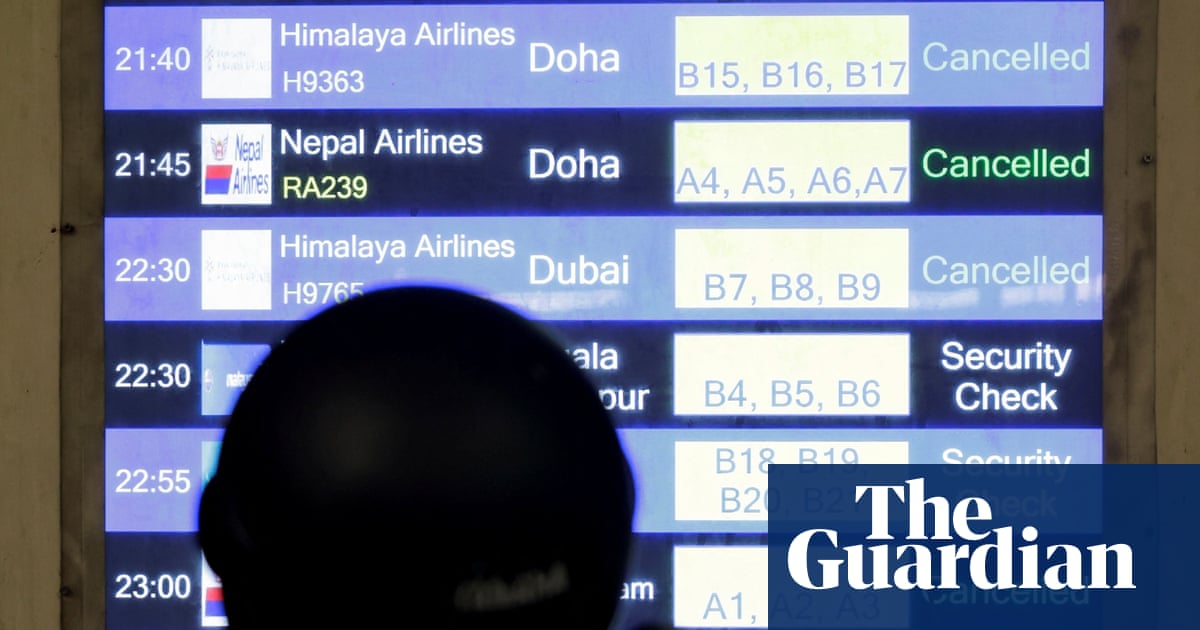
Hundreds of thousands of international travelers have found themselves stranded or rerouted as a result of extensive airspace closures across the Middle East, a direct consequence of escalating geopolitical tensions. The widespread disruption follows a reported attack on Iran by American and Israeli forces, coupled with the announcement of the death of Ayatollah Ali Khamenei, Iran's supreme leader since 1989. Key transit hubs, including the major international airports in Dubai, Abu Dhabi, and Doha, have ceased operations, leading to the cancellation of over 1,000 flights operated by prominent Middle Eastern airlines. Countries such as Israel, Qatar, Syria, Iran, Iraq, Kuwait, and Bahrain have implemented full airspace closures, while the United Arab Emirates declared a temporary and partial restriction, with flight tracking data indicating a complete halt to air traffic over its territory. The US President formally announced the passing of the Ayatollah, a claim further reiterated by former President Trump, marking a pivotal moment in regional dynamics.
The sudden and comprehensive closure of airspace across such a vast and strategically vital region underscores the profound impact of the recent military actions and leadership change. The Middle East serves as a critical nexus for global aviation, connecting Europe, Africa, and the Western hemisphere with Asia through its highly active air corridors and world-class airports. The reported attack on Iran by US and Israeli forces, a development that has significantly heightened regional instability, directly triggered these unprecedented travel restrictions. Ayatollah Ali Khamenei, who had held the position of Supreme Leader of Iran for over three decades since 1989, represented a continuous and powerful influence on Iranian domestic and foreign policy. His reported death, announced by the US President, introduces a new layer of uncertainty into an already volatile geopolitical landscape, prompting immediate and drastic measures by nations seeking to ensure safety and manage potential fallout.
The scale of the aviation crisis is substantial, with reports indicating that more than one thousand flights operated by major carriers in the Middle East have been cancelled. This has left an estimated hundreds of thousands of passengers in limbo, either unable to depart from their original locations or diverted to alternative, often distant, airports. The list of nations implementing full airspace closures is extensive, encompassing Israel, Qatar, Syria, Iran, Iraq, Kuwait, and Bahrain, effectively creating a no-fly zone across a significant portion of the region. Furthermore, the United Arab Emirates, home to two of the world's busiest international airports, announced a 'temporary and partial closure' of its airspace. This was corroborated by flight tracking website FlightRadar24, which showed no discernible flight activity over the UAE, highlighting the comprehensive nature of the restrictions even where they were described as partial. The cessation of operations at critical hubs like Dubai, Abu Dhabi, and Doha has reverberated globally, disrupting intricate flight schedules and supply chains.
This unfolding situation carries significant implications, not only for the immediate travel sector but also for broader regional stability and international relations. The swift and widespread airspace closures reflect the extreme caution and heightened alert levels adopted by governments in response to the reported military engagement and the death of a key regional leader. Such disruptions invariably strain diplomatic ties and can lead to further economic repercussions beyond the immediate impact on airlines and tourism. The reliance of global commerce and travel on the Middle East's air routes means that prolonged instability or unpredictable closures could have far-reaching effects on supply chains and international business operations. Observers note that the incident underscores the fragility of global connectivity in the face of geopolitical flashpoints, presenting a complex challenge for international bodies and individual nations alike in navigating future developments.
In summary, the Middle East is currently experiencing an unprecedented level of air travel disruption, with hundreds of thousands of passengers affected by widespread airspace closures. This crisis is directly linked to a reported US and Israeli attack on Iran and the announced death of Ayatollah Ali Khamenei, Iran's long-serving supreme leader. The cessation of operations at major transit hubs and the cancellation of over a thousand flights highlight the immediate and profound consequences of the escalating regional tensions. As the situation remains fluid, the international community will be closely watching for further developments, particularly regarding the political transition in Iran and any potential for de-escalation or further conflict. The immediate priority for airlines and governments remains the safe management of stranded travelers and the restoration of normal flight operations as geopolitical circumstances permit.