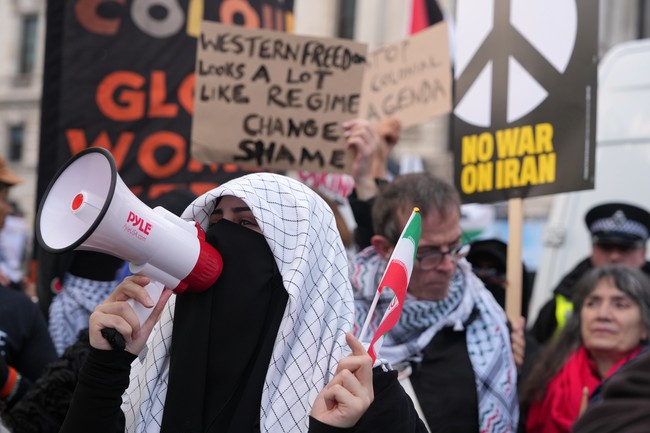
In a development that has drawn considerable attention, anti-U.S. protests reportedly materialized on American streets with remarkable speed, specifically targeting a U.S. and Israeli military action against Iran, even before the operation was officially confirmed by the White House. According to reports, a network of U.S.-based non-profit organizations, allegedly aligned with geopolitical rivals such as China, Russia, and Tehran, began mobilizing its activists approximately ten minutes prior to President Donald Trump's public announcement of 'Operation Epic Fury.' These groups, said to be financially supported by Shanghai-based American tech entrepreneur Neville Roy Singham, initiated their coordinated actions as early as 2:34 a.m. ET, calling for nationwide demonstrations against what they termed an 'unprovoked, illegal bombing of Iran.' This swift, pre-emptive response has prompted observers to question the organic nature of such demonstrations, suggesting a sophisticated level of organization and coordination within a broader information warfare context.
The rapid emergence of these protests highlights a recurring pattern where anti-U.S. demonstrations appear almost instantaneously following significant American foreign policy decisions. This particular instance, however, stands out due to its timing, preceding the official confirmation of military action. The organizations involved are described as regularly echoing narratives favored by America's adversaries, suggesting a deliberate strategic communication effort. The funding for some of these groups reportedly traces back to Neville Roy Singham, an American-born tech tycoon now based in Shanghai, whose financial contributions are said to empower entities that consistently disseminate messaging critical of U.S. foreign policy. This network of 'foot soldiers' is reportedly activated to converge in public spaces, amplifying anti-U.S. talking points and contributing to what analysts describe as an ongoing information war designed to shape public opinion and undermine American influence on the global stage, leveraging domestic platforms for international geopolitical objectives.
Specific details surrounding the pre-emptive mobilization indicate a high degree of planning. At 2:34 a.m. ET, the ANSWER Coalition, a non-profit organization whose leadership openly identifies with Marxist and communist ideologies, issued an urgent call to action. Their announcement proclaimed an 'EMERGENCY NATIONWIDE DAY OF ACTION TODAY, SAT. FEB 28 — STOP THE WAR WITH IRAN!' This declaration was made a full ten minutes before President Trump posted a video at 2:44 a.m. ET, confirming that the United States military had commenced 'major combat operations in Iran.' The ANSWER Coalition not only set the agenda for the protests but also dictated the specific language for its anti-U.S. messaging, characterizing the military intervention as an 'unprovoked, illegal bombing of Iran.' Furthermore, to facilitate these coordinated actions, the organization established a dedicated online presence, creating a website domain at http://ANSWERCoalition.org, underscoring the structured and prepared nature of their response.
The timing and coordination of these protests raise significant analytical questions regarding the dynamics of modern information warfare and the potential for foreign influence within domestic political discourse. The ability of certain groups to mobilize and articulate a specific narrative minutes before an official government announcement suggests a sophisticated intelligence gathering and rapid response capability, or perhaps, a pre-existing directive activated upon specific triggers. Experts suggest that such events are not merely spontaneous expressions of dissent but rather calculated 'salvos' in a continuous information conflict, where the goal is to control the narrative, sow discord, and challenge the legitimacy of U.S. actions. The alleged financial backing from individuals like Neville Roy Singham, coupled with the ideological alignment of the protesting organizations, points to a complex web of influence that seeks to leverage domestic activism for broader geopolitical aims, potentially blurring the lines between genuine grassroots movements and strategically orchestrated campaigns.
The incident surrounding the pre-emptive anti-U.S. protests against the Iran attack serves as a stark illustration of the evolving landscape of information warfare and the challenges it poses to national security and public perception. The unusual timing, the alleged foreign funding, and the swift, coordinated messaging highlight the sophisticated methods employed to influence public opinion and shape geopolitical narratives. As global tensions persist, observers will likely continue to scrutinize the origins and motivations behind seemingly spontaneous protest movements, particularly those that align closely with the interests of America's adversaries. The incident underscores the ongoing need for critical analysis of information sources and the potential for external actors to exploit domestic platforms to advance their strategic objectives, making vigilance against coordinated influence operations more crucial than ever.