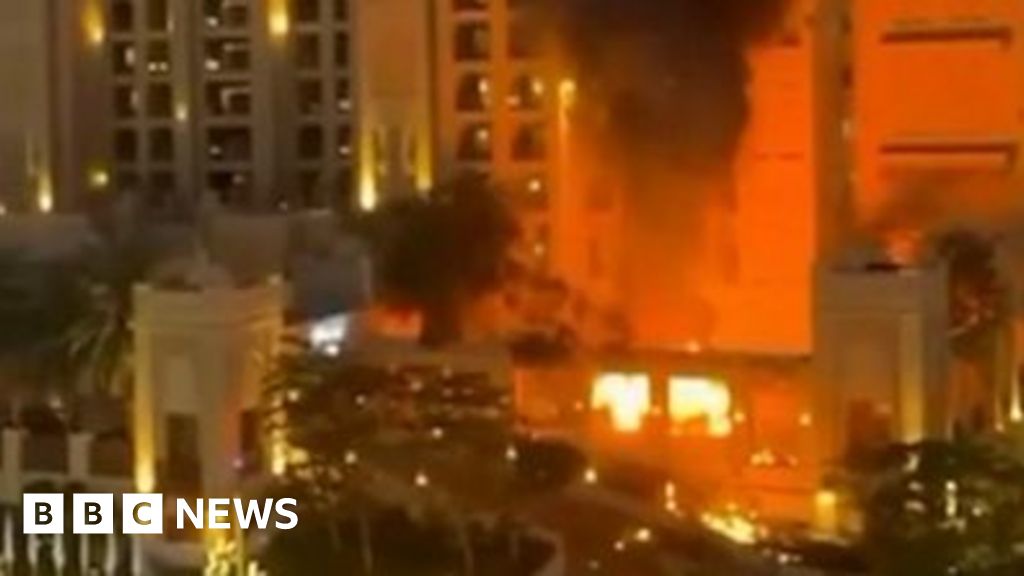
Iran has reportedly initiated a series of retaliatory missile strikes targeting various locations across the Middle East, a response to what it describes as a "massive" and ongoing assault by the United States and Israel. Among the reported impacts, a prominent luxury hotel in Dubai, the Fairmont The Palm, experienced a significant fire, with verified video footage showing dense black smoke ascending into the sky. Dubai authorities also confirmed that a separate blaze in the Palm Jumeirah vicinity resulted in four injuries, though officials stated this incident was subsequently brought under control. The widespread nature of these strikes has prompted several regional nations, including Qatar, Bahrain, Jordan, and Kuwait—all hosts to significant U.S. military installations—to report the interception of incoming missiles, signaling a substantial escalation in regional tensions. The full extent of damage and casualties beyond the reported injuries in Dubai remains largely undetermined, and the United States has yet to issue an official statement regarding the incidents or Iran's accusations.
These recent actions by Iran unfold against a backdrop of heightened geopolitical friction in the Middle East, with long-standing animosities between Tehran and its regional adversaries, particularly the United States and Israel. The claim by Iran of an ongoing "massive" attack by the US and Israel serves as the stated justification for its widespread retaliatory measures, though specific details of this alleged initial attack were not immediately available. The targeted regions, notably those housing American military assets like the al-Udeid air base in Qatar—the largest U.S. base in the area—and the proximity to the U.S. Navy's Fifth Fleet headquarters in Bahrain, underscore the strategic implications of Iran's actions. This pattern of strikes suggests a deliberate effort by Iran to project power and demonstrate its capacity to respond to perceived aggressions, potentially aiming to deter further actions against its interests. The involvement of multiple countries in intercepting these projectiles highlights the broad geographical scope and immediate regional security concerns generated by the unfolding events.
Further details emerging from the region paint a clearer picture of the immediate aftermath of the strikes. In Dubai, beyond the fire at the Fairmont The Palm, another verified video captured from a building opposite the hotel depicted the moment of impact, followed by a substantial explosion and a large orange fireball, causing the individual filming to apparently fall. Emergency services were observed attending the scene amidst significant smoke plumes. Dubai officials, while confirming the Palm Jumeirah building fire and four injuries, did not provide additional specifics regarding the cause or nature of that incident. Elsewhere, Qatar's defense ministry officially reported the successful interception of multiple missiles, which they indicated were seemingly aimed at the critical al-Udeid air base. In Bahrain, substantial dark smoke plumes were observed near the headquarters of the U.S. Navy's Fifth Fleet in Manama, although the precise extent of any damage there remains unconfirmed. Both Jordan and Kuwait also reported intercepting missiles directed towards their territories, further illustrating the broad reach of the Iranian offensive. Iranian state media had earlier acknowledged launching an attack on Dubai, though specific targets were not clearly identified in their initial reports.
The broad scope of Iran's retaliatory strikes carries significant implications for regional stability and international relations, potentially signaling a dangerous escalation in the ongoing shadow conflict. Experts suggest that by targeting areas with a U.S. military presence and even civilian infrastructure, Iran aims to demonstrate its resolve and capability to inflict costs on its adversaries, thereby altering the strategic calculus. The lack of immediate comment from the United States, as of reports, adds a layer of uncertainty to the situation, leaving open questions about the nature of any U.S. response and the potential for a wider conflict. For countries like Qatar, Bahrain, Jordan, and Kuwait, hosting U.S. forces, these events underscore the inherent risks of their strategic alliances and could prompt renewed debates about regional security arrangements. The deliberate targeting, even if intercepted, represents a direct challenge to the security architecture of the Gulf and broader Middle East, potentially pushing an already volatile region closer to open confrontation.
In summary, Iran's recent wave of retaliatory strikes across the Middle East marks a significant and concerning development, directly impacting civilian areas in Dubai and prompting defensive actions from several regional states hosting U.S. military assets. While the immediate damage and casualty figures remain limited, particularly outside of Dubai, the strategic implications are profound, raising fears of further escalation. The coming days will be crucial as the international community awaits official responses from the United States and Israel regarding Iran's accusations and the broader situation. Observers will be closely monitoring diplomatic efforts, military postures, and any further actions from all parties involved, as the region grapples with the potential for an intensified and more overt conflict.