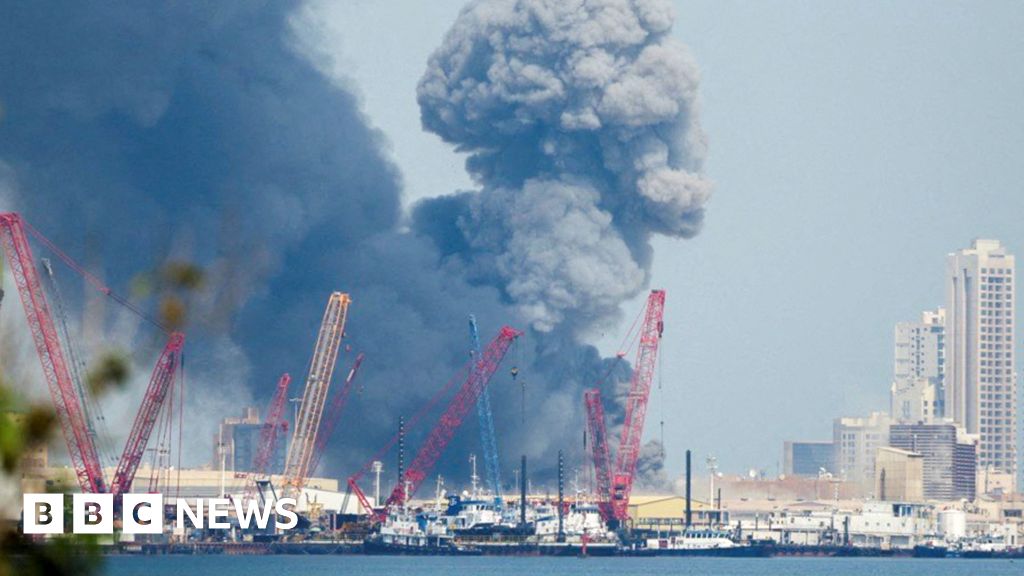
Iranian military forces, specifically the Islamic Revolutionary Guard Corps (IRGC), have publicly asserted responsibility for launching an attack against a United States naval facility situated in Bahrain. This significant declaration emerges as Tehran initiated a series of punitive military actions across the broader Middle East. Iranian authorities characterize these strikes as a direct response to what they describe as a substantial and ongoing offensive allegedly perpetrated against Iran by the United States and Israel. Reports emanating from Manama, Bahrain, detailed observations of considerable plumes of dark smoke rising from an area in close proximity to the operational headquarters of the U.S. Navy's Fifth Fleet. While the IRGC's statement provided explicit details of their alleged actions, the precise extent of any damage inflicted at the purported target remains unverified, and American officials have not yet released any public statement concerning the incident. This development signifies a critical escalation in regional tensions, with Iran indicating a direct confrontation with American military assets following what it terms an unprovoked assault on its sovereign territory.
The current wave of military operations by Iran, which the IRGC has officially named "Truthful Promise 4," is presented as a forceful and direct retaliation to an alleged initial aggression by the United States and Israel. According to Iranian sources, this purported offensive commenced on Saturday morning at approximately 09:15 Iran time, corresponding to 06:15 GMT, and reportedly concentrated on locations associated with the Iranian leadership. The complexity of this alleged attack on Iran is further compounded by reports suggesting that U.S. President Donald Trump publicly encouraged the Iranian populace to rise against their current government. This reported political incitement adds another layer of tension to the already volatile military confrontation. The strategic importance of allegedly targeting a U.S. naval base, particularly the headquarters of the Fifth Fleet, underscores a dramatic shift in the nature of engagement, moving beyond traditional proxy conflicts to direct claims of striking American military infrastructure.
The alleged target, the U.S. Navy's Fifth Fleet headquarters, holds immense strategic significance as a cornerstone of American military presence and operations in the Persian Gulf, Arabian Sea, and parts of the Indian Ocean. Its location in Bahrain makes it a critical hub for maritime security and stability in a region vital for global energy supplies. Reports from Manama, Bahrain, describing substantial dark smoke near this key facility, lend a degree of visual corroboration to the Iranian claims, though these observations do not confirm the source or impact of any alleged strike. Despite the explicit nature of the IRGC's assertion of responsibility, official confirmation regarding any damage or the nature of the alleged attack from United States authorities remains absent. This silence from Washington leaves a critical information vacuum, fueling speculation and heightening uncertainty about the true scope and consequences of the alleged incident. The Iranian claim, if substantiated, would represent a significant departure from previous patterns of engagement, directly challenging American military power in the region.
Analysts suggest that Iran's alleged direct targeting of a U.S. naval base, particularly the Fifth Fleet headquarters, marks a profound escalation that could fundamentally alter the dynamics of conflict in the Middle East. This move, if confirmed, would represent a dramatic shift from the long-standing practice of engaging through proxy forces, signaling Iran's willingness to confront American assets directly. The absence of an immediate response or confirmation from U.S. officials creates a tense waiting period, with experts warning of the potential for miscalculation and rapid escalation. The alleged timing of the Iranian strikes, following what Tehran describes as a "massive" offensive by the U.S. and Israel, indicates a calculated, albeit high-risk, retaliatory strategy. The reported political dimension, involving alleged calls from President Trump for an uprising, further complicates the narrative, potentially framing the conflict as an existential struggle for the Iranian regime. This situation places immense pressure on all parties to de-escalate, yet the direct nature of the alleged attack suggests a dangerous new phase in regional hostilities.
In summary, Iran's Islamic Revolutionary Guard Corps has claimed responsibility for striking a U.S. naval installation in Bahrain, asserting these actions are part of broader retaliatory strikes across the Middle East. This alleged attack, dubbed "Truthful Promise 4," is presented as a response to a purported "massive" offensive by the U.S. and Israel against Iran. While reports from Manama indicate dark smoke near the U.S. Navy's Fifth Fleet headquarters, American officials have yet to confirm any damage or even the occurrence of an attack. This unconfirmed but highly significant claim marks a severe escalation in regional tensions, moving toward direct confrontation between Iran and American military assets. The coming hours and days will be crucial as the international community awaits official statements and further developments, which could determine the trajectory of an increasingly volatile Middle East.