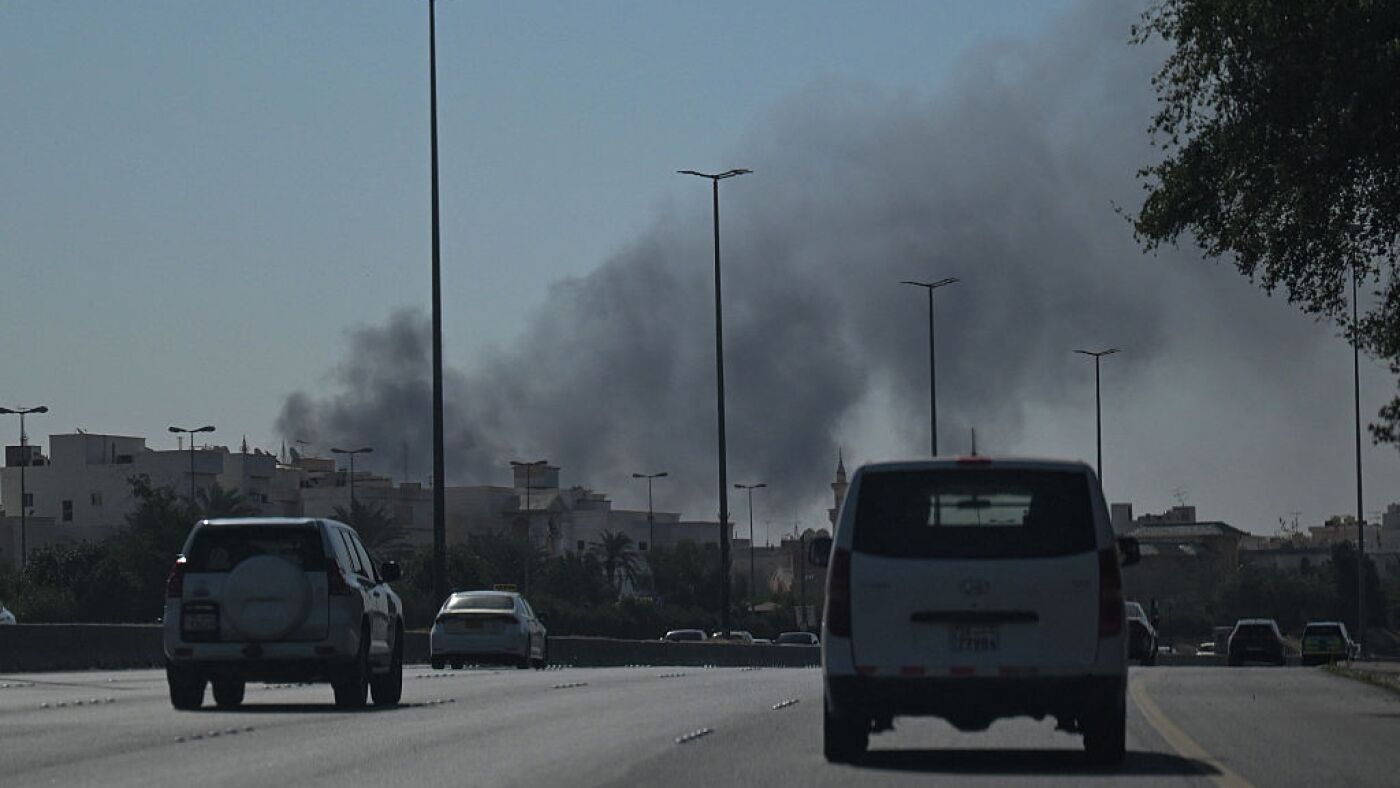
The protracted conflict centered around Iran dramatically intensified across the broader Middle East region on Monday, drawing in new actors and escalating existing fronts. Lebanon's militant group Hezbollah launched its initial assault on Israeli territory in over a year, reportedly in retaliation for the demise of Iran's spiritual head, according to various reports. This significant development coincided with a separate, critical incident in Kuwait, where multiple U.S. fighter aircraft crashed. The U.S. Central Command subsequently confirmed that three U.S. F-15E fighter jets were mistakenly shot down by Kuwaiti air defenses during active combat operations, which included aerial assaults from Iranian aircraft, ballistic missiles, and drones. All six crew members from the downed American jets were reported to have ejected safely, were recovered, and are currently in stable condition, officials stated. Kuwait has acknowledged the incident, with an investigation into its precise cause now underway, indicating a complex and rapidly evolving battlefield scenario.
This latest surge in hostilities underscores a dangerous expansion of what has been termed the 'war over Iran,' a conflict that has been simmering and occasionally flaring across the region. The recent death of Iran's supreme leader, Ayatollah Ali Khamenei, along with members of his family, reportedly among the 555 Iranian casualties since Saturday's U.S. and Israeli attacks, appears to have served as a significant catalyst for the current escalation. The involvement of Hezbollah marks a critical widening of the conflict, directly threatening to destabilize Lebanon, a nation already grappling with severe internal challenges. Beyond the Lebanese-Israeli border, powerful Iran-backed militias operating within Iraq have also actively entered the fray, targeting U.S. military assets and personnel, further illustrating the multi-front nature of this intensifying regional confrontation and the intricate web of alliances and proxy engagements at play.
The retaliatory Israeli airstrikes following Hezbollah's attack have inflicted a heavy toll on Lebanon, particularly in its southern regions. The Lebanese health ministry reported that these strikes resulted in the deaths of at least 31 individuals and wounded a minimum of 149 others, with the majority of casualties occurring in south Lebanon. In response to the rocket attack on Israel and the escalating violence, the Lebanese government announced its intention to apprehend those responsible for the initial assault, signaling a desperate effort to prevent the nation from being fully engulfed in another devastating war. Meanwhile, the U.S. Central Command confirmed that Iran claimed responsibility for downing one of the U.S. jets in Kuwait, adding another layer of complexity to the incident. Further afield, Iran-backed militias in Iraq launched attacks on a U.S. base in Erbil, located in the Kurdistan Region of Iraq, and also claimed responsibility for a drone strike targeting U.S. forces stationed at Baghdad airport. The Mediterranean island nation of Cyprus also reported a drone targeting a British base, indicating the conflict's expanding geographical reach. The Iranian Red Crescent Society, a humanitarian organization, provided grim statistics, stating that over 165 schoolgirls were among the reported Iranian fatalities.
The current trajectory of the conflict suggests a perilous escalation, with implications that could profoundly reshape the geopolitical landscape of the Middle East. The direct engagement of Hezbollah, a powerful non-state actor with significant political and military influence in Lebanon, raises the specter of a full-scale war between Lebanon and Israel, a scenario that both nations have largely sought to avoid for over a decade. The unfortunate incident involving U.S. F-15E jets in Kuwait, coupled with Iran's claim of responsibility for one of the downed aircraft, highlights the inherent risks of miscalculation and unintended escalation in a highly charged operational environment. The involvement of various Iran-backed militias across Iraq and the reported drone attack on a British base in Cyprus underscore the complex, multi-layered nature of this conflict, which extends far beyond the immediate borders of Iran and its direct adversaries. This widening scope presents significant challenges for international diplomacy, as efforts to de-escalate tensions are complicated by the multitude of actors and their interconnected grievances, potentially leading to a broader regional conflagration with severe humanitarian consequences.
In summary, the 'war over Iran' has entered an acutely dangerous phase, characterized by a rapid and significant expansion of hostilities across multiple fronts. The retaliatory actions between Hezbollah and Israel, the accidental downing of U.S. aircraft in Kuwait, and the sustained engagement of Iran-backed militias in Iraq and beyond collectively point to a region teetering on the brink of widespread conflict. The Lebanese government's immediate response to arrest those responsible for the initial rocket attack reflects a desperate attempt to mitigate further national devastation. As investigations into the Kuwaiti incident proceed and regional actors continue to maneuver, the international community will be closely watching for any signs of de-escalation or, conversely, further actions that could plunge the Middle East into an even more profound and destructive war.