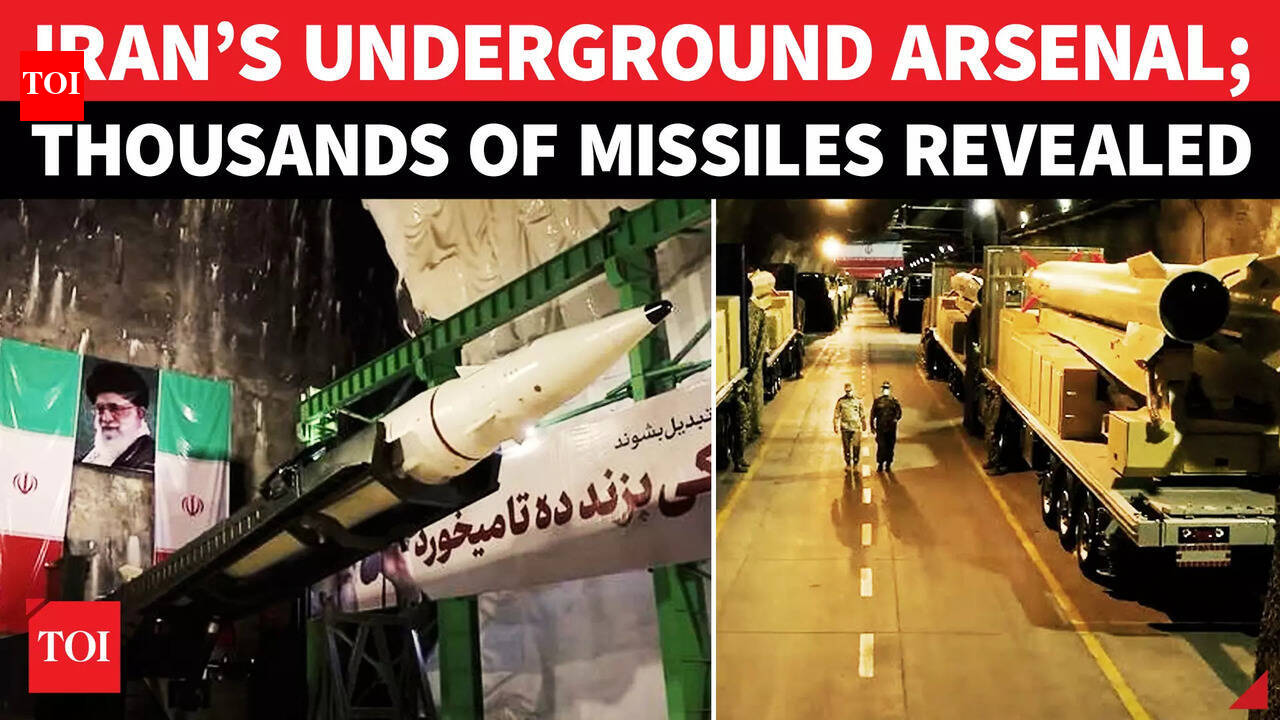
Reports indicate that Iran publicly unveiled a significant subterranean missile installation, which officials characterized as the nation's most strategically vital underground complex. This revelation, according to state media footage, occurred during a period described as preceding a potential conflict with Israel and the United States. Situated deep within Iran's formidable mountainous landscape, the expansive facility reportedly houses a substantial arsenal, including thousands of sophisticated ballistic missile systems. Among these advanced armaments are long-range variants such as the Kheibar Shekan, Sejil, Emad, and Qadr, all purportedly designed to enhance Tehran's capacity for military strikes and reinforce its deterrent stance against perceived threats. Iranian military authorities lauded the complex as a fundamental component of the country's defense infrastructure, emphasizing its robust construction and wide array of missile capabilities amidst a backdrop of increasing regional instability. This strategic disclosure aimed to project strength and readiness during a sensitive geopolitical climate.
The timing of this disclosure, as reported, is particularly noteworthy, occurring at a juncture described as preceding a potential military engagement with Israel and the United States. This context underscores Iran's long-standing strategy of developing indigenous military capabilities, particularly in missile technology, as a cornerstone of its national security doctrine. For decades, Tehran has invested heavily in ballistic missile programs, viewing them as a crucial asymmetrical advantage against technologically superior adversaries and a vital tool for maintaining regional influence. The construction of such an extensive underground complex, nestled within natural fortifications, reflects a strategic imperative to protect these critical assets from aerial bombardment and conventional attacks, ensuring their survivability in a conflict scenario. This approach aligns with Iran's broader defense philosophy, which prioritizes self-reliance and the development of a credible deterrent posture to safeguard its sovereignty and strategic interests in a volatile Middle East. The rugged terrain chosen for the site further amplifies its defensive attributes, making detection and neutralization exceptionally challenging for any potential aggressor.
State media broadcasts offered a glimpse into the vastness of this subterranean network, depicting an elaborate facility capable of accommodating an immense number of advanced ballistic missiles. Reports indicate the complex is equipped with thousands of these formidable weapons, highlighting the sheer scale of Iran's strategic missile reserves. Specifically named systems, such as the long-range Kheibar Shekan, known for its precision and extended reach; the Sejil, a solid-propellant missile offering rapid deployment; the Emad, a guided missile designed for improved accuracy; and the Qadr, another long-range liquid-propellant system, were prominently featured. These diverse missile types underscore Iran's commitment to developing a multi-layered offensive capability, capable of striking various targets with different operational profiles. Iranian military officials, according to statements, emphasized the "hardened infrastructure" of the complex, suggesting robust defensive measures designed to withstand significant attacks and ensure the operational readiness of its "diverse missile assets" even under duress. This implies a sophisticated engineering effort aimed at creating a resilient and survivable strategic arsenal.
The public unveiling of this extensive underground missile city carries significant geopolitical implications, particularly given the context of escalating regional tensions. By showcasing such a formidable array of ballistic missiles and hardened infrastructure, Iran appears to be sending a clear message about its military resolve and capabilities. This move can be interpreted as a strategic effort to reinforce its deterrence posture, aiming to dissuade potential adversaries from considering military action by demonstrating the high cost of such an endeavor. Experts suggest that revealing these assets, especially the long-range systems like Kheibar Shekan and Sejil, is intended to project a credible threat of retaliation, thereby enhancing Tehran's bargaining power in regional and international diplomacy. The emphasis on the facility being a "core pillar" of national defense underscores its perceived importance within Iran's overall security strategy, suggesting a long-term commitment to maintaining and expanding its missile program despite international pressure. This transparency, albeit controlled through state media, serves as a calculated display of strength in a volatile geopolitical landscape.
In summary, Iran's revelation of its extensive underground missile complex, housing thousands of advanced ballistic systems including the Kheibar Shekan, Sejil, Emad, and Qadr, marks a significant moment in regional military posturing. Attributed by Iranian officials as the nation's most strategically important subterranean facility, its public display via state media, reportedly preceding a potential conflict with Israel and the U.S., highlights Tehran's intent to bolster its strike capabilities and reinforce its deterrent stance. The emphasis on hardened infrastructure and diverse missile assets underscores a sophisticated and resilient defense strategy. As regional tensions persist, the operational status and strategic implications of this "missile city" will undoubtedly remain a focal point for international observers and security analysts, shaping perceptions of Iran's military power and its role in the broader Middle East. The move signals a continued commitment to developing and showcasing its indigenous missile program as a cornerstone of national security.