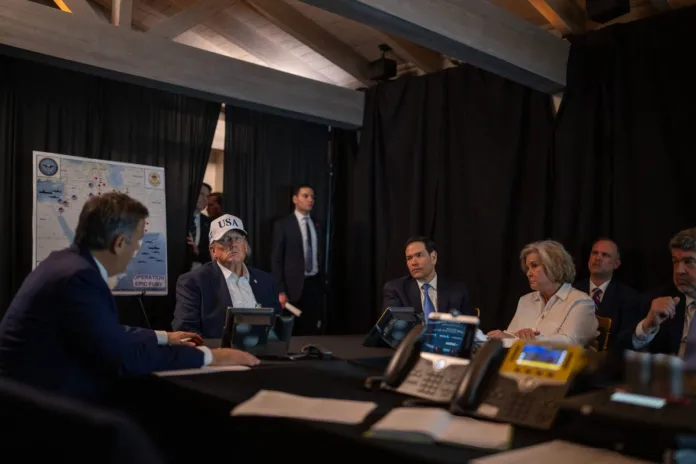
The White House recently made public a series of photographs depicting President Donald Trump and his senior national security team actively engaged in overseeing military operations targeting the Islamic Republic of Iran. These images, disseminated via the White House's official social media channels, capture critical moments during the initial phases of what has been designated "Operation Epic Fury." President Trump established a temporary command center at his Mar-a-Lago residence in Florida for this purpose, where he was joined by key advisors. Concurrently, Vice President JD Vance convened a parallel high-level meeting within the secure confines of the White House Situation Room in Washington D.C., ensuring comprehensive oversight of the unfolding events. The release of these visual records provides a rare glimpse into the decision-making processes and the coordination involved during a significant military action, underscoring the gravity of the strikes launched against Iran on Friday night, as confirmed by official reports.
The decision to launch "Operation Epic Fury" against Iran emerges from a complex geopolitical landscape marked by persistent tensions between the United States and the Islamic Republic. While specific triggers for this particular operation were not detailed in the released information, such military actions typically follow periods of heightened rhetoric, perceived threats, or retaliatory measures. The establishment of a forward operating hub at Mar-a-Lago by President Trump for a critical national security event is a notable departure from traditional protocols, highlighting the President's preference for his Florida estate as a base of operations. This setup necessitated a dual command structure, with Vice President Vance leading a separate but coordinated effort from the conventional White House Situation Room. Reports further indicate a collaborative effort, with the United States and Israel jointly involved in the strikes against Iran, signaling a broader regional strategy and alliance in addressing perceived threats from Tehran.
The photographs released by the White House offer specific insights into the composition of the teams involved in directing "Operation Epic Fury." At President Trump's Mar-a-Lago command center, Secretary of State Marco Rubio was prominently featured, indicating the diplomatic dimension of the military action. Also present were White House Chief of Staff Susie Wiles, CIA Director John Ratcliffe, and Chairman of the Joint Chiefs of Staff Dan Caine, forming a core group of military and intelligence leadership. Meanwhile, Vice President JD Vance's meeting in the White House Situation Room included Director of National Intelligence Tulsi Gabbard, Energy Secretary Chris Wright, and Treasury Secretary Scott Bessent, alongside other Cabinet members who were not in Florida. Prior to the strikes on Friday night, Secretary Rubio reportedly engaged in outreach to members of Congress's bipartisan "Gang of Eight," a group typically briefed on sensitive intelligence matters. A State Department spokesperson confirmed that one member of this critical congressional group could not be successfully contacted before the operation commenced.
The public dissemination of images depicting high-level officials directing military operations from both a presidential residence and the traditional Situation Room carries significant implications. Analysts suggest that the White House's decision to release these photographs serves multiple purposes, including projecting an image of decisive leadership and transparency during a critical national security event. It also underscores the administration's capacity for rapid response and coordination, even when the President is away from the capital. The dual command structure, with President Trump at Mar-a-Lago and Vice President Vance at the White House, highlights the adaptability of the national security apparatus but also raises questions about the logistical and communication challenges inherent in such a setup. Observers note that such an assertive military action against Iran, particularly one reportedly conducted in conjunction with Israel, could be interpreted as a strategic move designed to test Iran's resolve and elicit a response, potentially reshaping the dynamics of power in the Middle East. The pre-strike notification to Congressional leaders, despite one reported communication gap, emphasizes the administration's adherence to established protocols for informing the legislative branch on sensitive military actions.
In summary, the White House has provided a rare public glimpse into the command and control structure overseeing "Operation Epic Fury," a significant military engagement targeting Iran. The images confirm President Trump's leadership from a makeshift war room at Mar-a-Lago, complemented by Vice President Vance's coordination from the White House Situation Room, involving a broad array of national security and cabinet officials. This joint US-Israel operation, launched on Friday night, was preceded by diplomatic outreach to Congress, though not without minor communication challenges. The release of these photographs is likely intended to convey strength and transparency in the face of escalating regional tensions. Moving forward, the international community will be closely monitoring Iran's reaction to these strikes, the broader geopolitical fallout, and any further details the administration may release regarding the objectives and outcomes of "Operation Epic Fury."