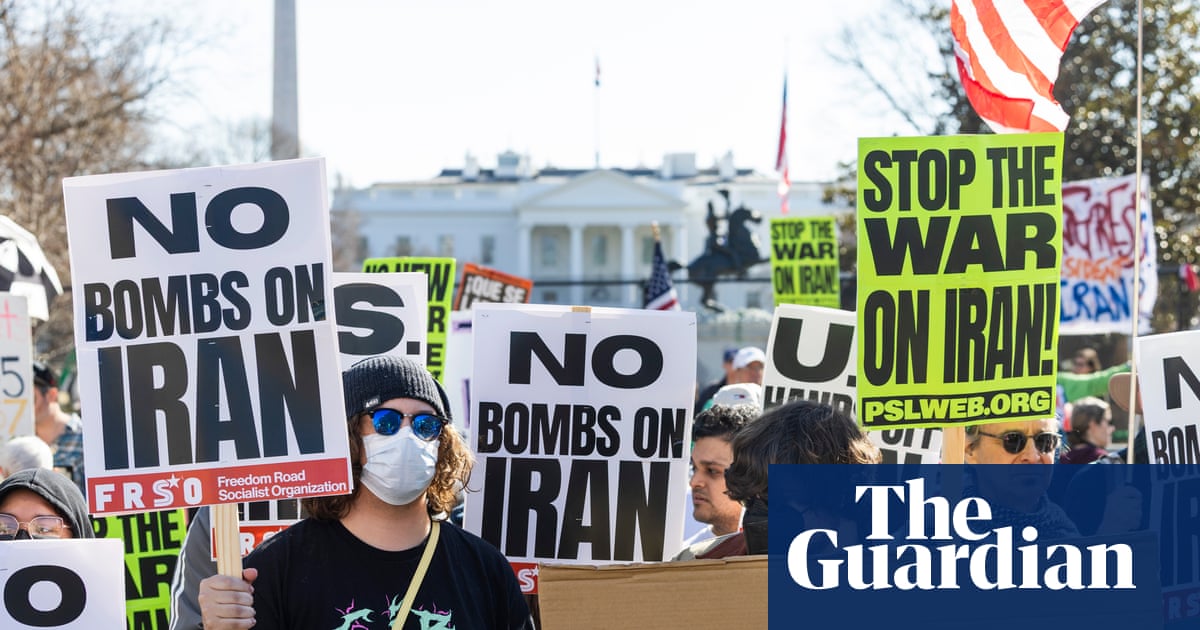
Across the United States, anti-war activists mobilized in significant numbers, staging protests in major urban centers and smaller communities alike, following unconfirmed news reports suggesting that Iran's Supreme Leader, Ali Khamenei, had been killed. These reports indicated that the alleged demise of the influential figure occurred during a series of US and Israeli airstrikes targeting Tehran, an operation identified by some as 'Operation Epic Fury.' Demonstrators converged on prominent locations, including the vicinity of the White House in Washington D.C. and New York City's iconic Times Square, to vociferously express their opposition to what they perceive as escalating American military involvement in the Middle East. The rapid organization of these rallies underscores a deep-seated public apprehension regarding the potential for broader conflict and the perceived unilateral nature of recent foreign policy decisions, with many participants citing a lack of Congressional approval for such aggressive actions. The protests served as an immediate public response to a highly volatile geopolitical situation, reflecting widespread concern over the implications of such a significant event.
The backdrop to these widespread demonstrations is a period of heightened tension in the Middle East, exacerbated by the circulating reports of the Iranian Supreme Leader's death. While details surrounding the alleged US and Israeli airstrikes on Tehran remained fluid, the mere suggestion of such a high-profile casualty ignited immediate public outcry and calls for de-escalation. This incident, according to various commentators and protesters, appears to fit into a broader pattern of the current administration's assertive foreign policy approach, which has been characterized by a sense of 'fait accompli' in international affairs. For instance, the recent capture of Venezuelan President Nicolás Maduro was cited by some attendees at the New York gathering as another example of the administration's willingness to act decisively without extensive prior consultation or traditional diplomatic channels. The swift organization of protests across numerous states, from the East Coast to the West, highlights the profound and immediate impact that developments in the region have on domestic political discourse and public sentiment regarding military engagement.
The anti-war movement's reach extended far beyond the nation's capital and New York, with scores of additional emergency protests sponsored by a diverse coalition of left-wing organizations. This alliance included prominent groups such as the ANSWER Coalition, the National Iranian American Council, 50501, American Muslims for Palestine, the People’s Forum, Palestinian Youth Movement, CodePink, Black Alliance for Peace, and the Democratic Socialists of America. These groups listed numerous other protest locations for both Saturday and Sunday, encompassing major cities like Atlanta, Baltimore, Boston, Chicago, Cincinnati, Denver, Las Vegas, Los Angeles, Miami, and Minneapolis, alongside smaller communities including Albany, New York; Ellensburg, Virginia; Chattanooga, Tennessee; Decorah, Iowa; Gainesville, Florida; and Springfield, Missouri. Protesters voiced strong criticisms of the administration's actions, with one demonstrator, Sue Johnson, asserting that the military engagement lacked Congressional sanction, suggesting it reflected a move towards a 'fascist state.' Johnson further characterized the President's actions as impulsive, stating he 'just couldn’t wait' and 'bombed Iran for no specific reason,' while also acknowledging a perceived disregard for Congressional authority in foreign policy decisions.
The immediate and widespread nature of these protests signals a significant public challenge to the administration's foreign policy strategy and its perceived unilateral actions. The core of the protesters' grievances revolves around the constitutional framework governing military engagement, specifically the role of Congress in authorizing the use of force. Critics argue that any military action against another sovereign nation, particularly one as significant as the alleged strikes on Tehran, must receive explicit Congressional approval to be considered legitimate and legal. This perspective highlights a fundamental tension between executive authority and legislative oversight in matters of war and peace. The sentiment of 'fait accompli,' as observed by attendees at the New York rally, suggests a growing concern that the administration is bypassing traditional checks and balances, potentially eroding democratic principles in foreign policy decision-making. Such a perception could have lasting implications for public trust in governmental processes and the future of American engagement on the global stage, fostering a climate of distrust and further polarizing the political landscape.
In conclusion, the nationwide anti-war protests, ignited by unconfirmed reports of Iran's Supreme Leader Ali Khamenei's death in alleged US and Israeli airstrikes, underscore a profound public apprehension regarding military escalation in the Middle East. The demonstrations, organized by a broad coalition of activist groups, highlighted deep concerns over the legality and wisdom of the administration's perceived unilateral foreign policy actions, particularly the apparent sidestepping of Congressional authorization for military engagement. As the situation continues to unfold, observers will be closely watching for further official statements regarding the alleged strikes, the verification of the Supreme Leader's status, and the administration's response to the growing domestic opposition. The sustained momentum of these protests could signal a renewed push for greater Congressional oversight in foreign policy and a re-evaluation of the nation's approach to international conflicts, making the coming days crucial for understanding the trajectory of both domestic dissent and geopolitical tensions.