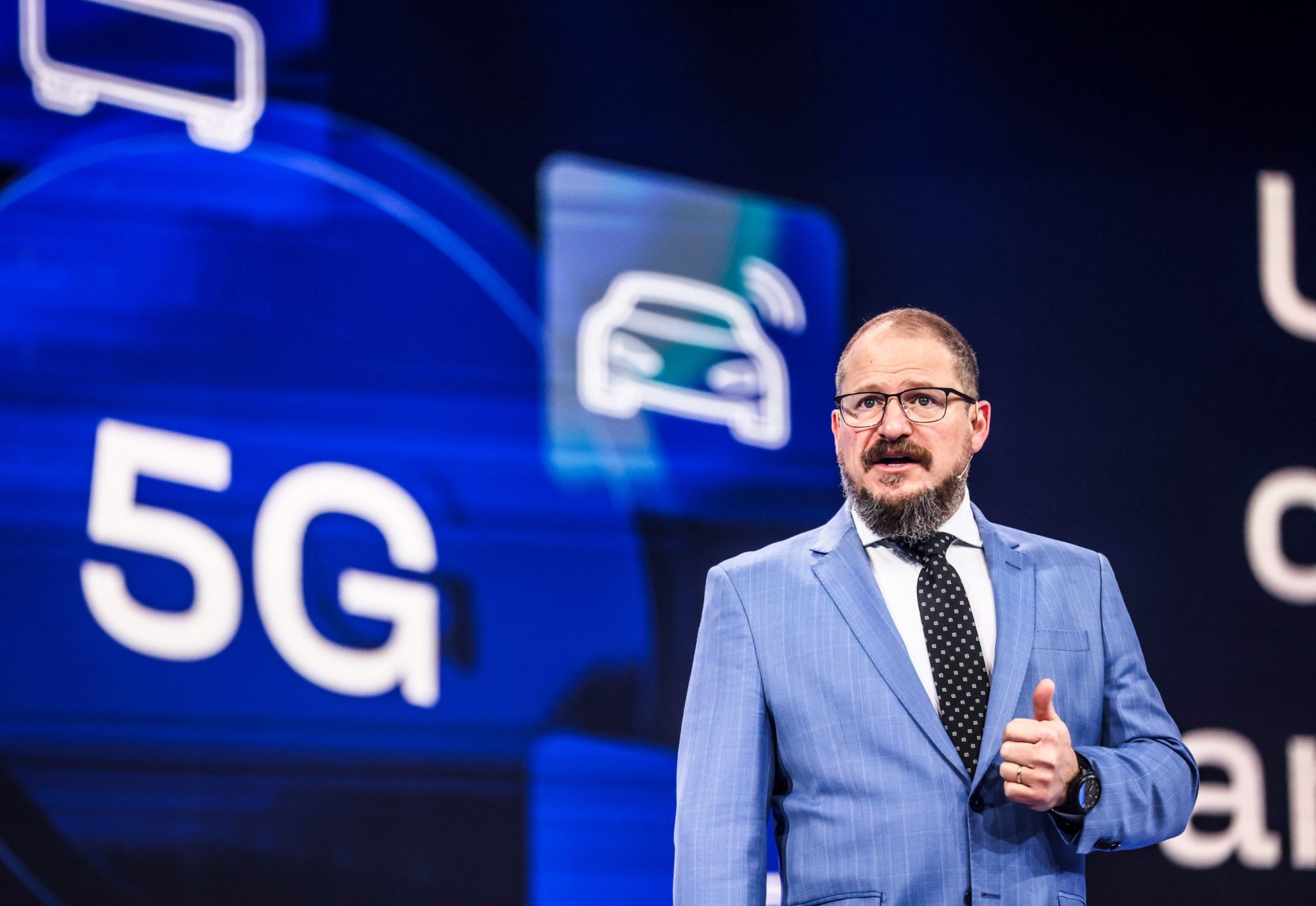
At the bustling Mobile World Congress in Barcelona, Qualcomm's chief executive, Cristiano Amon, delivered a compelling vision for the future of connectivity, asserting that the impending 6G mobile revolution will fundamentally reshape human interaction with technology. Amon's statements, made amidst a global gathering of digital innovators, paint 6G not merely as an incremental upgrade but as the foundational telecommunication system for the burgeoning age of artificial intelligence. This next-generation network, according to industry leaders present, is poised to enable the long-anticipated 'internet of everything,' where devices beyond traditional smartphones become seamlessly integrated into a vast digital ecosystem. Qualcomm, a telecommunications giant ranked 117th on the Fortune 500 list, held a prominent position at the event, showcasing its central role in driving this transformative shift. The consensus among experts at the congress is that 6G's arrival signifies a technological leap far more profound than any previous mobile generation, promising to redefine personal computing and our daily digital experiences.
The current technological inflection point at Mobile World Congress is being described by some attendees as significantly more impactful than the advent of email in the early 1990s. Reflecting on past technological shifts, one journalist recalled the cumbersome process of sending their first email, an experience they initially believed would never supersede the efficiency of a fax machine. This historical perspective highlights a recurring skepticism towards nascent technologies, much like the early days of the internet, which nonetheless proceeded to revolutionize information dissemination. The same journalist, as editor of a major UK media section, even questioned the future of print media with a front-page headline, 'The End of Newspapers?', upon acquiring one of the first WAP-enabled mobile phones. Despite such early doubts, newspapers have endured, yet the scale of the impending 6G and AI integration is now seen as a far more consequential paradigm shift. Qualcomm, founded in San Diego during the 1980s, has consistently been at the forefront of these debates, evolving from its roots to become a pivotal player in shaping our tech-enabled world.
The expansive exhibition halls at Mobile World Congress were a testament to the breadth of innovation on the horizon, featuring a diverse array of cutting-edge technologies. Attendees explored advancements in robotics, including robots adept at preparing sushi, alongside immersive virtual reality experiences like table football. The event also showcased futuristic concepts such as automobiles functioning as mobile communication hubs and advanced medical devices with the potential to significantly impact global health. A significant portion of these displays, particularly within one of the largest pavilions, belonged to Qualcomm, underscoring its influence in the telecommunications sector. Qualcomm's chief executive, Cristiano Amon, articulated the profound impact of AI, stating, “AI will fundamentally change our mobile experiences.” He further elaborated that this shift “is going to change how we think about our smartphones. Think about our personal computing. Think about and interact with” the digital world. Unlike its predecessors—2G for calls, 3G for texts, 4G for data, and 5G for smartphones—6G is envisioned as the comprehensive telecommunication backbone for the AI era, facilitating seamless data exchange between humans, AI agents, and the physical environment, where traditional phones will represent just one facet of a broader digital ecology.
The impending arrival of 6G signals the full realization of the 'internet of everything,' a concept that promises to integrate virtually every aspect of our physical world into a connected digital network. This profound shift extends beyond mere device connectivity, aiming to create an intelligent environment where AI agents interact seamlessly with human users and real-world data streams. The challenges and opportunities presented by this interconnected future are already being explored, with specialized IQ AI exhibits at the congress grappling with the complex relationship between human agency and the multitude of AI assistants that will offer both assistance and, potentially, raise new questions about trust and autonomy. The sentiment conveyed by industry leaders, including Qualcomm's CEO, suggests an inevitable and transformative wave of change, implying that efforts to resist this technological evolution would be futile. This paradigm shift is expected to redefine not only how we communicate but also how we perceive and interact with personal computing and the digital realm at large, ushering in an era of pervasive intelligence.
In summary, the Mobile World Congress in Barcelona served as a pivotal platform for Qualcomm's CEO, Cristiano Amon, to articulate the monumental significance of 6G. This next-generation mobile technology is poised to transcend previous iterations, acting as the essential infrastructure for the AI age and finally bringing the 'internet of everything' to fruition. Amon's vision underscores a future where AI fundamentally reshapes our mobile and personal computing experiences, integrating digital intelligence into every facet of daily life. As Qualcomm continues to lead the charge in this telecommunications evolution, the industry is now focused on the practical implementation and societal implications of a world where phones are but one component of a vast, intelligent digital ecology. The coming years will reveal the full extent of this transformation, as the lines between the physical and digital worlds increasingly blur under the pervasive influence of 6G and artificial intelligence.