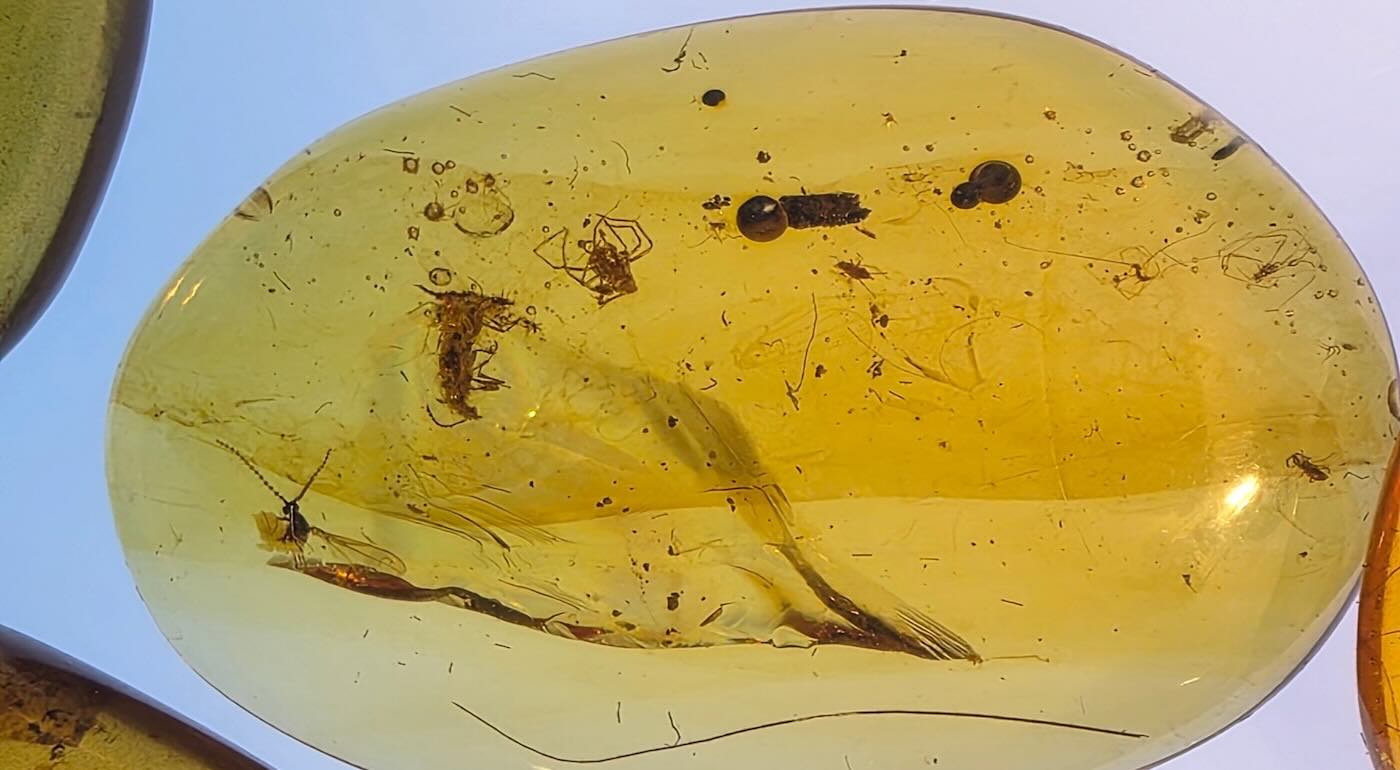
Recent scientific attention has been drawn to exceptionally rare insect fossils encased within ancient amber, particularly those originating from the Cretaceous period. These remarkable inclusions are prompting researchers to re-evaluate long-held assumptions about the ecological contributions and previously unknown behaviors of these tiny creatures from millions of years in the past. While insects are fundamental components of virtually every terrestrial ecosystem, their delicate anatomies mean they are seldom preserved in the conventional fossil record, making it extraordinarily challenging to reconstruct their historical roles and interactions. However, the unique properties of fossilized tree resin offer an unparalleled window into these ancient worlds, encapsulating organisms in a state of near-perfect preservation. It is these particularly rare instances, where amber has captured not just an insect but a specific, revealing moment of its existence, that are now fueling new inquiries into the 'secret lives' of Cretaceous insects, according to various scientific reports.
The scarcity of insect fossils, especially those detailing intricate behaviors, has long presented a significant hurdle for paleontologists striving to understand ancient biodiversity and ecological dynamics. Unlike organisms with robust skeletal structures, insects possess fragile exoskeletons that rapidly decompose or are scavenged after death, leaving little trace in sedimentary rock formations. This inherent fragility makes comprehensive studies of their roles in habitats spanning millions of years an arduous task. Yet, a distinct and invaluable form of preservation emerges through fossilized tree resin. This viscous substance, exuded by ancient trees, can swiftly engulf small organisms, creating an anaerobic environment that protects them from decay and geological pressures. Over vast stretches of geological time, this resin hardens into amber, effectively freezing a precise moment in time, capturing not only the physical form of an insect but sometimes even its final actions or interactions. This unique preservation mechanism provides an unparalleled level of detail, offering insights that conventional fossilization simply cannot.
The true scientific value of these amber inclusions becomes most apparent when they capture more than just an individual specimen; they can encapsulate entire ecological vignettes. While specific discoveries are continually emerging, the general scientific understanding suggests that such finds can illuminate a spectrum of 'secret lives' previously hidden from direct observation. These might include predatory encounters frozen mid-strike, parasitic relationships where one organism is attached to another, or even evidence of ancient pollination events, showcasing co-evolutionary relationships between insects and plants. Furthermore, amber can preserve delicate anatomical features, such as wing venation, mouthparts, or even internal structures visible through advanced imaging techniques, offering clues about diet, locomotion, and sensory capabilities. Researchers emphasize that these detailed snapshots provide crucial data points for reconstructing ancient food webs, understanding behavioral evolution, and tracing the diversification of insect groups through the Mesozoic Era, particularly during the Cretaceous period when many modern insect orders were diversifying.
These rare and precious fossil finds carry profound implications for the fields of paleontology and evolutionary biology. By offering direct evidence of ancient insect behaviors and interactions, they allow scientists to move beyond mere morphological descriptions to infer ecological roles with greater confidence. For instance, the discovery of a specific feeding interaction or a parasitic relationship within amber can provide concrete proof for hypotheses about ancient food chains or disease vectors that were previously speculative. Such insights are instrumental in refining our understanding of how ecosystems functioned millions of years ago, how species adapted to their environments, and the intricate dance of co-evolution between different life forms. Experts suggest that each new amber inclusion that captures a behavioral moment contributes significantly to filling critical gaps in the fossil record, offering tangible data points that can validate or challenge existing evolutionary models and phylogenetic trees, thereby enriching our overall comprehension of life's deep history on Earth.
In conclusion, the ongoing discovery of exceptionally preserved insects within Cretaceous amber represents a vital frontier in paleontological research. These unique fossilized moments offer an unparalleled opportunity to peer directly into the 'secret lives' of ancient arthropods, revealing behaviors, ecological roles, and anatomical details that would otherwise be lost to time. While the challenges of studying creatures from millions of years ago remain, the distinct preservation capabilities of amber continue to provide invaluable data, reshaping our understanding of Earth's past ecosystems. Scientists anticipate that as more of these rare inclusions come to light, they will continue to raise new questions and provide compelling answers, further illuminating the complex and critical roles insects played in shaping the ancient world and guiding the trajectory of life on our planet. The continued exploration of these amber treasures promises to unlock even more secrets from the Cretaceous period.