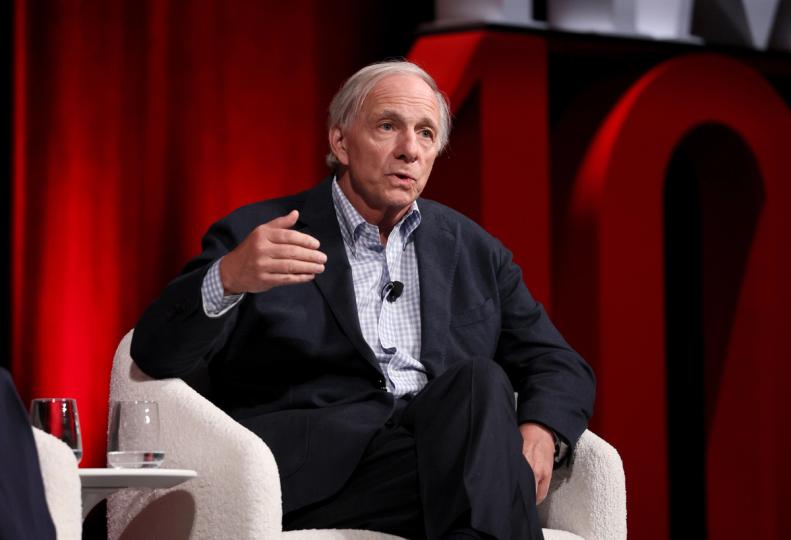
Billionaire hedge fund manager Ray Dalio has recently reignited a debate within financial circles by expressing renewed skepticism about Bitcoin's long-term viability and its comparison to gold. Speaking on a recent podcast, the founder of Bridgewater Associates articulated concerns regarding the digital asset's perceived lack of privacy, absence of central bank endorsement, and potential vulnerabilities stemming from future quantum computing advancements. According to reports, Dalio specifically highlighted Bitcoin's public ledger, suggesting that its transparent nature could lead to monitoring and potential control of transactions. However, these critiques have been met with swift and strong rebuttals from prominent figures within the cryptocurrency industry, who argue that Dalio's points represent 'tired narratives' and that the very risks he identifies are precisely what make Bitcoin an attractive long-term investment for those betting on its future evolution and widespread adoption. Industry leaders contend that these perceived weaknesses are either already factored into Bitcoin's current valuation or are actively being addressed by ongoing technological developments.
Dalio's recent comments are not an isolated incident but rather a continuation of his longstanding engagement with and critical perspective on digital assets. Last year, the renowned investor disclosed a modest 1% allocation to Bitcoin, even while voicing reservations about its potential as a global reserve asset. At that time, his concerns largely revolved around the asset's traceability and the existential threat posed by quantum computing, themes he has now reiterated. This ongoing dialogue between a titan of traditional finance and the burgeoning crypto sector underscores a fundamental philosophical divide regarding the nature of value, security, and monetary systems. The critiques from figures like Dalio typically reflect established paradigms of financial stability and control, contrasting sharply with the decentralized, permissionless ethos championed by many in the cryptocurrency community. The significance of this debate lies in its potential to influence institutional adoption and regulatory frameworks for digital currencies globally, shaping their trajectory in the broader financial landscape.
In response to Dalio's renewed skepticism, several influential voices from the crypto industry have offered pointed counter-arguments. Matt Hougan, Chief Investment Officer at Bitwise, reportedly stated that the very risks highlighted by Dalio are precisely why Bitcoin's market capitalization currently stands at approximately 4% of gold's. Hougan's perspective suggests that long-term investors are making a calculated bet that these challenges will be overcome through innovation and time, unlocking significant future upside potential. Further reinforcing this sentiment, Alex Thorn of Galaxy and Matthew Sigel from VanEck countered Dalio's assessment by emphasizing Bitcoin's continuous growth in adoption and utility. They also pointed out that the industry is actively engaged in developing solutions to mitigate the theoretical risks associated with quantum computing, indicating that these are not insurmountable obstacles but rather areas of ongoing development and improvement. These experts collectively argue that Dalio's concerns, while valid in an absolute sense, are already priced into the asset's current valuation and do not fully account for its dynamic evolution.
The ongoing pushback against Dalio's analysis highlights a crucial divergence in how different financial sectors perceive risk and opportunity within the digital asset space. For many in traditional finance, the lack of central bank backing and the transparency of a public ledger are seen as inherent vulnerabilities, potentially leading to instability or governmental intervention. Conversely, proponents of Bitcoin often view these very characteristics as strengths, embodying decentralization, censorship resistance, and an immutable record – qualities they believe are essential for a truly global and independent monetary system. The debate also touches upon the concept of 'priced-in' risk, where the market's current valuation of an asset is presumed to already account for known challenges. Experts suggest that if quantum computing risks or surveillance concerns were truly existential and unaddressable, Bitcoin's market value would be significantly lower, implying that current investors are either dismissing these threats or anticipating technological solutions. This ongoing dialogue is critical for the maturation of the crypto market, forcing both sides to refine their arguments and consider the evolving landscape of digital finance.
In summary, Ray Dalio's recent warnings regarding Bitcoin's perceived shortcomings, particularly its comparison to gold and potential vulnerabilities to quantum computing and surveillance, have once again brought to the forefront a fundamental debate within the global financial community. While Dalio, a seasoned investor, highlights what he views as significant risks, leading figures in the cryptocurrency sector contend that these very concerns are either already reflected in Bitcoin's market valuation or are actively being addressed through ongoing innovation and increasing utility. The core takeaway is a philosophical clash between traditional financial prudence and the disruptive potential of decentralized digital assets. As Bitcoin continues to mature and integrate into the broader financial ecosystem, the resolution of these long-standing debates—particularly around security, privacy, and institutional acceptance—will undoubtedly play a pivotal role in shaping its future trajectory and its ultimate position as a global financial instrument.