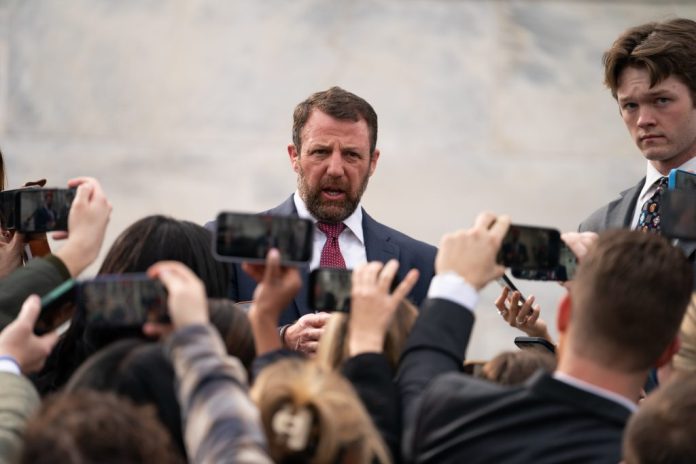
Senator Markwayne Mullin, a Republican representing Oklahoma, has been tapped by President Donald Trump to assume the critical role of Homeland Security Secretary, a move that has immediately drawn attention to his well-documented history of public confrontations within the halls of Congress. The announcement, made on Thursday, indicates that Mullin is set to replace current Homeland Security Secretary Kristi Noem, with his tenure slated to commence on March 31. This high-profile nomination places Mullin, known for his background as a professional wrestler and trained mixed martial arts (MMA) fighter, at the center of another significant public debate, as his confirmation process is expected to scrutinize his often-combative legislative style. Having served approximately three years in the Senate following a decade in the House of Representatives, Mullin's political career has been marked by a willingness to engage in direct and sometimes fiery exchanges, a characteristic now under renewed focus as he prepares for a pivotal cabinet position responsible for national security.
Mullin's journey from the wrestling ring to the legislative arena has shaped a distinctive political persona, characterized by a direct and often confrontational approach to debate and policy discussions. His professional background, which includes competitive wrestling and MMA training, has frequently been cited by observers as influencing his assertive communication style in Washington. Over his thirteen years in Congress, encompassing ten years in the House and roughly three in the Senate, Mullin has cultivated a reputation for not shying away from heated exchanges, often making headlines for his outspoken remarks and willingness to challenge political opponents directly. This consistent pattern of engaging in what have been described as 'historic clashes' underscores a significant aspect of his public service, setting a precedent for the kind of interactions that could define his confirmation hearings and, if confirmed, his leadership at the Department of Homeland Security. His nomination for such a sensitive role, therefore, invites a deeper examination of how his past conduct might inform his future effectiveness and public perception.
Among Senator Mullin's most notable and widely reported congressional confrontations are his repeated clashes with Senator Bernie Sanders. One such incident occurred in February 2026 during a Senate hearing concerning Dr. Casey Means, President Trump’s nominee for surgeon general. During a discussion on the imperative for affordable healthcare, Mullin reportedly acknowledged, "I ranted too long," prompting Senator Sanders to interject with a concise, "Yes, you did!" This brief exchange quickly escalated, with Mullin responding pointedly to Sanders, stating, "I’m sorry, I didn’t ask your opinion on that, and if I cared about your opinion, I would ask you, but I don’t care about your opinion." Mullin further attributed systemic issues to Sanders, asserting, "You’re part of the system. You’re part of the problem. You’ve been sitting here longer than I’ve even been alive! This is your problem. You should have fixed this a long time ago. You’ve been railing on it so long. What have you been doing?" This direct challenge followed another instance in December 2025, when Mullin, while delivering a speech on the Give Kids A Chance Act, reportedly likened Senator Sanders to the Grinch, a character known for his aversion to holiday cheer, further illustrating Mullin's penchant for sharp, personal rhetoric in political discourse.
The nomination of Senator Mullin for such a pivotal cabinet position, given his history of public and often fiery confrontations, presents a complex dynamic for both the administration and the Senate. Observers suggest that Mullin's combative style, while potentially appealing to a segment of the electorate that values directness and a willingness to challenge established norms, could also pose challenges during the rigorous confirmation process. His past exchanges, particularly those with a prominent figure like Senator Sanders, highlight a political approach that prioritizes assertive debate over diplomatic consensus-building. This characteristic, rooted in his background as a professional fighter, might be perceived differently in the context of leading a vast federal agency like DHS, which requires extensive collaboration, nuanced policy implementation, and careful international relations. The implications of such a leadership style for an agency tasked with critical national security functions, from border protection to cybersecurity, will undoubtedly be a central theme as the Senate considers his suitability for the role, prompting questions about his capacity for measured leadership in high-stakes environments.
As Senator Markwayne Mullin prepares for his confirmation hearings as President Trump's nominee for Homeland Security Secretary, his distinctive and often confrontational political style remains a significant point of discussion. His background as a professional fighter and his thirteen years in Congress have been marked by a series of public clashes, most notably with Senator Bernie Sanders, which have underscored his direct and assertive approach to political discourse. The transition from a legislative role, where such exchanges are common, to a high-level cabinet position like DHS Secretary will require a careful examination of his temperament and leadership capabilities. The upcoming confirmation process will serve as a crucial platform for senators to scrutinize how Mullin's past conduct might translate into effective leadership of a critical national security agency, making his hearings a key event to watch for insights into the future direction of homeland security policy and the tenor of executive branch leadership.