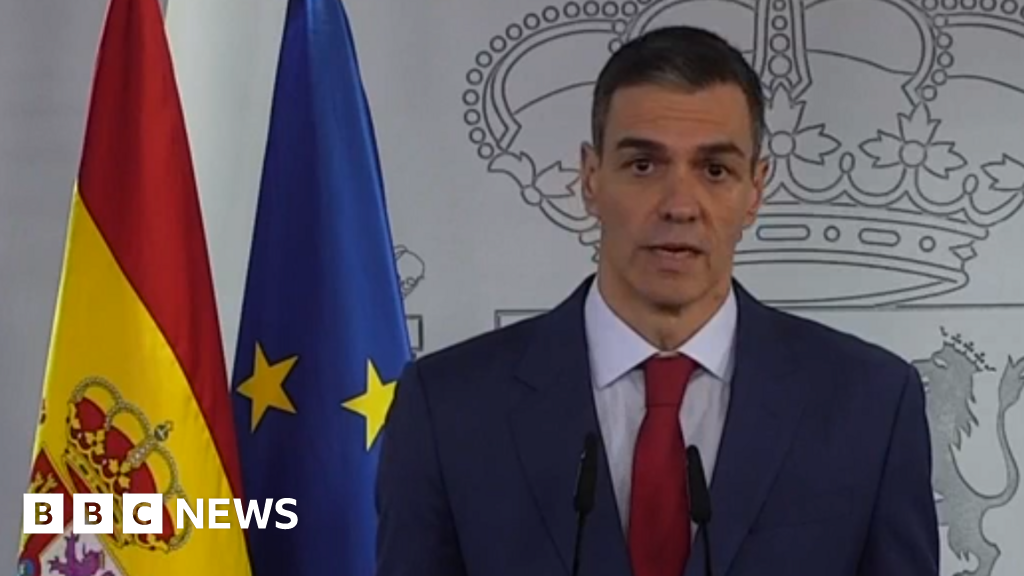
Spanish Prime Minister Pedro Sánchez has issued a robust rejection of former US President Donald Trump's recent threat to impose a comprehensive trade embargo on Spain. In a televised address lasting ten minutes, Sánchez articulated a clear stance against conflict, encapsulated by his declaration of "No to war," and underscored the critical importance of upholding international legal frameworks. This forceful rebuttal comes after Trump reportedly threatened to sever all trade ties with Spain, expressing his strong disapproval of Madrid's refusal to permit the United States to utilize the jointly operated military bases at Morón and Rota for potential strikes against Iran. Trump's remarks, made during a meeting with German Chancellor Friedrich Merz, also included an accusation that Spain had been "terrible" in its dealings with the US, setting the stage for a significant diplomatic disagreement between the two long-standing allies. Sánchez's address, delivered from the prime minister's residence, reflects a principled position that links current global conflicts, such as those in Ukraine and Gaza, with historical events like the Iraq War, emphasizing a consistent commitment to peace and international norms.
The escalating tension between the United States and Spain stems primarily from two key grievances articulated by Donald Trump. Firstly, Spain's government has reportedly declined to grant the US permission to launch military operations targeting Iran from the strategically important Morón and Rota air bases, which are jointly managed by both nations. This refusal appears to be a direct catalyst for Trump's threat of a full trade embargo, signaling a potential shift in the long-standing military cooperation between the two countries. Secondly, Trump has also criticized Spain's contributions to the North Atlantic Treaty Organization (NATO), labeling Spain a "terrible partner" for allegedly failing to meet a specific defense spending target. According to reports, Trump indicated Spain had not increased its defense budget to a level equivalent to 5% of its economic output (GDP), a figure he seemingly expects from NATO allies. The implications of a trade cut, as threatened by Trump, could be substantial for both economies, potentially disrupting established supply chains and economic partnerships. German Chancellor Friedrich Merz, present during Trump's initial statements, reportedly conveyed to Trump that any separate economic agreement with Germany could not exclude Spain or the broader European Union, highlighting the interconnected nature of European trade relations.
During his televised address from La Moncloa, the official residence of the Spanish Prime Minister, Pedro Sánchez elaborated on the foundational principles guiding his government's foreign policy. He reflected deeply on the devastating human and geopolitical consequences of ongoing conflicts, specifically mentioning the wars in Ukraine and Gaza, and drawing parallels to the Iraq War, which occurred over two decades ago. Sánchez underscored that his government's position on such matters could be concisely summarized as "No to war," a declaration intended to convey Spain's unwavering commitment to peaceful resolutions and adherence to international law. Furthermore, the Prime Minister assured the Spanish populace that his administration is actively evaluating and developing a range of economic measures designed to mitigate any potential adverse effects that might arise from the ongoing international disputes or the threatened trade actions. This proactive approach aims to safeguard the economic stability and well-being of Spanish citizens. The intervention by German Chancellor Friedrich Merz during his meeting with Donald Trump further emphasized the collective nature of European economic policy, with Merz reportedly making it unequivocally clear that Germany could not enter into a separate trade arrangement with the US that would bypass or exclude Spain, thereby reinforcing European solidarity in the face of external pressures.
This diplomatic exchange highlights a significant point of friction in transatlantic relations and underscores the broader implications for international alliances and global trade. Should Donald Trump return to the US presidency, his rhetoric and actions could profoundly reshape the dynamics between the United States and its European partners, particularly those like Spain that prioritize adherence to international law and sovereign decision-making regarding military deployments. Experts suggest that such threats of economic retaliation could strain the unity of NATO, potentially exacerbating existing debates over burden-sharing and defense expenditures. Spain's assertion of sovereignty over the use of its military bases, even those jointly operated, reflects a commitment to national interests and a principled stance against unilateral military action without broader international consensus. The incident also brings into sharper focus the tension between a multilateral approach to global security and a more transactional, unilateral foreign policy. The economic ramifications of a full trade embargo, if implemented, would extend beyond Spain, potentially impacting European supply chains and setting a precedent for how powerful nations interact with their allies on matters of defense and commerce.
The firm stance taken by Spanish Prime Minister Pedro Sánchez against Donald Trump's trade threat marks a critical moment in US-Spain relations and broader international diplomacy. Sánchez's emphasis on "No to war" and the importance of international law positions Spain as a proponent of principled foreign policy, even when faced with significant economic pressure. The dispute over military base usage and NATO defense spending targets reveals underlying tensions within the transatlantic alliance, highlighting differing perspectives on security responsibilities and national sovereignty. As the global political landscape continues to evolve, the resolution of such disagreements will be crucial for maintaining stability and cooperation among allies. Observers will be closely watching for further developments, particularly regarding future US elections and how Spain navigates its foreign policy objectives amidst these complex international challenges, ensuring its economic and security interests are protected.