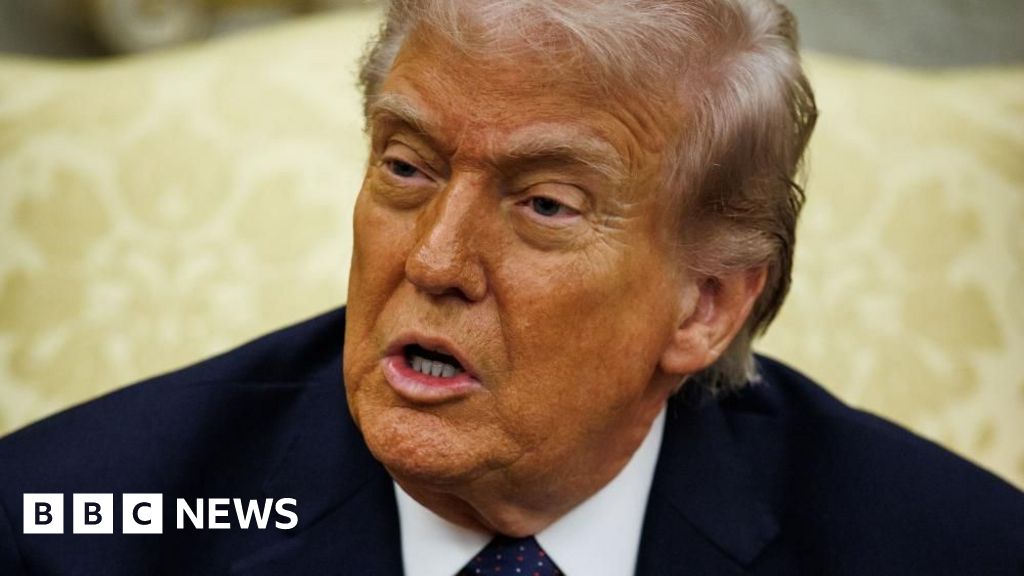
President Donald Trump has issued a stark warning to Spain, indicating a potential cessation of all commercial exchanges between the two nations. This severe threat, articulated during remarks at the White House, reportedly stems from Spain's decision to restrict the United States' access to its military installations for ongoing operations related to Iran. According to statements made by the President, Spain's actions were deemed "terrible," leading to his suggestion that the US would "cut off all trade" and no longer desire any dealings with the European country. He further emphasized his perceived immediate capability to halt all business interactions with Spain, asserting this power could be exercised "tomorrow" or even "today." The precise mechanism by which such a comprehensive trade embargo against a member state of the European Union would be enacted remains unclear, as does the likelihood of the administration proceeding with this significant punitive measure. This declaration marks a notable escalation in diplomatic rhetoric, placing immediate strain on the relationship between Washington and Madrid, and raises questions about the future of bilateral cooperation.
This latest development adds to an already strained relationship between the United States and Spain, which has seen growing friction over several policy areas. A significant point of contention has been the Spanish government's reluctance to meet President Trump's demands for NATO member states to increase their defense spending to the alliance's target of two percent of GDP. The current dispute, however, directly concerns strategic military access, a critical component of US foreign policy, particularly in regions of heightened geopolitical tension like the Middle East. The US has been engaged in various operations concerning Iran, and access to allied military bases provides crucial logistical and operational support. Spain's decision to deny this access underscores a potential divergence in strategic priorities or a desire to avoid entanglement in specific US military endeavors. Such a move by an ally can complicate operational planning and force the US to seek alternative arrangements, potentially increasing costs and logistical challenges for its forces. The broader context involves the delicate balance of alliances and national sovereignty, where host nations weigh their commitments against their own national interests and regional stability concerns.
The legal justification for such an unprecedented trade action against an ally was a focal point of discussion within the administration. President Trump, alongside Treasury Secretary Scott Bessent, asserted that the United States possesses the legal authority to impose an embargo on goods imported from Spain. This claim suggests a belief in broad executive powers to control international trade in matters of national security or economic interest. However, when questioned about the feasibility of the plan, US Trade Representative Jamieson Greer offered a more measured response. While acknowledging the President's "strong power," which he indicated had been clarified by the Supreme Court, Greer stated that the matter would require further discussion. He affirmed that if such measures were deemed necessary to safeguard national and economic security, the administration would proceed. This exchange highlights a potential internal debate or at least a cautious approach to implementing such a drastic policy. Reports indicate these comments were made on a Tuesday, further solidifying the timeline of this significant diplomatic incident. The White House, when approached for comment regarding the trade threat, did not provide an immediate response, leaving many questions unanswered about the administration's immediate next steps.
The President's threat to sever all trade ties with Spain carries profound implications, not only for bilateral relations but also for the broader framework of international alliances and global trade. Such a move, if implemented, would represent a significant departure from established diplomatic norms, potentially setting a precedent for how the US interacts with allies who do not align with its specific foreign policy objectives. Economically, a complete trade halt would have substantial repercussions for both nations, disrupting supply chains, impacting industries, and potentially leading to higher consumer costs. For Spain, as a member of the European Union, an embargo would also raise complex legal and political questions within the EU bloc, potentially challenging the principles of free movement of goods among member states. Analysts suggest that this rhetoric could be interpreted as a tactic to exert pressure on Spain to reconsider its stance on military base access and defense spending, rather than an immediate intention to enact a full trade stoppage. However, the public nature and severity of the threat risk alienating a key European partner and could encourage other allies to question the reliability and predictability of US foreign policy. This situation underscores the delicate balance between national interests, alliance commitments, and the potential for economic leverage in international diplomacy.
In conclusion, President Trump's explicit threat to halt all trade with Spain over its refusal to grant military base access for Iran-related operations marks a critical juncture in US-Spain relations. This declaration, made amidst existing tensions regarding NATO defense contributions, signals a potential shift towards more confrontational diplomacy with traditional allies. While the President and Treasury Secretary have asserted the legal grounds for such an embargo, the US Trade Representative's more cautious remarks and the lack of immediate White House clarification underscore the uncertainty surrounding the actual implementation of this drastic measure. The international community will be closely watching for any follow-through on this threat, which could have far-reaching economic and geopolitical consequences, potentially reshaping alliance dynamics and trade relationships within Europe and beyond. The coming days will reveal whether this remains a rhetorical warning or escalates into tangible policy action.