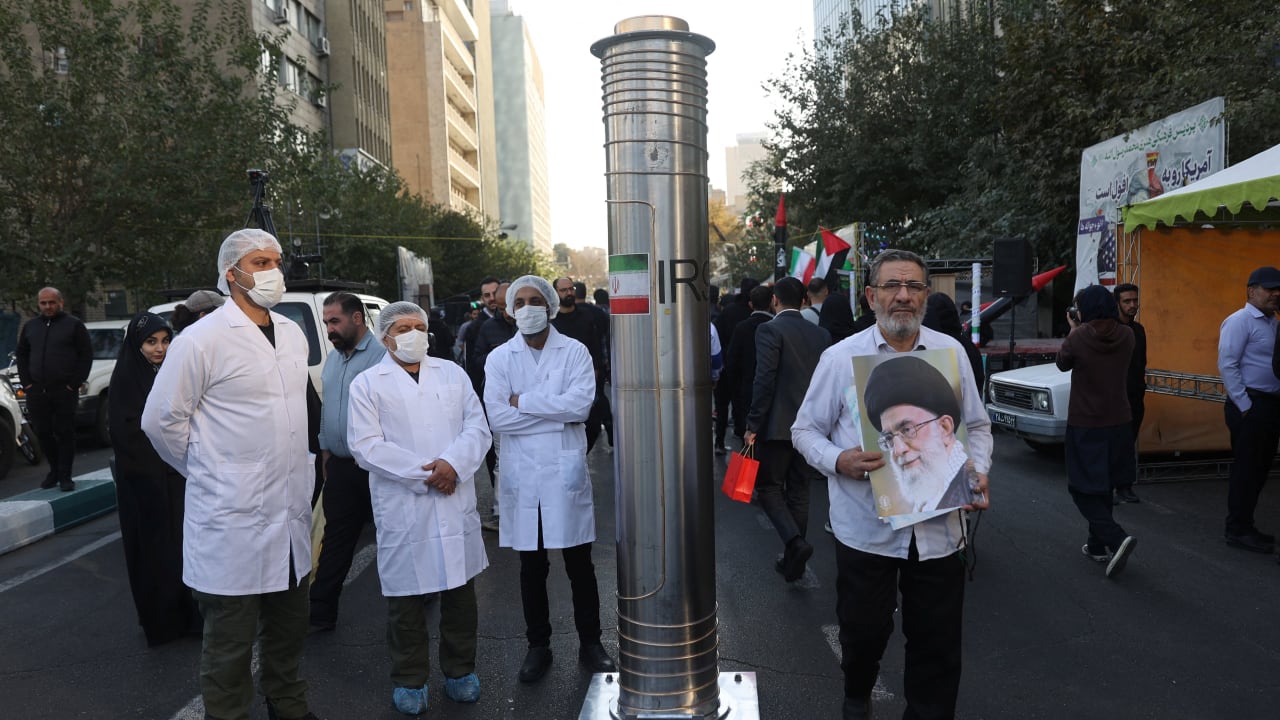
Iran has reportedly amassed a significant quantity of uranium enriched to 60%, a level considered highly sensitive for nuclear weapons development, according to revelations made by Steve Witkoff, who served as a special envoy during the Trump administration. Speaking on Fox News, Witkoff disclosed that Iranian negotiators directly informed US officials, including himself and former President Donald Trump's son-in-law Jared Kushner, of their possession of 460 kilograms of 60% enriched uranium. This quantity, according to Witkoff, is sufficient to produce the fissile material needed for multiple nuclear bombs. The Iranian representatives reportedly conveyed this information 'directly and with no shame,' indicating their awareness of the material's potential for rapid further enrichment to weapons-grade levels. While possessing the material, Witkoff noted that the actual construction of a functional nuclear device would still require at least two years.
The reported accumulation of 60% enriched uranium marks a critical escalation in Iran's nuclear activities, pushing its program closer to weapons-grade capability than previously acknowledged in such direct terms. The international community has long viewed Iran's uranium enrichment efforts with concern, particularly since the 2015 Joint Comprehensive Plan of Action (JCPOA) sought to limit these activities in exchange for sanctions relief. Enrichment to 60% is a substantial leap from the 3.67% limit set by the JCPOA and even the 20% level, which itself was a significant step. This development raises serious questions about the effectiveness of international monitoring protocols, especially as Iranian negotiators reportedly expressed pride in having circumvented oversight mechanisms to achieve this advanced state of enrichment. The context of these disclosures comes amidst ongoing diplomatic efforts and tensions surrounding Iran's nuclear ambitions.
Further detailing Iran's nuclear inventory, Witkoff reported that the nation possesses an approximate total of 10,000 kilograms of fissionable uranium. This broader stock is categorized into various enrichment levels: about 460 kilograms at 60% enrichment, 1,000 kilograms at 20% enrichment, with the remaining bulk at 3.67%. A particularly alarming aspect highlighted by Witkoff is the speed with which these materials can be further processed. He indicated that the 460 kilograms of 60% enriched uranium could be upgraded to 90% weapons-grade purity in a remarkably short timeframe, potentially within a week, or at most ten days. Even the 20% enriched uranium could reach weapons-grade levels within three to four weeks. Moreover, officials stated that Iran's capacity to manufacture its own centrifuges provides an almost unchecked and seemingly endless supply for its enrichment program, presenting a significant challenge to any efforts aimed at halting its progress.
The implications of these revelations are profound for global non-proliferation efforts and regional stability. Iran's reported ability to independently produce centrifuges, coupled with its significant stockpile of highly enriched uranium, suggests a diminishing window for diplomatic solutions to curb its nuclear program. Experts suggest that the explicit and 'shameless' manner in which Iranian negotiators conveyed their capabilities to US officials could be interpreted as a deliberate signal of strength and defiance, potentially aimed at enhancing their leverage in future negotiations. This situation poses a critical dilemma for international powers, as the material readiness for nuclear weapons is now reportedly closer than many had publicly estimated, even if the actual weaponization process still requires additional time and technical steps. The perceived evasion of oversight protocols, as claimed by Iran, further complicates trust-building and verification mechanisms essential for any future agreements.
In summary, the disclosures by former US special envoy Steve Witkoff paint a concerning picture of Iran's advanced nuclear capabilities, particularly its reported possession of 460 kilograms of 60% enriched uranium. This quantity is deemed sufficient for multiple nuclear devices, and the speed at which it could be further enriched to weapons-grade levels is alarmingly swift. While the actual construction of a nuclear bomb remains a multi-year endeavor, the material readiness significantly escalates proliferation risks. The international community now faces the urgent challenge of addressing Iran's self-sufficiency in centrifuge production and its apparent willingness to operate outside established oversight. Future developments will likely focus on how global powers respond to these reported advancements and whether new diplomatic or enforcement strategies can effectively mitigate the growing nuclear threat posed by Iran's program.