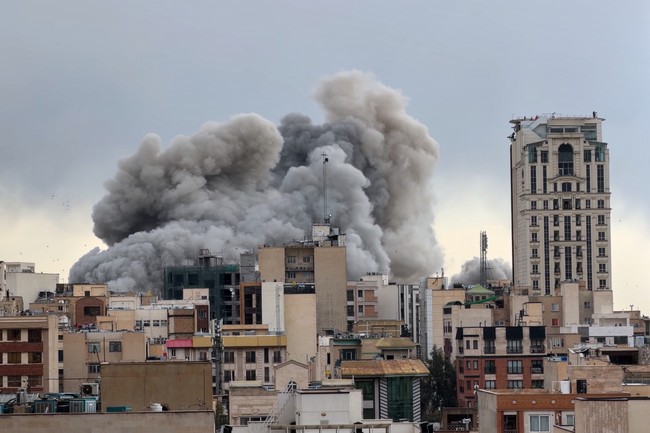
Iranian state television and its associated digital platforms are reportedly engaged in a sophisticated information campaign, presenting a significantly altered reality of the nation's military engagements with the United States and Israel. This narrative, disseminated through official networks and sympathetic social media accounts, aims to project an image of unwavering resilience and triumph, even as external reports indicate that Iran has faced thousands of strikes from both the U.S. and Israel targeting its cities, military installations, and political leadership. A striking example recently highlighted by online observers involved a broadcast purportedly showing an Iranian success against the U.S., which bizarrely featured a Soyuz space launch vehicle's missile striking the Japanese battleship Yamato – a vessel that famously sank in April 1945, decades before the Soyuz program's inception. This particular incident underscores a broader pattern of blending historical inaccuracies, unproven claims, and potentially AI-generated content to construct a compelling, albeit fictional, account of ongoing conflicts.
This strategic deployment of misleading information by Iranian media appears to be a crucial component of a parallel 'information war' waged alongside real-world military and political tensions. The objective, according to various analyses, is to counter the impact of substantial military actions taken by the United States and Israel against Iranian interests. While external reports detail extensive damage to Iranian infrastructure and leadership, the internal narrative crafted for domestic and regional consumption paints a picture of a nation not merely defending itself, but actively winning against its adversaries. This approach seeks to bolster national morale, consolidate public support, and potentially deter further aggression by projecting an image of formidable strength and successful retaliation, irrespective of the verifiable facts on the ground. The historical context of state-controlled media in the region often involves shaping public perception to align with governmental objectives, and this current campaign appears to be a modern, technologically enhanced iteration of that long-standing practice.
The scope of these fabricated narratives extends beyond isolated incidents, encompassing a range of audacious claims broadcast across Iranian official television networks and amplified through a network of affiliated social media channels. According to reports, these broadcasts have asserted that Iranian missiles have inflicted severe damage upon Tel Aviv and other Israeli urban centers. Furthermore, the narrative suggests that Iranian air forces have successfully decimated an American aircraft carrier, and that hundreds of U.S. personnel have been killed at various bases and embassies across the broader region. These specific claims, which lack corroboration from independent sources or international monitoring bodies, are presented as definitive victories. The methods employed to create this alternate reality reportedly include not only the selective presentation of facts but also the extensive use of unproven allegations and sophisticated fake videos, some of which are believed to be generated using advanced artificial intelligence technologies to enhance their deceptive realism.
The implications of such pervasive information warfare are multifaceted, raising significant questions about domestic perception within Iran and the broader regional geopolitical landscape. While the precise impact on the Iranian populace remains uncertain, as the source material notes, a consistent diet of fabricated victories could cultivate a distorted understanding of the nation's actual standing and the realities of its conflicts. This could potentially lead to miscalculations by both the public and, if the propaganda is also believed by decision-makers, by the leadership itself. From an analytical perspective, this strategy highlights the growing challenge of distinguishing truth from fiction in an era of advanced digital manipulation, particularly in state-controlled media environments. Experts suggest that such campaigns aim to foster a sense of national pride and resilience, potentially galvanizing support for the government while simultaneously attempting to undermine the credibility of external news sources that present a contrasting reality.
In summary, Iranian state media is reportedly orchestrating an extensive information campaign, leveraging official television channels and sympathetic online accounts to disseminate a narrative of military success against the United States and Israel. This strategy involves the broadcast of fabricated events, historical inaccuracies, and potentially AI-generated content, starkly contrasting with external reports of significant strikes against Iran. The primary goal appears to be the projection of national resilience and strength, both domestically and regionally, amidst ongoing geopolitical tensions. As this information war continues to unfold, observers will be closely watching how these manufactured narratives influence public opinion within Iran and whether they contribute to further escalation or misinterpretation of the actual dynamics of conflict in the Middle East.