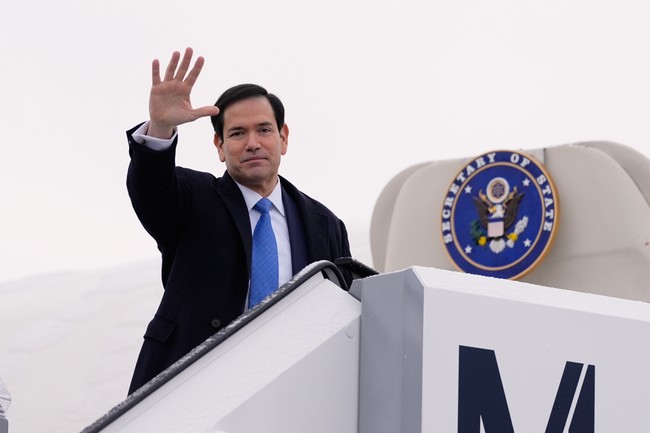
Amidst an ongoing American-led aerial campaign targeting Iran, a notable segment of the political right is experiencing significant apprehension, according to recent reports. This concern is reportedly intertwined with a growing preoccupation over the past year with conspiracy theories involving Jewish influence and the state of Israel. Adherents of these theories are actively seeking any information that appears to validate their claims, which frequently include assertions that prominent Israeli figures, such as Prime Minister Benjamin Netanyahu, and intelligence agencies like Mossad, exert undue control over U.S. President Donald Trump's administration. In the context of the current military operations against Iran, these narratives often frame the entire endeavor as primarily serving Israeli interests rather than American ones. A recent statement by Secretary of State Marco Rubio has become a focal point for these discussions, with critics alleging his remarks are being severely misrepresented to bolster these pre-existing conspiratorial viewpoints.
The backdrop to this situation is a discernible rise in anti-Semitic and anti-Israel conspiracy theories within certain right-wing circles. These theories often posit that the U.S. foreign policy agenda, particularly concerning the Middle East, is dictated by external, non-American interests. This includes the repeated suggestion that Israeli leadership and intelligence operations are pulling the strings of the American presidency. As part of this broader narrative, the U.S.-led military actions against Iran are frequently characterized as an operation undertaken 'for Israel,' rather than for U.S. national security objectives. This sentiment has been amplified by public figures, with one notable instance being commentator Megyn Kelly, who, according to reports, controversially claimed that the American service members who lost their lives – initially four, now six – due to an Iranian missile strike in Kuwait, perished not in service to their own nation, but for a foreign power. This assertion underscores the depth of the belief that U.S. military sacrifices are being made on behalf of another country, further fueling the contentious debate.
The mischaracterization of Secretary Rubio's comments is exemplified by statements from elected officials, such as Republican Representative Thomas Massie of Kentucky. According to a social media post by Rep. Massie, the administration has purportedly conceded that Israel was instrumental in drawing the United States into the conflict with Iran. Massie's statement further claimed that this engagement has already resulted in the loss of numerous American lives and billions of dollars in expenditure. He also predicted significant economic repercussions for American citizens, including rising costs for essential goods like gasoline and groceries. In his assessment, the only beneficiaries of this conflict within the United States would be shareholders in defense companies. However, sources indicate that these interpretations grossly distort the original context and intent of Secretary Rubio's remarks, suggesting a deliberate or inadvertent misreading to fit a pre-established narrative that aligns with the aforementioned conspiracy theories regarding Israeli influence over U.S. foreign policy decisions.
The widespread misinterpretation of official statements, particularly from high-ranking government officials like Secretary Rubio, carries significant implications for public discourse and national understanding of complex geopolitical events. Expert perspectives suggest that such distortions can erode public trust in government communications and legitimate news sources, making it challenging to distinguish factual reporting from speculative or conspiratorial narratives. When figures, including elected representatives, amplify these mischaracterizations, it lends an unwarranted air of credibility to baseless claims, potentially radicalizing segments of the population and fostering a climate of suspicion. This trend is particularly concerning during active military engagements, where accurate information is crucial for informed public opinion and national unity. The propagation of ideas suggesting U.S. troops are dying for a 'foreign power' not only disrespects their sacrifice but also undermines the rationale for military operations, irrespective of their actual merits or origins, creating deep divisions within the populace.
In conclusion, the ongoing U.S.-led bombing campaign in Iran has become a flashpoint for a specific segment of the political right, who are leveraging a misinterpretation of Secretary of State Marco Rubio's comments to support long-standing conspiracy theories about Israeli control over U.S. foreign policy. This situation highlights the persistent challenge of misinformation, especially when fueled by prominent voices and amplified through social media. The claims, exemplified by Rep. Thomas Massie's statements, suggest a narrative where American lives and resources are expended for external interests, rather than national security. As military operations continue, it remains crucial for the public to critically evaluate information, distinguishing between established facts and unsubstantiated allegations, and to rely on credible sources for understanding the complex realities of international relations and conflict. The trajectory of these discussions will likely continue to shape public perception of the conflict and U.S. foreign policy going forward.