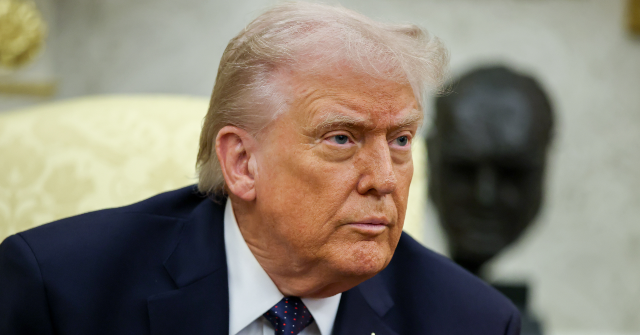
During a bilateral meeting in the Oval Office with German Chancellor Friedrich Merz, President Donald Trump asserted that a growing international consensus is forming against Iran. Responding to a query from Breitbart News, President Trump attributed this expanding unity to what he described as the Iranian regime's "evil" philosophy and its characterization as a "bad seed." He specifically highlighted Iran's alleged aggressive actions against several neighboring states, including Saudi Arabia, the United Arab Emirates, Qatar, and Oman, as key drivers of this regional and broader international alignment. The President's remarks underscored his administration's firm stance on Iran, framing its internal governance and external conduct as the primary catalysts for the increasing opposition it faces from various global actors, particularly within the Middle East, where traditional rivalries are reportedly being set aside to address the perceived threat.
The question posed by Breitbart News specifically delved into the reasons behind the robust international alignment against Tehran, noting an unusual collaboration among nations that historically have not worked in concert. The outlet pointed to instances such as Iraq and Saudi Arabia reportedly cooperating with the United States on Iran-related issues, Qatar's alleged downing of Iranian aircraft, and increasing engagement from European countries as evidence of this unified front. President Trump acknowledged the significance of this observation, commencing his nearly five-minute response by unequivocally labeling the Iranian regime as inherently "evil." He clarified that, in his view, the issue transcended mere political disagreements, instead stemming from what he termed Iran's fundamental "philosophy," which he deemed "terrible" and unlike anything previously encountered on the global stage, setting the stage for a detailed condemnation of the regime's actions.
Elaborating on his condemnation, President Trump made stark allegations regarding the Iranian regime's internal conduct, claiming responsibility for a significant loss of life. He stated that the regime had killed "much more than 35,000 people," revising an earlier figure he had in mind, which he initially believed to be 32,000. The President further specified harrowing details of these alleged atrocities, asserting that unarmed individuals were targeted with machine guns and subjected to sniper attacks from elevated positions. He vividly described snipers reportedly aiming "right through the eyes" of their victims, emphasizing the brutal and indiscriminate nature of these alleged acts. President Trump reiterated his belief that this represented "a very evil ideology," suggesting its unprecedented nature and stressing that Iran had initiated hostilities against neighboring countries that were, at the time, actively involved in diplomatic efforts to de-escalate regional tensions.
President Trump's strong rhetoric, delivered during a high-profile meeting with a key European ally, signals a continued hardline approach from the U.S. administration towards Tehran. By characterizing Iran's actions as stemming from an "evil ideology" rather than mere political differences, the President aims to delegitimize the regime on a moral and philosophical level, potentially seeking to galvanize broader international support for containment or pressure. His emphasis on alleged human rights abuses, particularly the graphic details of violence against unarmed citizens, serves to underscore the perceived brutality of the regime and could be interpreted as an effort to sway public opinion and diplomatic stances globally. The assertion that Iran attacked neighbors involved in diplomacy also positions Tehran as an unreliable and aggressive actor, further justifying the international unity he describes. This framing suggests that the administration views the Iranian challenge as existential, requiring a unified, principled stand rather than traditional diplomatic maneuvering, which could impact future negotiations or escalations.
In summary, President Trump's remarks during his Oval Office meeting with German Chancellor Merz underscored his administration's unwavering conviction that Iran's "evil ideology" is the fundamental reason behind a burgeoning international coalition against it. He cited specific alleged attacks on regional neighbors and severe internal repression, including the killing of tens of thousands of unarmed individuals, as evidence of this unprecedented malevolence. The President's strong language and detailed accusations serve to reinforce a narrative that positions the Iranian regime as a unique and dangerous global threat, necessitating a unified response from diverse international actors. Moving forward, observers will be closely watching how these pronouncements influence ongoing diplomatic efforts, regional alliances, and the broader trajectory of international relations concerning Iran, particularly as the U.S. continues to advocate for a united front against what it perceives as Tehran's destabilizing influence.